Unit of Cellular Neurophysiology and Unit of Neuropsychopharmacology, Division of Neuroscience, IRCCS San Raffaele Scientific Institute, via Olgettina 60, I-20132, Milano, Italy.
Vita-Salute San Raffaele University, via Olgettina 58, I-20132, Milano, Italy.
Sci Rep. 2017 Sep 5;7(1):10563. doi: 10.1038/s41598-017-11096-1.
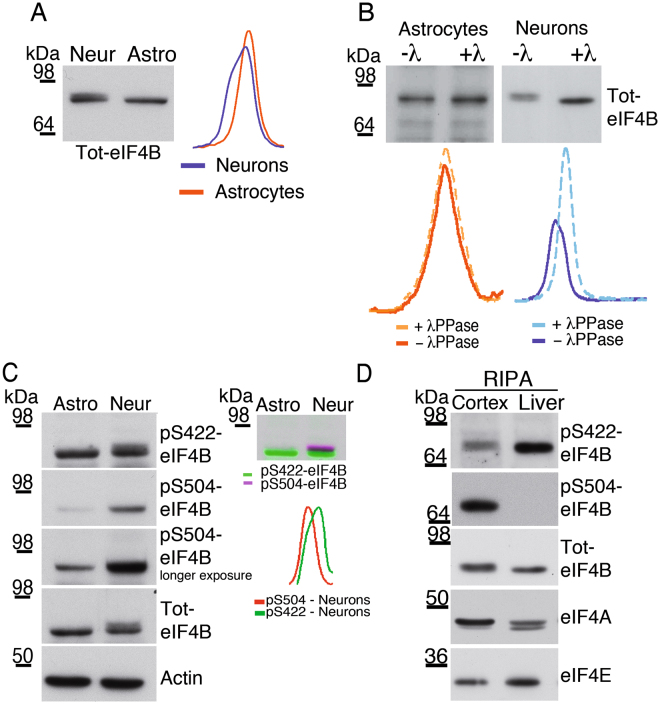
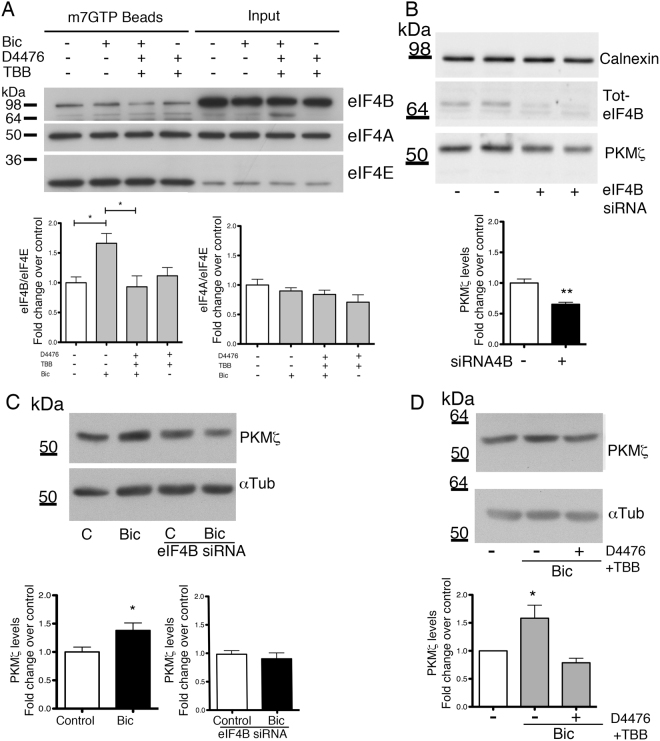
Neuronal physiology requires activity-driven protein translation, a process in which translation initiation factors are key players. We focus on eukaryotic initiation factor 4B (eIF4B), a regulator of protein translation, whose function in neurons is undetermined. We show that neuronal activity affects eIF4B phosphorylation and identify Ser504 as a phosphorylation site regulated by casein kinases and sensitive to the activation of metabotropic glutamate receptors. Ser504 phosphorylation increases eIF4B recruitment to the pre-initiation complex and influences eIF4B localization at synapses. Moreover, Ser504 phosphorylation modulates the translation of protein kinase Mζ. Therefore, by sensing synaptic activity, eIF4B could adjust translation to neuronal needs, promoting adaptive changes in synaptic plasticity. We also show that Ser504 phosphorylation is increased in vivo in a rat model of epilepsy during epileptogenesis i.e. when translation drives maladaptive synaptic changes. We propose eIF4B as a mediator between neuronal activity and translation, with relevance in the control of synaptic plasticity.
神经元生理学需要活动驱动的蛋白质翻译,在这个过程中,翻译起始因子是关键的参与者。我们专注于真核起始因子 4B(eIF4B),它是一种蛋白质翻译的调节剂,但其在神经元中的功能尚未确定。我们表明神经元活动会影响 eIF4B 的磷酸化,并确定丝氨酸 504 是一个受酪蛋白激酶调节且对代谢型谷氨酸受体激活敏感的磷酸化位点。丝氨酸 504 的磷酸化增加了 eIF4B 向起始复合物的募集,并影响 eIF4B 在突触处的定位。此外,丝氨酸 504 的磷酸化调节蛋白激酶 Mζ的翻译。因此,通过感知突触活动,eIF4B 可以调整翻译以满足神经元的需求,促进突触可塑性的适应性变化。我们还表明,在癫痫发生过程中的癫痫大鼠模型中,即翻译导致适应性突触变化时,体内 eIF4B 的丝氨酸 504 磷酸化增加。我们提出 eIF4B 是神经元活动和翻译之间的中介,在控制突触可塑性方面具有重要意义。