Sato Jun, Inage Kazuhide, Miyagi Masayuki, Sakuma Yoshihiro, Yamauchi Kazuyo, Koda Masao, Furuya Takeo, Nakamura Junichi, Suzuki Miyako, Kubota Go, Oikawa Yasuhiro, Sainoh Takeshi, Fujimoto Kazuki, Shiga Yasuhiro, Abe Koki, Kanamoto Hirohito, Inoue Masahiro, Kinoshita Hideyuki, Norimoto Masaki, Umimura Tomotaka, Takahashi Kazuhisa, Ohtori Seiji, Orita Sumihisa
Department of Orthopedic Surgery, Chiba University Graduate School of Medicine, Chiba, Japan.
Department of Orthopedic Surgery, Chiba Aoba Municipal Hospital, Chiba, Japan.
Asian Spine J. 2017 Aug;11(4):556-561. doi: 10.4184/asj.2017.11.4.556. Epub 2017 Aug 7.
An experimental animal study.
To evaluate effects of anti-vascular endothelial growth factor (VEGF) on the content and distribution of the calcitonin gene-related peptide (CGRP) in the dorsal ganglia in a rat model.
Increased expression of VEGF in degenerative disc disease increases the levels of inflammatory cytokines and nerve ingrowth into the damaged discs. In animal models, increased levels of VEGF can persist for up to 2 weeks after an injury.
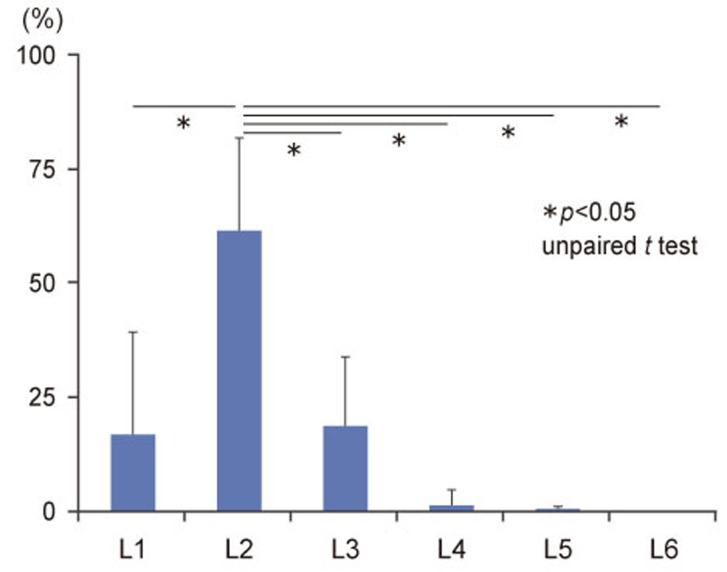
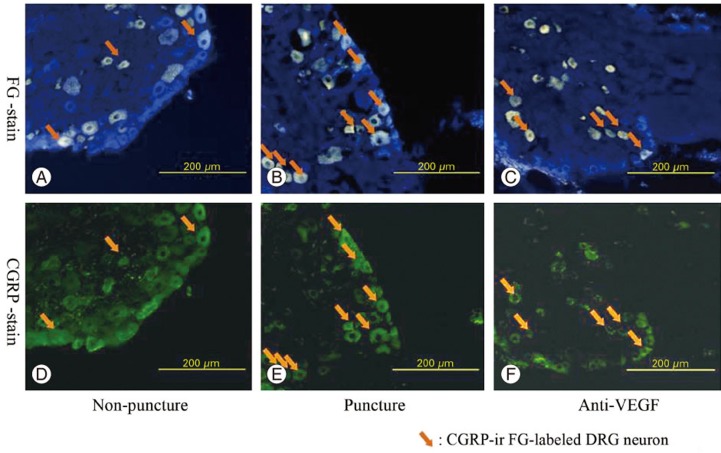
Through abdominal surgery, the dorsal root ganglia (DRG) innervating L5/L6 intervertebral disc were labeled (FluoroGold neurotracer) in 24, 8-week old Sprague Dawley rats. The rats were randomly allocated to three groups of eight rats each. The anti-VEGF group underwent L5/6 intervertebral disc puncture using a 26-gauge needle, intradiscal injection of 33.3 µg of the pegaptanib sodium, a VEGF165 aptamer. The control-puncture group underwent disc puncture and intradiscal injection of 10 µL saline solution, and the sham-surgery group underwent labeling but no disc puncture. Two rats in each group were sacrificed on postoperative days 1, 7, 14, and 28 after surgery. L1-L6 DRGs were harvested, sectioned, and immunostained to detect the content and distribution of CGRP.
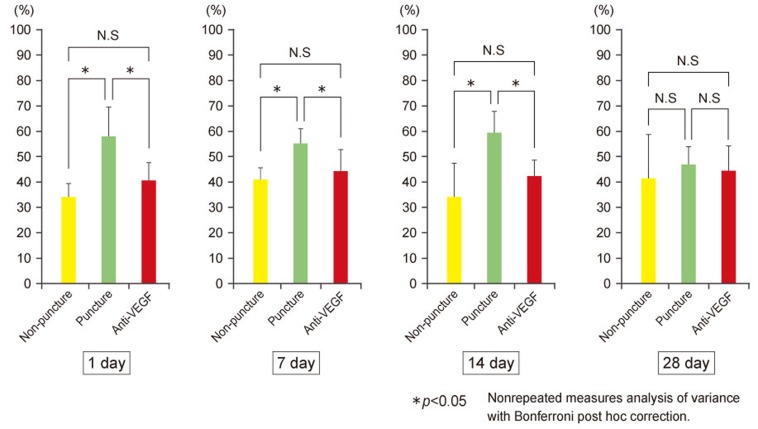
Compared with the control, the percentage of CGRP-positive cells was lower in the anti-VEGF group (<0.05; 40.6% and 58.1% on postoperative day 1, 44.3% and 55.4% on day 7, and 42.4% and 59.3% on day 14). The percentage was higher in the control group compared with that of the sham group (<0.05; sham group, 34.1%, 40.7%, and 33.7% on postoperative days 1, 7, and 14, respectively).
Decreasing CGRP-positive cells using anti-VEGF therapy provides fundamental evidence for a possible therapeutic role of anti-VEGF in patients with discogenic lower back pain.
一项实验性动物研究。
在大鼠模型中评估抗血管内皮生长因子(VEGF)对背根神经节中降钙素基因相关肽(CGRP)含量及分布的影响。
退变椎间盘疾病中VEGF表达增加会使炎症细胞因子水平升高,且神经长入受损椎间盘。在动物模型中,损伤后VEGF水平升高可持续长达2周。
通过腹部手术,在24只8周龄的Sprague Dawley大鼠中标记支配L5/L6椎间盘的背根神经节(FluoroGold神经示踪剂)。将大鼠随机分为三组,每组8只。抗VEGF组使用26号针进行L5/6椎间盘穿刺,椎间盘内注射33.3μg的培加他尼钠(一种VEGF165适配体)。对照穿刺组进行椎间盘穿刺并椎间盘内注射10μL盐溶液,假手术组进行标记但不进行椎间盘穿刺。每组在术后第1、7、14和28天处死2只大鼠。采集L1-L6背根神经节,切片并进行免疫染色以检测CGRP的含量和分布。
与对照组相比,抗VEGF组中CGRP阳性细胞的百分比更低(<0.05;术后第1天分别为40.6%和58.1%,第7天分别为44.3%和55.4%,第14天分别为42.4%和59.3%)。与假手术组相比,对照组的百分比更高(<0.05;假手术组在术后第1、7和14天分别为34.1%、40.7%和33.7%)。
使用抗VEGF疗法减少CGRP阳性细胞为抗VEGF在椎间盘源性下腰痛患者中可能的治疗作用提供了基本证据。