Cho Yongjae
Department of Neurosurgery, Ewha Womans University School of Medicine, Seoul, Korea.
Asian Spine J. 2017 Aug;11(4):634-640. doi: 10.4184/asj.2017.11.4.634. Epub 2017 Aug 7.
Single-center, retrospective case series.
To investigate the effectiveness of posterior vertebrectomy and circumferential fusion in patients with advanced Kümmell disease with neurologic deficit.
Various surgical options exist for the treatment of Kümmell disease, and determination of the appropriate treatment is based on the clinical and radiologic status of the patient. However, surgical intervention is required for patients with advanced Kümmell disease accompanied by neurologic deficit.
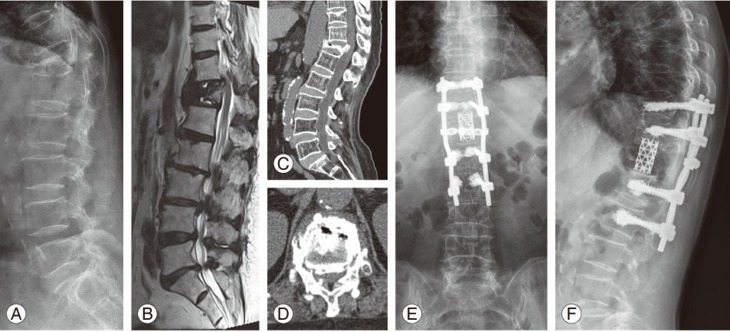
We retrospectively analyzed 22 neurologically compromised patients with advanced Kümmell disease who were treated surgically at Ewha Womans Hospital between January 2011 and January 2014. The surgical approach used by us was a posterior vertebrectomy with mesh cage insertion and segmental cement-augmented pedicle screw fixation. The tissue from the corpectomy was histopathologically examined. Anterior vertebral height, kyphotic angle, visual analog scale (VAS) score, and the Frankel classification were used to evaluate the efficacy of the procedure.
The mean follow-up period was 26 months (range, 13-40 months). VAS score, anterior vertebral height, kyphotic angle, and neurologic state were significantly improved immediately postoperatively and at the last follow-up compared with preoperatively (<0.05). Most patients exhibited intravertebral clefts on imaging, and postoperative pathology revealed bone necrosis.
Posterior vertebrectomy with mesh cage insertion and segmental cement-augmented pedicle screw fixation is an effective approach for treating patients with advanced Kümmell disease with neurologic deficit.
单中心回顾性病例系列研究。
探讨后路椎体切除术及环形融合术治疗伴有神经功能缺损的晚期椎体缺血性坏死(Kümmell病)患者的有效性。
治疗Kümmell病有多种手术选择,合适治疗方法的确定基于患者的临床和影像学状况。然而,伴有神经功能缺损的晚期Kümmell病患者需要手术干预。
我们回顾性分析了2011年1月至2014年1月在梨花女子大学医院接受手术治疗的22例伴有神经功能障碍的晚期Kümmell病患者。我们采用的手术方法是后路椎体切除术并植入网笼及节段性骨水泥强化椎弓根螺钉固定。对椎体切除的组织进行组织病理学检查。采用椎体前缘高度、后凸角、视觉模拟评分(VAS)及Frankel分级来评估手术疗效。
平均随访时间为26个月(范围13 - 40个月)。与术前相比,术后即刻及末次随访时VAS评分、椎体前缘高度、后凸角及神经功能状态均有显著改善(<0.05)。大多数患者影像学上表现为椎体内裂隙,术后病理显示骨坏死。
后路椎体切除术并植入网笼及节段性骨水泥强化椎弓根螺钉固定是治疗伴有神经功能缺损的晚期Kümmell病患者的有效方法。