Kovácsová Gabriela, Grünbein Marie Luise, Kloos Marco, Barends Thomas R M, Schlesinger Ramona, Heberle Joachim, Kabsch Wolfgang, Shoeman Robert L, Doak R Bruce, Schlichting Ilme
Department of Biomolecular Mechanisms, Max Planck Institute for Medical Research, Jahnstrasse 29, Heidelberg 69120, Germany.
Genetic Biophysics, Department of Physics, Freie Universität Berlin, Arnimallee 14, Berlin 14195, Germany.
IUCrJ. 2017 May 5;4(Pt 4):400-410. doi: 10.1107/S2052252517005140. eCollection 2017 Jul 1.
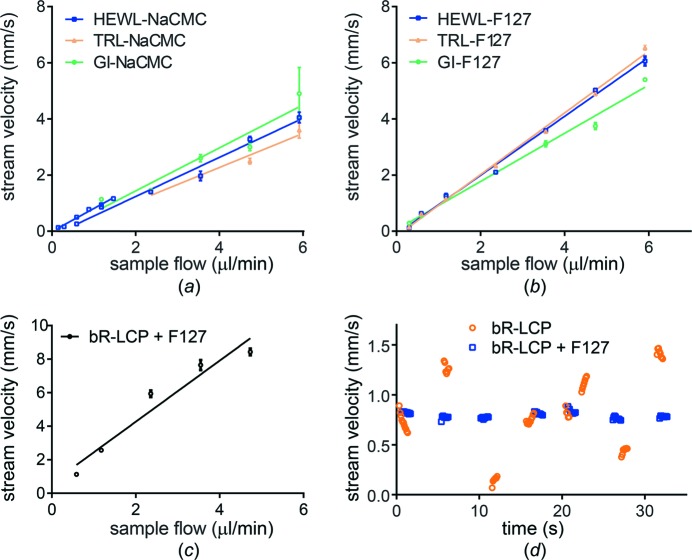
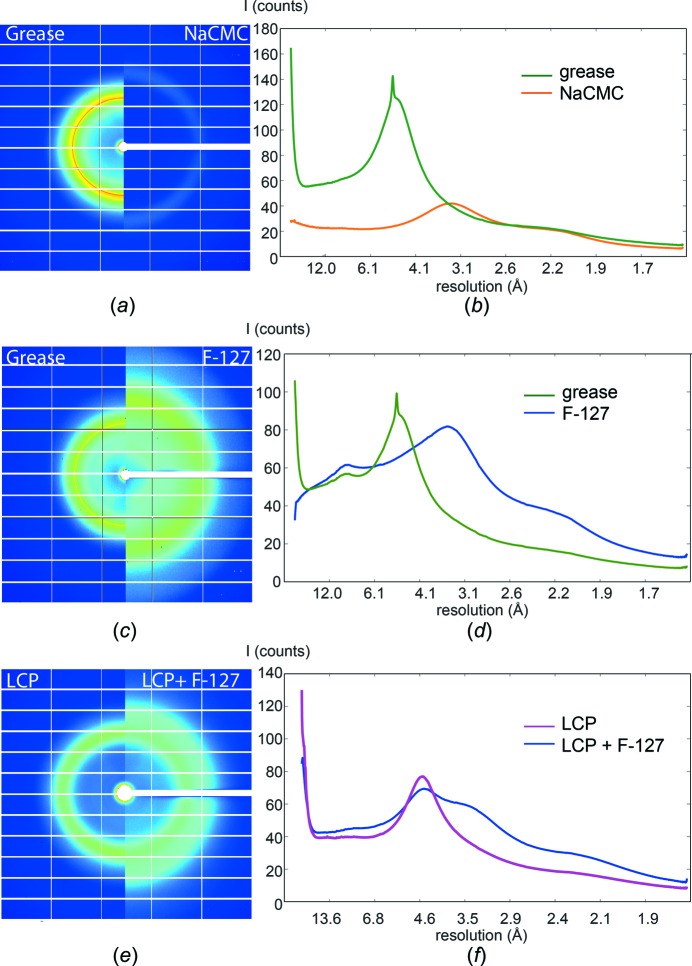
Serial (femtosecond) crystallography at synchrotron and X-ray free-electron laser (XFEL) sources distributes the absorbed radiation dose over all crystals used for data collection and therefore allows measurement of radiation damage prone systems, including the use of microcrystals for room-temperature measurements. Serial crystallography relies on fast and efficient exchange of crystals upon X-ray exposure, which can be achieved using a variety of methods, including various injection techniques. The latter vary significantly in their flow rates - gas dynamic virtual nozzle based injectors provide very thin fast-flowing jets, whereas high-viscosity extrusion injectors produce much thicker streams with flow rates two to three orders of magnitude lower. High-viscosity extrusion results in much lower sample consumption, as its sample delivery speed is commensurate both with typical XFEL repetition rates and with data acquisition rates at synchrotron sources. An obvious viscous injection medium is lipidic cubic phase (LCP) as it is used for membrane protein crystallization. However, LCP has limited compatibility with many crystallization conditions. While a few other viscous media have been described in the literature, there is an ongoing need to identify additional injection media for crystal embedding. Critical attributes are reliable injection properties and a broad chemical compatibility to accommodate samples as heterogeneous and sensitive as protein crystals. Here, the use of two novel hydro-gels as viscous injection matrices is described, namely sodium carb-oxy-methyl cellulose and the thermo-reversible block polymer Pluronic F-127. Both are compatible with various crystallization conditions and yield acceptable X-ray background. The stability and velocity of the extruded stream were also analysed and the dependence of the stream velocity on the flow rate was measured. In contrast with previously characterized injection media, both new matrices afford very stable adjustable streams suitable for time-resolved measurements.
在同步加速器和X射线自由电子激光(XFEL)源上进行的串行(飞秒)晶体学,将吸收的辐射剂量分布在用于数据收集的所有晶体上,因此能够测量易受辐射损伤的系统,包括使用微晶进行室温测量。串行晶体学依赖于X射线照射时晶体的快速有效交换,这可以通过多种方法实现,包括各种注入技术。后者的流速差异很大——基于气体动力学虚拟喷嘴的注射器提供非常薄的快速流动射流,而高粘度挤出注射器产生的液流要厚得多,流速低两到三个数量级。高粘度挤出导致样品消耗低得多,因为其样品输送速度与典型的XFEL重复率以及同步加速器源的数据采集率相当。一种明显的粘性注入介质是脂质立方相(LCP),因为它用于膜蛋白结晶。然而,LCP与许多结晶条件的兼容性有限。虽然文献中描述了其他一些粘性介质,但仍需要寻找更多用于晶体包埋的注入介质。关键特性是可靠的注入性能和广泛的化学兼容性,以适应像蛋白质晶体这样异质且敏感的样品。这里描述了使用两种新型水凝胶作为粘性注入基质,即羧甲基纤维素钠和热可逆嵌段聚合物普朗尼克F - 127。它们都与各种结晶条件兼容,并产生可接受的X射线背景。还分析了挤出液流的稳定性和速度,并测量了液流速度对流速的依赖性。与先前表征的注入介质相比,这两种新基质都提供了非常稳定的可调节液流,适用于时间分辨测量。