Sokai Akihiko, Tanizawa Kiminobu, Handa Tomohiro, Kanatani Kumiko, Kubo Takeshi, Ikezoe Kohei, Nakatsuka Yoshinari, Tokuda Shinsaku, Oga Toru, Hirai Toyohiro, Nagai Sonoko, Chin Kazuo, Mishima Michiaki
Dept of Respiratory Medicine, Graduate School of Medicine, Kyoto University, Kyoto, Japan.
Dept of Respiratory Care and Sleep Control Medicine, Graduate School of Medicine, Kyoto University, Kyoto, Japan.
ERJ Open Res. 2017 Aug 30;3(3). doi: 10.1183/23120541.00019-2016. eCollection 2017 Jul.
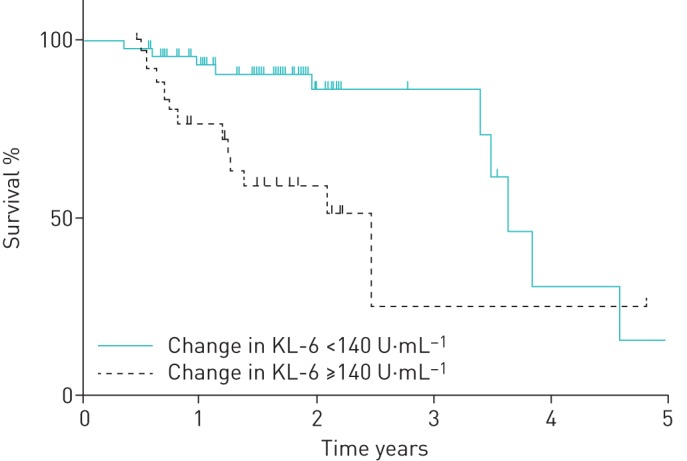
The clinical significance of serial changes in serum biomarkers in patients with idiopathic pulmonary fibrosis (IPF) remains to be established. This retrospective study was conducted to clarify the associations of serial changes in serum Krebs von den Lungen-6 (KL-6) and surfactant protein-D (SP-D) with changes in physiological indices and overall mortality in IPF. The study subjects were 75 patients with IPF. The 6 month change in serum KL-6 was significantly correlated with changes in the percentage of the predicted forced vital capacity (FVC % pred) and the percentage of the predicted diffusing capacity of the lung for carbon monoxide (% ), while the 6 month change in serum SP-D was correlated only with % . During the mean follow-up period of 647 days, 22 (29.3%) patients died. An increase in serum KL-6 over a 6 month period was a significant predictor of mortality even after adjustment for %FVC, % and serum KL-6 at the baseline (hazard ratio 1.10 per 100 U·mL, 95% CI 1.01-1.18, p=0.03), whereas the 6 month increase in serum SP-D was not significant. Serial measurements of serum KL-6 may provide additional prognostic information compared to that provided by physiological parameters in patients with IPF.
特发性肺纤维化(IPF)患者血清生物标志物的系列变化的临床意义仍有待确定。本回顾性研究旨在阐明血清克雷布斯-冯-登-伦格恩6(KL-6)和表面活性蛋白-D(SP-D)的系列变化与IPF患者生理指标变化及总体死亡率之间的关联。研究对象为75例IPF患者。血清KL-6的6个月变化与预计用力肺活量百分比(FVC % pred)和预计肺一氧化碳弥散量百分比(% )的变化显著相关,而血清SP-D的6个月变化仅与% 相关。在平均647天的随访期内,22例(29.3%)患者死亡。即使在对基线时的%FVC、% 和血清KL-6进行校正后,血清KL-6在6个月内的升高仍是死亡率的显著预测指标(每100 U·mL的风险比为1.10,95% CI为1.01-1.18,p = 0.03),而血清SP-D在6个月内的升高并不显著。与IPF患者的生理参数相比,血清KL-6的系列测量可能提供额外的预后信息。