Department of Plant and Microbial Biology, North Carolina State University, Raleigh, NC 27695-7612, USA.
Instituto de Biologia, Universidade Federal de Uberlândia (UFU), Av. Pará 1720, Uberlândia, Minas Gerais 38405-320, Brazil.
Sci Adv. 2017 Aug 30;3(8):e1701284. doi: 10.1126/sciadv.1701284. eCollection 2017 Aug.
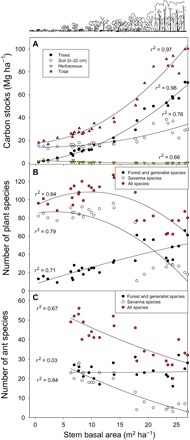
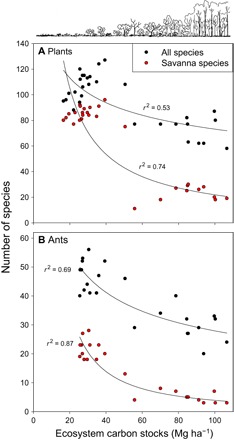
Tropical savannas have been increasingly viewed as an opportunity for carbon sequestration through fire suppression and afforestation, but insufficient attention has been given to the consequences for biodiversity. To evaluate the biodiversity costs of increasing carbon sequestration, we quantified changes in ecosystem carbon stocks and the associated changes in communities of plants and ants resulting from fire suppression in savannas of the Brazilian Cerrado, a global biodiversity hotspot. Fire suppression resulted in increased carbon stocks of 1.2 Mg ha year since 1986 but was associated with acute species loss. In sites fully encroached by forest, plant species richness declined by 27%, and ant richness declined by 35%. Richness of savanna specialists, the species most at risk of local extinction due to forest encroachment, declined by 67% for plants and 86% for ants. This loss highlights the important role of fire in maintaining biodiversity in tropical savannas, a role that is not reflected in current policies of fire suppression throughout the Brazilian Cerrado. In tropical grasslands and savannas throughout the tropics, carbon mitigation programs that promote forest cover cannot be assumed to provide net benefits for conservation.
热带稀树草原越来越被视为通过抑制火灾和造林来固碳的机会,但对生物多样性的后果关注不足。为了评估增加碳固存的生物多样性成本,我们量化了由于巴西塞拉多稀树草原的火灾抑制而导致的生态系统碳储量的变化,以及植物和蚂蚁群落的相关变化,巴西塞拉多是全球生物多样性热点地区。自 1986 年以来,火灾抑制导致碳储量增加了 1.2 Mg ha year,但与急性物种丧失有关。在完全被森林侵占的地点,植物物种丰富度下降了 27%,蚂蚁丰富度下降了 35%。由于森林侵占而最容易局部灭绝的稀树草原特有种的植物丰富度下降了 67%,蚂蚁丰富度下降了 86%。这种损失凸显了火灾在维持热带稀树草原生物多样性方面的重要作用,而这一作用在巴西塞拉多目前的火灾抑制政策中并没有得到体现。在整个热带地区的热带草原和稀树草原中,促进森林覆盖的碳缓解计划不能被假定为对保护提供净效益。