Zhang Xiaohua Douglas, Pechter David, Yang Liming, Ping Xiaoli, Yao Zuliang, Zhang Rumin, Shen Xiaolan, Li Nina Xiaoyan, Connick Jonathan, Nawrocki Andrea R, Chakravarthy Manu, Li Cai
Department of BARDS, Merck Research Laboratories, Kenilworth, New Jersey, United States of America.
Department of Pharmacology, Merck Research Laboratories, Kenilworth, New Jersey, United States of America.
PLoS One. 2017 Sep 6;12(9):e0182810. doi: 10.1371/journal.pone.0182810. eCollection 2017.
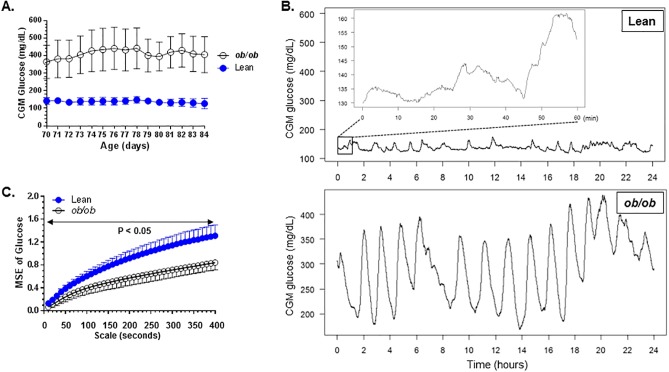
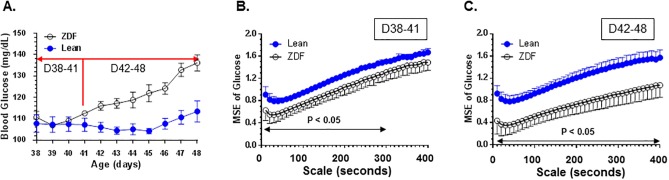
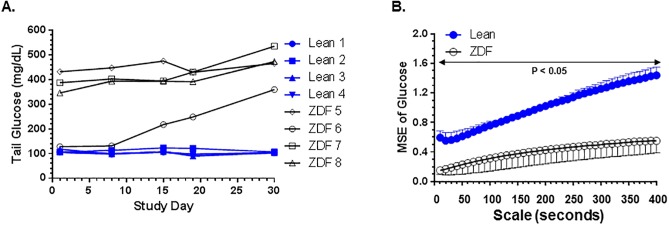
Continuous glucose monitoring (CGM) is a platform to measure blood glucose (BG) levels continuously in real time with high enough resolution to document their underlying fluctuations. Multiscale entropy (MSE) analysis has been proposed as a measure of time-series complexity, and when applied to clinical CGM data, MSE analysis revealed that diabetic patients have lower MSE complexity in their BG time series than healthy subjects. To determine if the clinical observations on complexity of glucose dynamics can be back-translated to relevant preclinical species used routinely in diabetes drug discovery, we performed CGM in both mouse (ob/ob) and rat (Zucker Diabetic Fatty, ZDF) models of diabetes. We demonstrate that similar to human data, the complexity of glucose dynamics is also decreased in diabetic mice and rats. We show that low complexity of glucose dynamics is not simply a reflection of high glucose values, but rather reflective of the underlying disease state (i.e. diabetes). Finally, we demonstrate for the first time that the complexity of glucose fluctuations in ZDF rats, as probed by MSE analysis, is decreased prior to the onset of overt diabetes, although complexity undergoes further decline during the transition to frank diabetes. Our study suggests that MSE could serve as a novel biomarker for the progression to diabetes and that complexity studies in preclinical models could offer a new paradigm for early differentiation, and thereby, selection of appropriate clinical candidate molecules to be tested in human clinical trials.
连续血糖监测(CGM)是一个能够实时连续测量血糖(BG)水平的平台,其分辨率足以记录血糖的潜在波动情况。多尺度熵(MSE)分析已被提出作为一种衡量时间序列复杂性的方法,当应用于临床CGM数据时,MSE分析显示糖尿病患者血糖时间序列的MSE复杂性低于健康受试者。为了确定关于葡萄糖动态复杂性的临床观察结果是否可以反向转化为糖尿病药物研发中常用的相关临床前物种,我们在糖尿病小鼠(ob/ob)和大鼠(Zucker糖尿病脂肪大鼠,ZDF)模型中进行了CGM。我们证明,与人类数据相似,糖尿病小鼠和大鼠的葡萄糖动态复杂性也降低了。我们表明,葡萄糖动态的低复杂性不仅仅是高血糖值的反映,而是反映了潜在的疾病状态(即糖尿病)。最后,我们首次证明,通过MSE分析探测,ZDF大鼠在明显糖尿病发作之前,葡萄糖波动的复杂性就已经降低,尽管在向显性糖尿病转变过程中复杂性会进一步下降。我们的研究表明,MSE可以作为糖尿病进展的一种新型生物标志物,并且临床前模型中的复杂性研究可以为早期区分提供一种新的范例,从而选择合适的临床候选分子进行人体临床试验。