Lucertini Francesco, Gervasi Marco, D'Amen Giancarlo, Sisti Davide, Rocchi Marco Bruno Luigi, Stocchi Vilberto, Benelli Piero
Department of Biomolecular Sciences-Division of Exercise and Health Sciences, University of Urbino Carlo Bo, Urbino, Italy.
Department of Biomolecular Sciences-Service of Biostatistics, University of Urbino Carlo Bo, Urbino, Italy.
PLoS One. 2017 Sep 6;12(9):e0184240. doi: 10.1371/journal.pone.0184240. eCollection 2017.
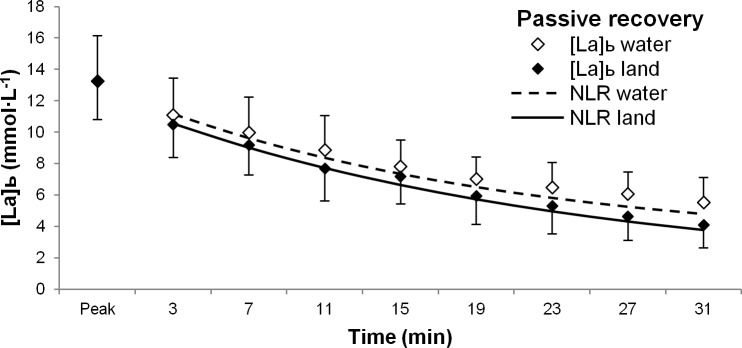
This study assessed the effectiveness of water immersion to the shoulders in enhancing blood lactate removal during active and passive recovery after short-duration high-intensity exercise. Seventeen cyclists underwent active water- and land-based recoveries and passive water and land-based recoveries. The recovery conditions lasted 31 minutes each and started after the identification of each cyclist's blood lactate accumulation peak, induced by a 30-second all-out sprint on a cycle ergometer. Active recoveries were performed on a cycle ergometer at 70% of the oxygen consumption corresponding to the lactate threshold (the control for the intensity was oxygen consumption), while passive recoveries were performed with subjects at rest and seated on the cycle ergometer. Blood lactate concentration was measured 8 times during each recovery condition and lactate clearance was modeled over a negative exponential function using non-linear regression. Actual active recovery intensity was compared to the target intensity (one sample t-test) and passive recovery intensities were compared between environments (paired sample t-tests). Non-linear regression parameters (coefficients of the exponential decay of lactate; predicted resting lactates; predicted delta decreases in lactate) were compared between environments (linear mixed model analyses for repeated measures) separately for the active and passive recovery modes. Active recovery intensities did not differ significantly from the target oxygen consumption, whereas passive recovery resulted in a slightly lower oxygen consumption when performed while immersed in water rather than on land. The exponential decay of blood lactate was not significantly different in water- or land-based recoveries in either active or passive recovery conditions. In conclusion, water immersion at 29°C would not appear to be an effective practice for improving post-exercise lactate removal in either the active or passive recovery modes.
本研究评估了肩部水浸在短时间高强度运动后的主动和被动恢复过程中增强血乳酸清除的有效性。17名自行车运动员分别进行了主动水上和陆上恢复以及被动水上和陆上恢复。每种恢复条件持续31分钟,在通过在自行车测力计上进行30秒全力冲刺诱导出每位自行车运动员的血乳酸积累峰值后开始。主动恢复在自行车测力计上以对应乳酸阈值的耗氧量的70%进行(强度控制为耗氧量),而被动恢复则让受试者坐在自行车测力计上休息。在每种恢复条件下测量8次血乳酸浓度,并使用非线性回归通过负指数函数对乳酸清除进行建模。将实际主动恢复强度与目标强度进行比较(单样本t检验),并比较不同环境下的被动恢复强度(配对样本t检验)。分别针对主动和被动恢复模式,比较不同环境下的非线性回归参数(乳酸指数衰减系数;预测的静息乳酸;预测的乳酸增量下降)(重复测量的线性混合模型分析)。主动恢复强度与目标耗氧量无显著差异,而被动恢复在水中进行时的耗氧量略低于在陆上进行时。在主动或被动恢复条件下,水上或陆上恢复时血乳酸的指数衰减均无显著差异。总之,29°C的水浸似乎不是在主动或被动恢复模式下改善运动后乳酸清除的有效方法。