Choi Eun-Su, Oh Ah-Young, In Chi-Bum, Ryu Jung-Hee, Jeon Young-Tae, Kim Hyoung-Gyun
Department of Anesthesiology and Pain Medicine, Nowon Eulji Medical Center, Eulji University, Seoul, Republic of Korea.
Department of Anesthesiology and Pain Medicine, Seoul National University Bundang Hospital, Seongnam, Republic of Korea.
PLoS One. 2017 Sep 6;12(9):e0183311. doi: 10.1371/journal.pone.0183311. eCollection 2017.
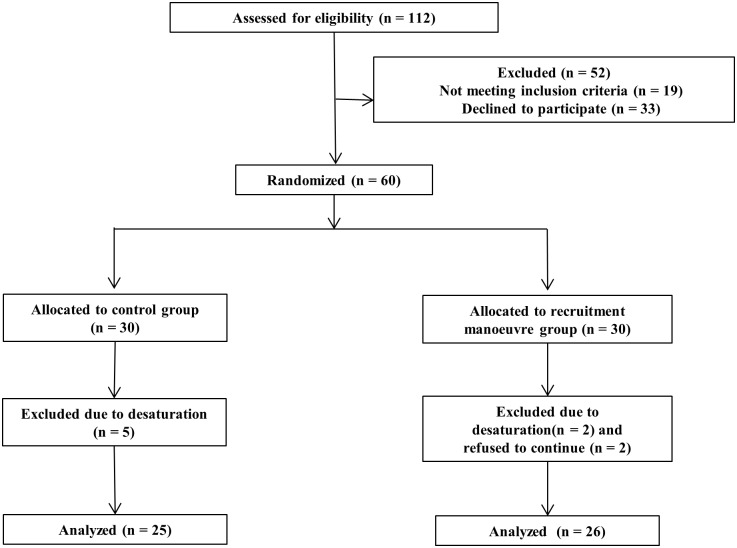
Robotic-assisted laparoscopic radical prostatectomy (RARP) needs a steep Trendelenburg position and a relatively high CO2 insufflation pressure, and patients undergoing RARP are usually elderly. These factors make intraoperative ventilatory care difficult and increase the risk of perioperative pulmonary complications. The aim was to determine the efficacy of recruitment manoeuvre (RM) on perioperative pulmonary complications in elderly patients undergoing RARP. A total of 60 elderly patients scheduled for elective RARP were randomly allocated to two groups after induction of anaesthesia; positive end expiratory pressure (PEEP) was applied during the operation without RM in the control group (group C) and after RM in the recruitment group (group R). The total number of patients who developed intraoperative desaturation or postoperative atelectasis was significantly higher in group C compared to group R (43.3% vs. 17.8%, P = 0.034). Intraoperative respiratory mechanics, perioperative blood gas analysis, and pulmonary function testing did not show differences between the groups. Adding RM to PEEP compared to PEEP alone significantly reduced perioperative pulmonary complications in elderly patients undergoing RARP.
机器人辅助腹腔镜根治性前列腺切除术(RARP)需要采用头低脚高位以及相对较高的二氧化碳气腹压力,且接受RARP的患者通常为老年人。这些因素使得术中通气护理变得困难,并增加了围手术期肺部并发症的风险。本研究旨在确定肺复张手法(RM)对接受RARP的老年患者围手术期肺部并发症的疗效。共有60例计划接受择期RARP的老年患者在麻醉诱导后被随机分为两组;对照组(C组)在手术期间不进行RM仅应用呼气末正压(PEEP),复张组(R组)在RM后应用PEEP。与R组相比,C组发生术中低氧血症或术后肺不张的患者总数显著更高(43.3%对17.8%,P = 0.034)。两组之间的术中呼吸力学、围手术期血气分析和肺功能测试均未显示出差异。与单独使用PEEP相比,在PEEP基础上加用RM可显著降低接受RARP的老年患者围手术期肺部并发症的发生率。