1 Laboratory for Equine and Comparative Orthopedic Research, School of Veterinary Medicine, Louisiana State University , Baton Rouge, Louisiana.
2 Department of Pathobiological Sciences, Louisiana State University , Baton Rouge, Louisiana.
Tissue Eng Part C Methods. 2017 Oct;23(10):592-603. doi: 10.1089/ten.TEC.2017.0078.
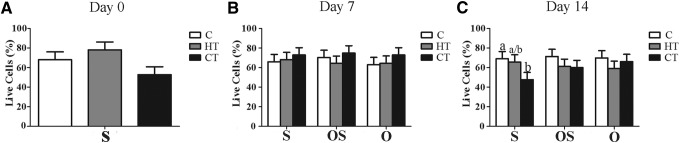
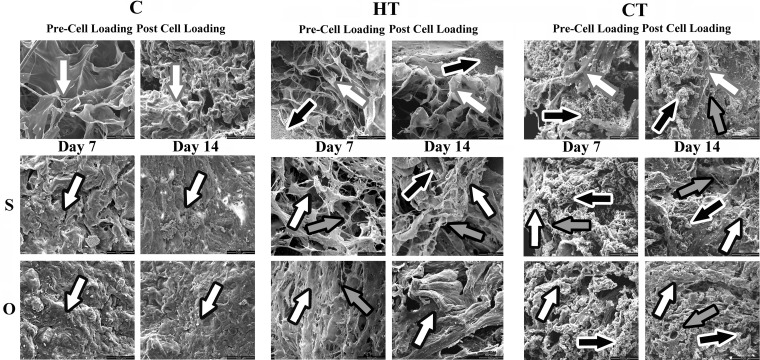
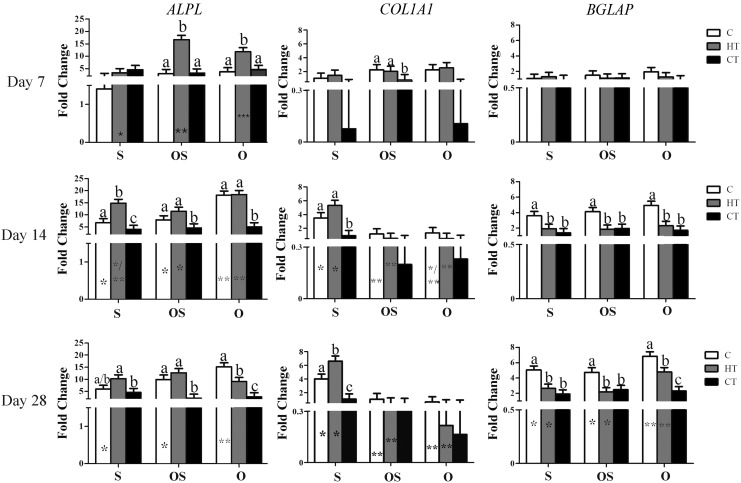
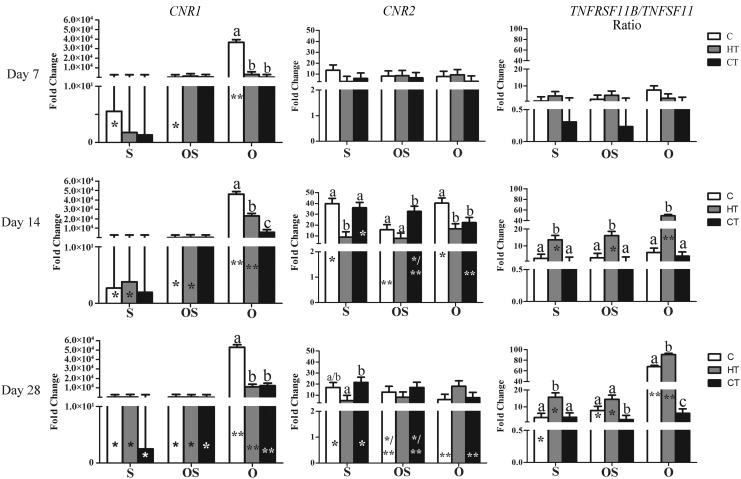
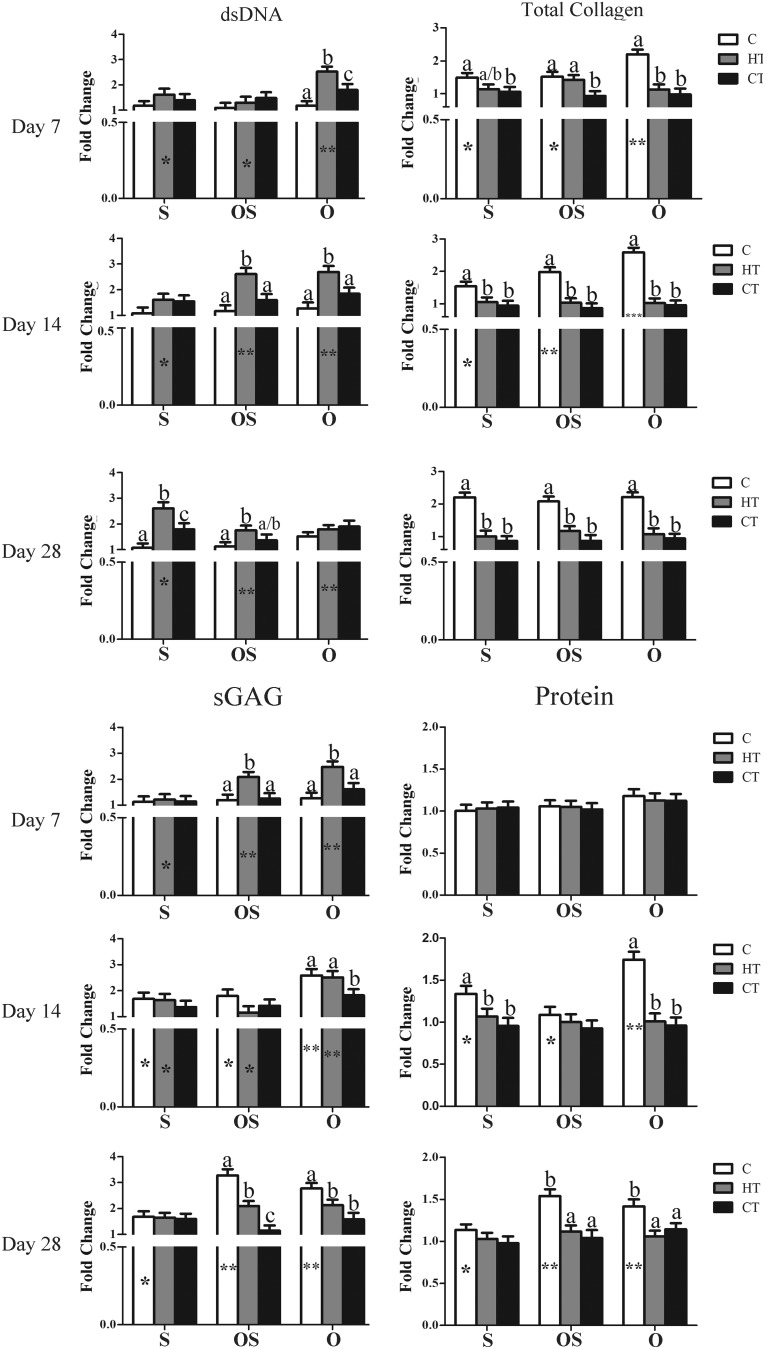
Osteogenic cell signaling pathway disruption varies among bone diseases. This investigation was designed to identify adipose-derived multipotent stromal cell (ASC) and bone graft scaffold combinations for local, targeted restoration of gene expression and extracellular matrix (ECM) deposition. Human ASC osteogenesis on bone graft materials was quantified following culture in stromal (S), osteogenic (O), or osteogenic for 48 h followed by stromal medium (OS) to test the two-part hypothesis: (1) identical ASC isolates on distinct bone graft scaffolds demonstrate unique viability, differentiation, ECM production, and gene expression in the same culture conditions; (2) identical ASC-bone graft scaffold combinations have different cell viability, differentiation, ECM production, and gene expression when cultured in S, O, or OS medium. Three commercially available bone graft scaffold materials, type I bovine collagen (C), hydroxyapatite + β-tricalcium phosphate + type I bovine collagen (HT), and β-tricalcium phosphate + type I bovine collagen (CT) were evaluated. Passage 3 ASCs were loaded onto scaffold blocks with a spinner flask bioreactor, and constructs were cultured up to 28 days. Cell viability, gene expression (alkaline phosphatase [ALPL], osteoprotegerin [TNFRSF11B], osteocalcin [BGLAP], cannabinoid receptors type I [CNR1] and II [CNR2], receptor activator of nuclear factor kappa β ligand [TNFSF11]), as well as ECM DNA, collagen, sulfated glycosaminoglycan, and protein content were quantified. Matrix organization was evaluated with scanning electron microscopy. Effects of scaffold, medium, or culture duration on cell viability were minimal. Significantly higher initial ALPL expression decreased with time, while BGLAP expression increased in HT constructs in O medium, and the constructs had the most abundant ECM components and ultrastructural organization. There was a similar, although delayed, pattern of gene expression and greater ECM collagen with less organization in C constructs in O medium. Higher CNR1 expression in C versus higher TNFRSF11B/TNFSF11 expression in HT constructs throughout the study support stimulation of unique osteogenic signaling pathways by identical cell isolates. These results suggest that bone scaffold composition may be used to selectively target specific osteogenic cell signaling pathways in ASC constructs to stimulate ECM deposition based on therapeutic needs.
成骨细胞信号通路的破坏在不同的骨骼疾病中有所不同。本研究旨在鉴定脂肪来源的多能基质细胞(ASC)和骨移植物支架组合,用于局部、靶向基因表达和细胞外基质(ECM)沉积的恢复。在基质(S)、成骨(O)或成骨培养 48 小时后再用基质培养基(OS)培养人 ASC 成骨后,对骨移植物材料上的 ASC 成骨进行定量,以检验两个假设:(1)不同骨移植物支架上相同的 ASC 分离株在相同的培养条件下表现出独特的活力、分化、细胞外基质产生和基因表达;(2)当在 S、O 或 OS 培养基中培养时,相同的 ASC-骨移植物支架组合具有不同的细胞活力、分化、细胞外基质产生和基因表达。评估了三种市售的骨移植物支架材料,I 型牛胶原蛋白(C)、羟基磷灰石+β-三磷酸钙+I 型牛胶原蛋白(HT)和β-三磷酸钙+I 型牛胶原蛋白(CT)。第 3 代 ASC 加载到带有旋转瓶生物反应器的支架块上,并培养长达 28 天。细胞活力、基因表达(碱性磷酸酶[ALPL]、骨保护素[TNFRSF11B]、骨钙素[BGLAP]、大麻素受体 1[CNR1]和 2[CNR2]、核因子κB 配体受体激活剂[TNFSF11])以及 ECM DNA、胶原蛋白、硫酸化糖胺聚糖和蛋白质含量进行了定量。用扫描电子显微镜评估基质组织。支架、培养基或培养时间对细胞活力的影响很小。在 O 培养基中,HT 构建体中初始 ALPL 表达显著升高,但随时间下降,BGLAP 表达增加,构建体具有最丰富的 ECM 成分和超微结构组织。在 O 培养基中,C 构建体中基因表达和 ECM 胶原蛋白具有相似的(尽管延迟)模式,但组织更差。在整个研究过程中,C 构建体中 CNR1 的表达高于 HT 构建体中 TNFRSF11B/TNFSF11 的表达,这支持相同的细胞分离株通过独特的成骨信号通路刺激。这些结果表明,骨支架组成可以用于根据治疗需求选择性地靶向 ASC 构建体中的特定成骨细胞信号通路,以刺激 ECM 沉积。