College of Medicine, Roseman University of Health Sciences, 10530 Discovery drive, Las Vegas, NV, 89135, USA.
Comprehensive Cancer Centers of Nevada, 9280 W Sunset Road, Las Vegas, NV, 89148, USA.
BMC Cancer. 2017 Sep 6;17(1):631. doi: 10.1186/s12885-017-3589-6.
Neoplastic cells proliferate rapidly and obtain requisite building blocks by reprogramming metabolic pathways that favor growth. Previously, we observed that prostate cancer cells uptake and store lipids in the form of lipid droplets, providing building blocks for membrane synthesis, to facilitate proliferation and growth. Mechanisms of lipid uptake, lipid droplet dynamics and their contribution to cancer growth have yet to be defined. This work is focused on elucidating the prostate cancer-specific modifications in lipid storage pathways so that these modified gene products can be identified and therapeutically targeted.
To identify genes that promote lipid droplet formation and storage, the expression profiles of candidate genes were assessed and compared between peripheral blood mononuclear cells and prostate cancer cells. Subsequently, differentially expressed genes were inhibited and growth assays performed to elucidate their role in the growth of the cancer cells. Cell cycle, apoptosis and autophagy assays were performed to ascertain the mechanism of growth inhibition.
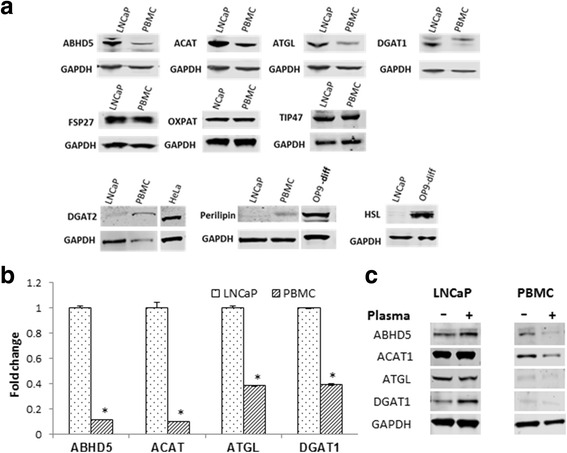
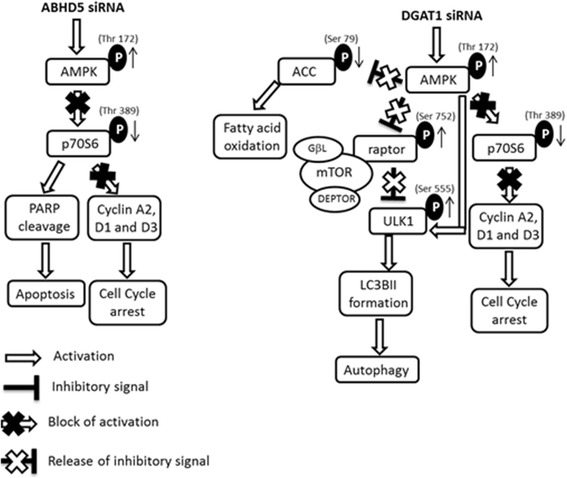
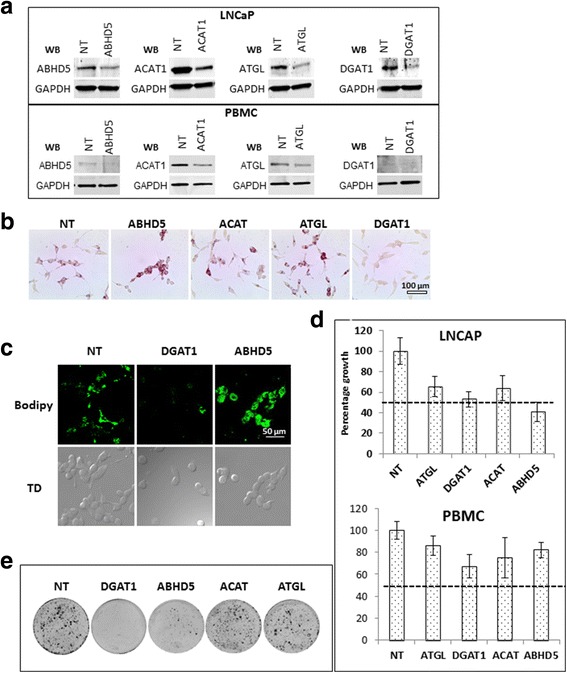
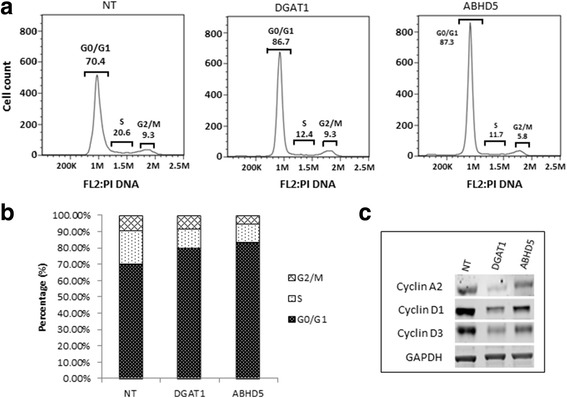
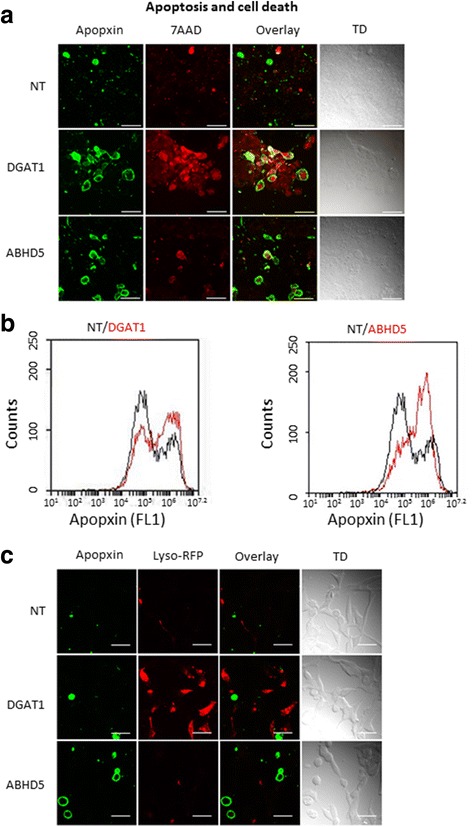
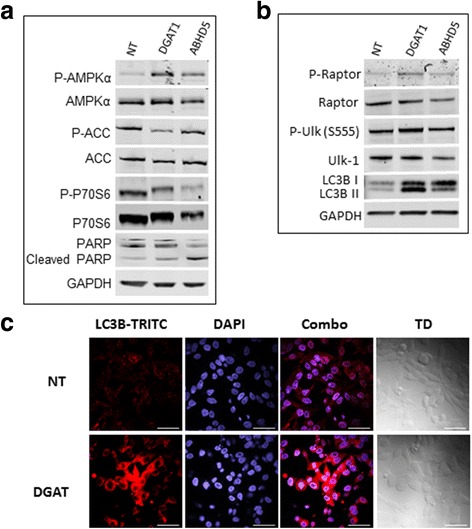
Our results indicate that DGAT1, ABHD5, ACAT1 and ATGL are overexpressed in prostate cancer cells compared to PBMCs and of these overexpressed genes, DGAT1 and ABHD5 aid in the growth of the prostate cancer cells. Blocking the expression of both DGAT1 and ABHD5 results in inhibition of growth, cell cycle block and cell death. DGAT1 siRNA treatment inhibits lipid droplet formation and leads to autophagy where as ABHD5 siRNA treatment promotes accumulation of lipid droplets and leads to apoptosis. Both the siRNA treatments reduce AMPK phosphorylation, a key regulator of lipid metabolism. While DGAT1 siRNA reduces phosphorylation of ACC, the rate limiting enzyme in de novo fat synthesis and triggers phosphorylation of raptor and ULK-1 inducing autophagy and cell death, ABHD5 siRNA decreases P70S6 phosphorylation, leading to PARP cleavage, apoptosis and cell death. Interestingly, DGAT-1 is involved in the synthesis of triacylglycerol where as ABHD5 is a hydrolase and participates in the fatty acid oxidation process, yet inhibition of both enzymes similarly promotes prostate cancer cell death.
Inhibition of either DGAT1 or ABHD5 leads to prostate cancer cell death. Both DGAT1 and ABHD5 can be selectively targeted to block prostate cancer cell growth.
肿瘤细胞通过重新编程有利于生长的代谢途径快速增殖并获取必要的构建模块。此前,我们观察到前列腺癌细胞以脂滴的形式摄取和储存脂质,为膜合成提供构建模块,从而促进增殖和生长。脂质摄取、脂滴动力学及其对癌症生长的贡献的机制尚未确定。这项工作的重点是阐明前列腺癌特有的脂质储存途径的修饰,以便能够识别和针对这些修饰的基因产物进行治疗。
为了鉴定促进脂滴形成和储存的基因,评估候选基因在周围血单核细胞和前列腺癌细胞之间的表达谱,并进行比较。随后,抑制差异表达的基因并进行生长测定,以阐明它们在癌细胞生长中的作用。进行细胞周期、凋亡和自噬测定以确定生长抑制的机制。
我们的结果表明,与 PBMC 相比,DGAT1、ABHD5、ACAT1 和 ATGL 在前列腺癌细胞中过度表达,并且在这些过度表达的基因中,DGAT1 和 ABHD5 有助于前列腺癌细胞的生长。阻断 DGAT1 和 ABHD5 的表达均可抑制生长、细胞周期阻滞和细胞死亡。DGAT1 siRNA 处理抑制脂滴形成并诱导自噬,而 ABHD5 siRNA 处理促进脂滴积累并导致细胞凋亡。两种 siRNA 处理均降低 AMPK 磷酸化,这是脂质代谢的关键调节剂。DGAT1 siRNA 降低从头脂肪合成的限速酶 ACC 的磷酸化并触发 Raptor 和 ULK-1 的磷酸化,诱导自噬和细胞死亡,而 ABHD5 siRNA 降低 P70S6 的磷酸化,导致 PARP 裂解、凋亡和细胞死亡。有趣的是,DGAT-1 参与三酰基甘油的合成,而 ABHD5 是一种水解酶,参与脂肪酸氧化过程,但抑制这两种酶同样促进前列腺癌细胞死亡。
抑制 DGAT1 或 ABHD5 均可导致前列腺癌细胞死亡。DGAT1 和 ABHD5 均可作为选择性靶点,阻断前列腺癌细胞生长。