Hovlid Einar, Frich Jan C, Walshe Kieran, Nilsen Roy M, Flaatten Hans Kristian, Braut Geir Sverre, Helgeland Jon, Teig Inger Lise, Harthug Stig
Department of Social Science, Western Norway University of Applied Sciences, Sogndal and Norwegian Board of Health Supervision, Oslo, Norway.
Institute of Health and Society, University of Oslo, Oslo, Norway.
BMJ Open. 2017 Sep 5;7(9):e016213. doi: 10.1136/bmjopen-2017-016213.
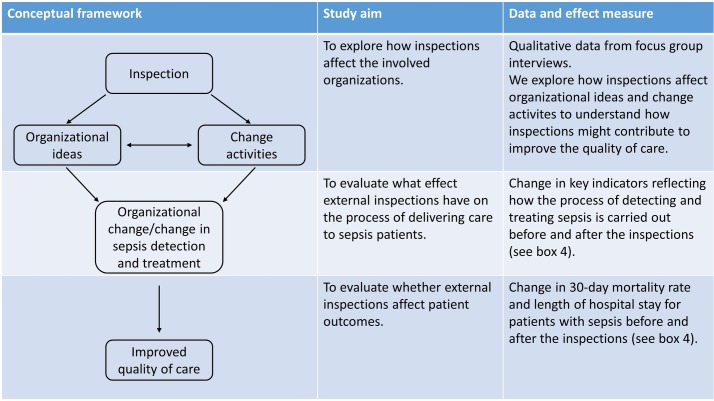
Inspections are widely used in health care as a means to improve the health services delivered to patients. Despite their widespread use, there is little evidence of their effect. The mechanisms for how inspections can promote change are poorly understood. In this study, we use a national inspection campaign of sepsis detection and initial treatment in hospitals as case to: (1) Explore how inspections affect the involved organizations. (2) Evaluate what effect external inspections have on the process of delivering care to patients, measured by change in indicators reflecting how sepsis detection and treatment is carried out. (3) Evaluate whether external inspections affect patient outcomes, measured as change in the 30-day mortality rate and length of hospital stay.
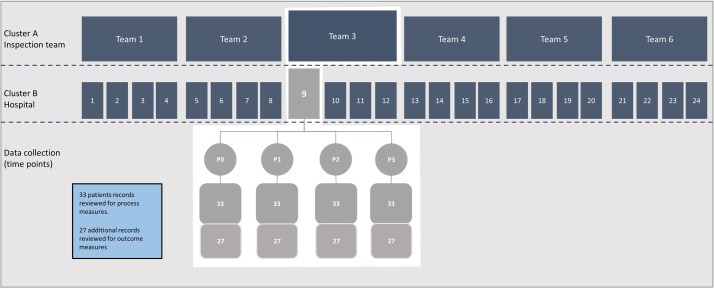
The intervention that we study is inspections of sepsis detection and treatment in hospitals. The intervention will be rolled out sequentially during 12 months to 24 hospitals. Our effect measures are change on indicators related to the detection and treatment of sepsis, the 30-day mortality rate and length of hospital stay. We collect data from patient records at baseline, before the inspections, and at 8 and 14 months after the inspections. We use logistic regression models and linear regression models to compare the various effect measurements between the intervention and control periods. All the models will include time as a covariate to adjust for potential secular changes in the effect measurements during the study period. We collect qualitative data before and after the inspections, and we will conduct a thematic content analysis to explore how inspections affect the involved organisations.
The study has obtained ethical approval by the Regional Ethics Committee of Norway Nord and the Norwegian Data Protection Authority. It is registered at www.clinicaltrials.gov (Identifier: NCT02747121). Results will be reported in international peer-reviewed journals.
NCT02747121; Pre-results.
检查在医疗保健中被广泛用作改善提供给患者的医疗服务的一种手段。尽管其被广泛使用,但几乎没有证据表明其效果如何。对于检查如何促进变革的机制了解甚少。在本研究中,我们以一项全国性的医院败血症检测和初始治疗检查活动为例,以:(1)探索检查如何影响相关组织。(2)评估外部检查对向患者提供护理过程的影响,通过反映败血症检测和治疗实施情况的指标变化来衡量。(3)评估外部检查是否影响患者结局,以30天死亡率和住院时间的变化来衡量。
我们研究的干预措施是对医院败血症检测和治疗的检查。该干预措施将在12个月内依次推广到24家医院。我们的效果指标是与败血症检测和治疗、30天死亡率和住院时间相关的指标变化。我们在基线(检查前)以及检查后8个月和14个月从患者记录中收集数据。我们使用逻辑回归模型和线性回归模型来比较干预期和对照期之间的各种效果测量值。所有模型都将把时间作为协变量,以调整研究期间效果测量值中潜在的长期变化。我们在检查前后收集定性数据,并将进行主题内容分析,以探索检查如何影响相关组织。
该研究已获得挪威北部地区伦理委员会和挪威数据保护局的伦理批准。它已在www.clinicaltrials.gov上注册(标识符:NCT02747121)。结果将在国际同行评审期刊上发表。
NCT02747121;预结果。