Onoue Takeshi, Goto Motomitsu, Kobayashi Tomoko, Tominaga Takashi, Ando Masahiko, Honda Hiroyuki, Yoshida Yasuko, Tosaki Takahiro, Yokoi Hisashi, Kato Sawako, Maruyama Shoichi, Arima Hiroshi
Department of Endocrinology and Diabetes, Nagoya University Graduate School of Medicine, Nagoya, Japan.
Center for Advanced Medicine and Clinical Research, Nagoya University Hospital, Nagoya, Japan.
Nagoya J Med Sci. 2017 Aug;79(3):323-329. doi: 10.18999/nagjms.79.3.323.
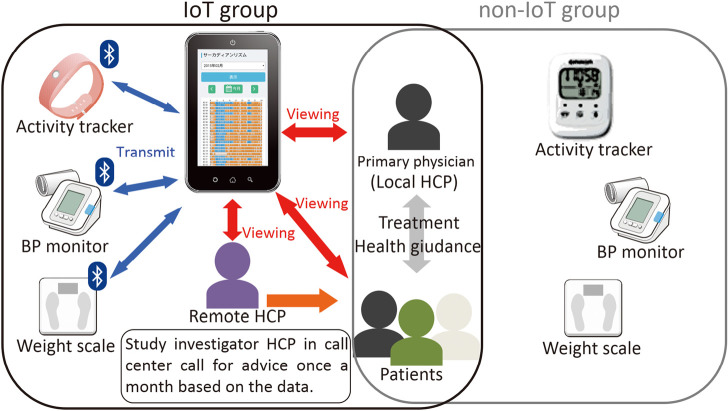
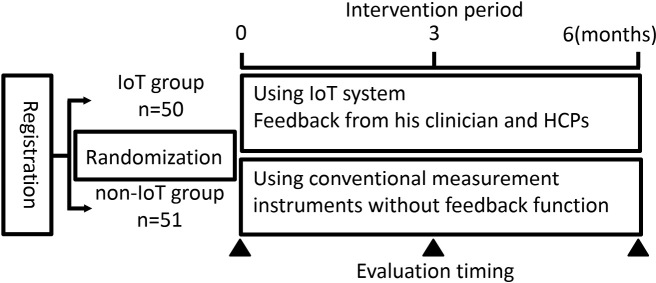
The Internet of Things (IoT) allows collecting vast amounts of health-relevant data such as daily activity, body weight (BW), and blood pressure (BP) automatically. The use of IoT devices to monitor diabetic patients has been studied, but could not evaluate IoT-dependent effects because health data were not measured in control groups. This multicenter, open-label, randomized, parallel group study will compare the impact of intensive health guidance using IoT and conventional medical guidance on glucose control. It will be conducted in outpatients with type 2 diabetes for a period of 6 months. IoT devices to measure amount of daily activity, BW, and BP will be provided to IoT group patients. Healthcare professionals (HCPs) will provide appropriate feedback according to the data. Non-IoT control, patients will be given measurement devices that do not have a feedback function. The primary outcome is glycated hemoglobin at 6 months. The study has already enrolled 101 patients, 50 in the IoT group and 51 in the non-IoT group, at the two participating outpatient clinics. The baseline characteristics of two groups did not differ, except for triglycerides. This will be the first randomized, controlled study to evaluate IoT-dependent effects of intensive feedback from HCPs. The results will validate a new method of health-data collection and provision of feedback suitable for diabetes support with increased effectiveness and low cost.
物联网(IoT)能够自动收集大量与健康相关的数据,如日常活动、体重(BW)和血压(BP)。使用物联网设备监测糖尿病患者的情况已得到研究,但由于对照组未测量健康数据,无法评估物联网相关的影响。这项多中心、开放标签、随机、平行组研究将比较使用物联网的强化健康指导与传统医学指导对血糖控制的影响。研究将在2型糖尿病门诊患者中进行,为期6个月。将为物联网组患者提供测量日常活动量、体重和血压的物联网设备。医疗保健专业人员(HCPs)将根据数据提供适当的反馈。非物联网对照组患者将获得不具备反馈功能的测量设备。主要结局指标是6个月时的糖化血红蛋白。在两家参与研究的门诊诊所,该研究已招募了101名患者,其中物联网组50名,非物联网组51名。除甘油三酯外,两组的基线特征无差异。这将是第一项评估HCPs强化反馈的物联网相关影响的随机对照研究。研究结果将验证一种新的健康数据收集和反馈提供方法,该方法适用于糖尿病支持,具有更高的有效性和更低的成本。