Taylor Claire, Tsakirides Costas, Moxon James, Moxon James W, Dudfield Michael, Witte Klaus, Ingle Lee, Carroll Sean
Carnegie School of Sport,Leeds Beckett University, Leeds, UK.
Burton Croft Surgery, Leeds, UK.
Open Heart. 2017 Jul 28;4(2):e000623. doi: 10.1136/openhrt-2017-000623. eCollection 2017.
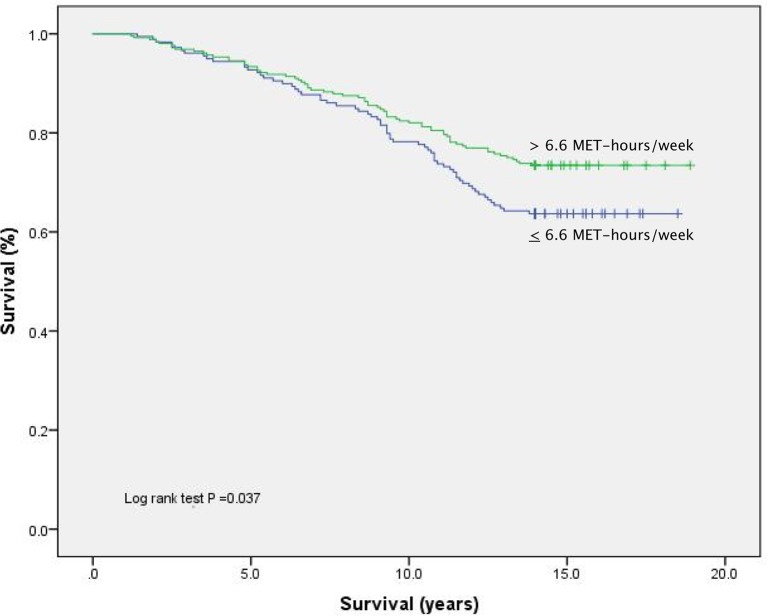
To investigate the relationship between exercise participation, exercise 'dose' expressed as metabolic equivalent (MET) hours (h) per week, and prognosis in individuals attending an extended, community-based exercise rehabilitation programme.
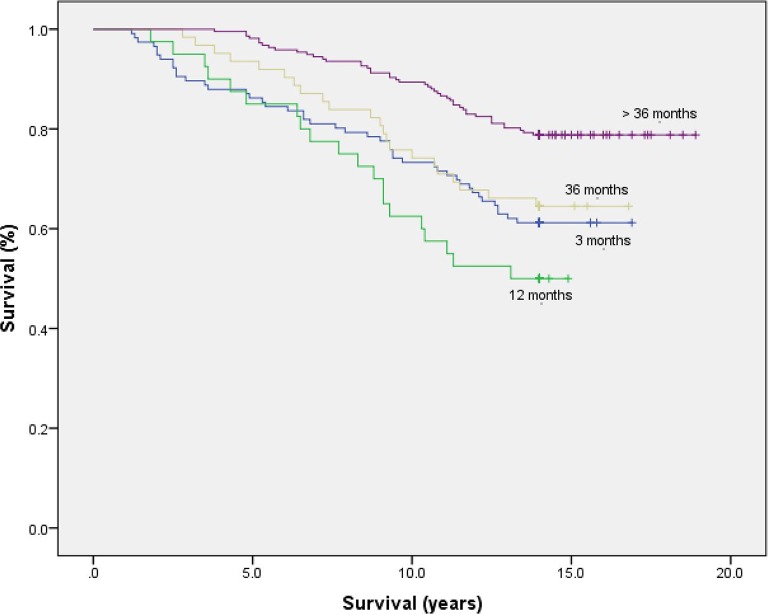
Cohort study of 435 participants undertaking exercise-based cardiac rehabilitation (CR) in Leeds, West Yorkshire, UK between 1994 and 2006, followed up to 1 November 2013. MET intensity of supervised exercise was estimated utilising serial submaximal exercise test results and corresponding exercise prescriptions. Programme participation was routinely monitored. Cox regression analysis including time-varying and propensity score adjustment was applied to identify predictors of long-term, all-cause mortality across exercise dose and programme duration groups.
There were 133 events (31%) during a median follow-up of 14 years (range, 1.2 to 18.9 years). The significant univariate association between exercise dose and all-cause mortality was attenuated following multivariable adjustment for other predictors, including duration in the programme. Longer-term adherence to supervised exercise training (>36 months) was associated with a 33% lower mortality risk (multivariate-adjusted HR: 0.67; 95% CI: 0.47 to 0.97; p=0.033) compared with all lesser durations of CR (3, 12, 36 months), even after adjustment for baseline fitness, comorbidities and survivor bias.
Exercise dose (MET-h per week) appears less important than long-term adherence to supervised exercise for the reduction of long-term mortality risk. Extended, supervised CR programmes within the community may play a key role in promoting long-term exercise maintenance and other secondary prevention therapies for survival benefit.
探讨参加社区长期运动康复计划的个体的运动参与情况、以代谢当量(MET)小时/周表示的运动“剂量”与预后之间的关系。
对1994年至2006年期间在英国西约克郡利兹市进行基于运动的心脏康复(CR)的435名参与者进行队列研究,随访至2013年11月1日。利用系列次极量运动测试结果和相应的运动处方估计监督运动的MET强度。常规监测项目参与情况。应用包括时间变化和倾向评分调整的Cox回归分析,以确定运动剂量和项目持续时间组中全因长期死亡率的预测因素。
在中位随访14年(范围1.2至18.9年)期间发生了133起事件(31%)。在对包括项目持续时间在内的其他预测因素进行多变量调整后,运动剂量与全因死亡率之间的显著单变量关联减弱。与所有较短的CR持续时间(3、12、36个月)相比,长期坚持监督运动训练(>36个月)与死亡风险降低33%相关(多变量调整后的HR:0.67;95%CI:0.47至0.97;p=0.033),即使在调整了基线健康状况、合并症和幸存者偏倚之后也是如此。
对于降低长期死亡风险而言,运动剂量(每周MET小时数)似乎不如长期坚持监督运动重要。社区内长期的、有监督的CR项目可能在促进长期运动维持和其他生存获益的二级预防治疗方面发挥关键作用。