Iyer Rajesh Shankar, Ramakrishnan T C R, Shinto Ajit, Kamaleshwaran Koramadai Karuppuswamy
Department of Neurology, KG Hospital & Post Graduate Medical Institute, Coimbatore, Tamil Nadu, India.
Department of Radiology, KG Hospital & Post Graduate Medical Institute, Coimbatore, Tamil Nadu, India.
Epilepsy Behav Case Rep. 2017 Jun 8;8:47-50. doi: 10.1016/j.ebcr.2017.06.001. eCollection 2017.
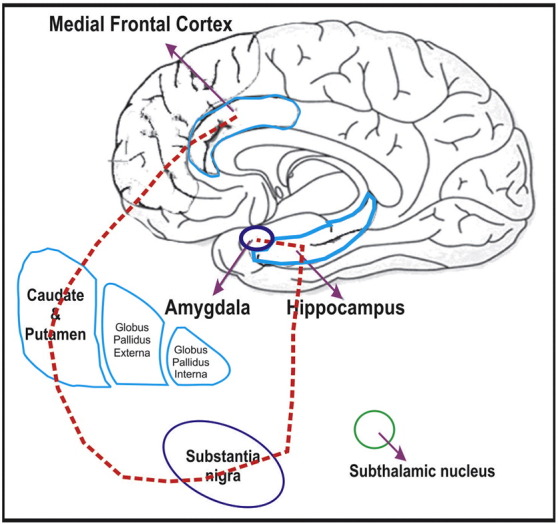
•Faciobrachial dystonic seizures (FBDS) are caused by autoantibodies to leucine-rich glioma-inactivated1 proteins, a component of the voltage-gated potassium channel complex (VGKC-complex) and precede the clinical presentation of limbic encephalitis.•The exact pathophysiology of FBDS is not known and whether they are seizures or movement disorder is still debated.•We suggest the fronto-temporo-basal ganglia network involving the medial frontal and temporal regions along with the corpus striatum and substantia nigra being responsible for the clinical phenomenon of FBDS.•The varied clinical, electrical and imaging features of FBDS in our cases and in the literature are best explained by involvement of this network.•Entrainment from any part of this network will result in similar clinical expression of FBDS, whereas other electro-clinical associations and duration depends on the extent of involvement of the network.
•面臂肌张力障碍性癫痫(FBDS)由针对富含亮氨酸胶质瘤失活1蛋白的自身抗体引起,该蛋白是电压门控钾通道复合物(VGKC复合物)的一个组成部分,且先于边缘性脑炎的临床表现出现。•FBDS的确切病理生理学尚不清楚,其究竟是癫痫还是运动障碍仍存在争议。•我们认为,涉及额颞基底神经节网络,包括内侧额叶和颞叶区域以及纹状体和黑质,是FBDS临床现象的原因。•我们病例及文献中FBDS多样的临床、电生理和影像学特征,最好通过该网络的受累来解释。•该网络任何部位的同步化都会导致FBDS相似的临床症状,而其他电临床关联和病程则取决于该网络的受累程度。