Sachdev Vandana, Sidenko Stanislav, Wu Melinda D, Minniti Caterina P, Hannoush Hwaida, Brenneman Cynthia L, Waclawiw Myron A, Arai Andrew E, Schechter Alan N, Kato Gregory J, Lindner Jonathan R
National Heart, Lung and Blood Institute (NHLBI), National Institutes of Health, Bethesda, MD, USA.
Knight Cardiovascular Institute, Oregon Health and Science University, Portland, OR, USA.
Br J Haematol. 2017 Nov;179(4):648-656. doi: 10.1111/bjh.14918. Epub 2017 Sep 7.
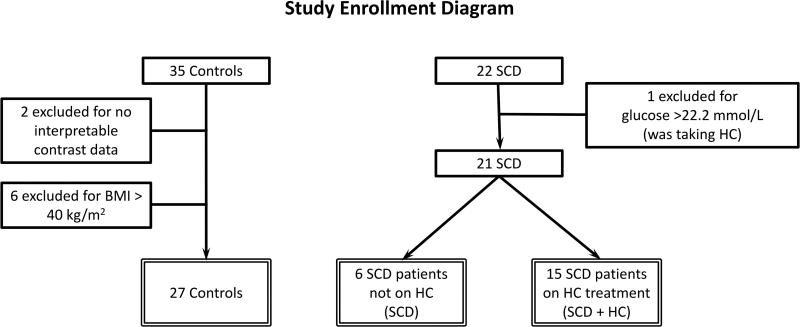
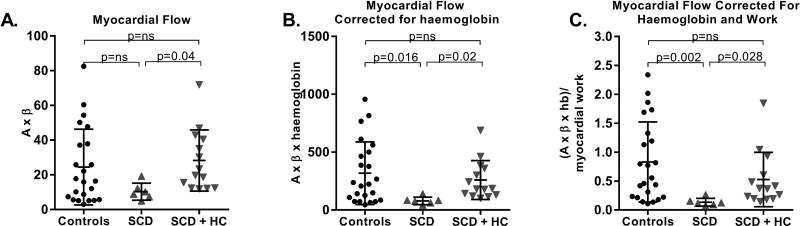
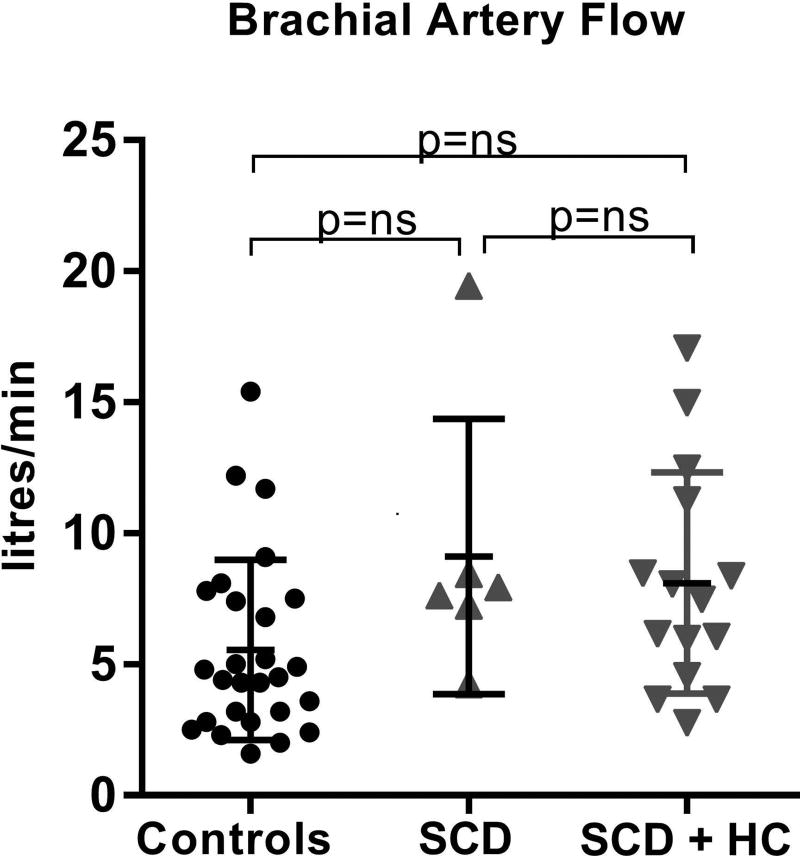
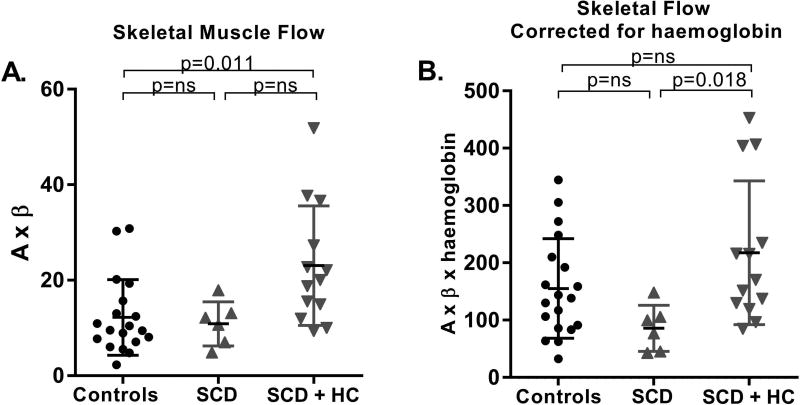
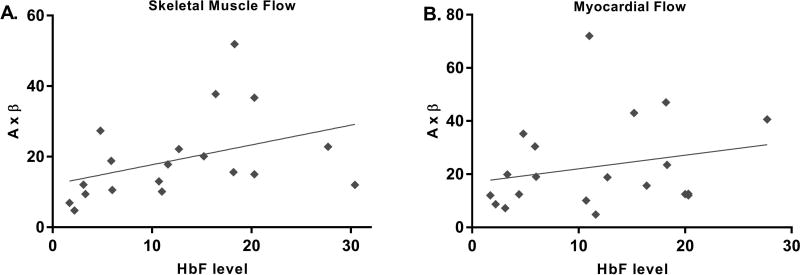
In sickle cell disease (SCD), abnormal microvascular function combined with chronic anaemia predisposes patients to perfusion-demand mismatch. We hypothesized that skeletal muscle and myocardial perfusion, normalized to the degree of anaemia, is reduced at basal-state compared to controls, and that this defect is ameliorated by hydroxycarbamide (HC; also termed hydroxyurea) therapy. Twenty-one SCD patients, of whom 15 were treated with HC, and 27 controls underwent contrast-enhanced ultrasound (CEU) perfusion imaging of the forearm as well as the myocardium. HC treatment was associated with lower white cell and reticulocyte counts, and higher fetal haemoglobin and total haemoglobin levels. When corrected for the degree of anaemia in SCD patients, skeletal flow in HC-treated patients was significantly higher than in untreated SCD patients (217·7 ± 125·4 vs. 85·9 ± 40·2, P = 0·018). Similarly, when normalized for both anaemia and increased myocardial work, resting myocardial perfusion was also significantly higher in HC-treated patients compared with untreated SCD patients (0·53 ± 0·47 vs. 0·13 ± 0·07, P = 0·028). Haemoglobin F (HbF) levels correlated with skeletal muscle microvascular flow (r = 0·55, P = 0·01). In conclusion, patients with SCD not on HC therapy have resting flow deficits in both skeletal muscle and myocardial flow. HC therapy normalizes flow and there is a direct correlation with HbF levels. Clinical trial registration ClinicalTrials.gov Identifier: NCT01602809; https://clinicaltrials.gov/ct2/show/NCT01602809?term=sACHDEV&rank=9.
在镰状细胞病(SCD)中,异常的微血管功能与慢性贫血相结合,使患者易发生灌注需求不匹配。我们假设,与对照组相比,在基础状态下,校正贫血程度后的骨骼肌和心肌灌注会降低,并且这种缺陷可通过羟基脲(HC;也称为羟基尿素)治疗得到改善。21例SCD患者(其中15例接受HC治疗)和27例对照者接受了前臂以及心肌的对比增强超声(CEU)灌注成像检查。HC治疗与较低的白细胞和网织红细胞计数以及较高的胎儿血红蛋白和总血红蛋白水平相关。校正SCD患者的贫血程度后,接受HC治疗的患者的骨骼肌血流明显高于未接受治疗的SCD患者(217.7±125.4 vs. 85.9±40.2,P = 0.018)。同样,校正贫血和增加的心肌做功后,接受HC治疗的患者静息心肌灌注也明显高于未接受治疗的SCD患者(0.53±0.47 vs. 0.13±0.07,P = 0.028)。血红蛋白F(HbF)水平与骨骼肌微血管血流相关(r = 0.55,P = 0.01)。总之,未接受HC治疗的SCD患者在骨骼肌和心肌血流方面存在静息血流不足。HC治疗可使血流正常化,且与HbF水平直接相关。临床试验注册ClinicalTrials.gov标识符:NCT01602809;https://clinicaltrials.gov/ct2/show/NCT01602809?term=sACHDEV&rank=9 。