Strömvall Kerstin, Sundkvist Kristoffer, Ljungberg Börje, Halin Bergström Sofia, Bergh Anders
Department of Medical Biosciences, Pathology, Umeå University, Umeå, Sweden.
Department of Surgical and Perioperative Sciences, Urology and Andrology, Umeå University, Umeå, Sweden.
Prostate. 2017 Nov;77(15):1468-1477. doi: 10.1002/pros.23407. Epub 2017 Sep 7.
Tumor-derived antigens are captured by CD169 (SIGLEC1 ) sinus macrophages in regional lymph nodes (LNs), and are presented to effector cells inducing an anti-tumor immune response. Reduced CD169 expression in pre-metastatic regional LNs is associated with subsequent metastatic disease and a poor outcome in several tumor types, but if this is the case in prostate cancer has not been explored.
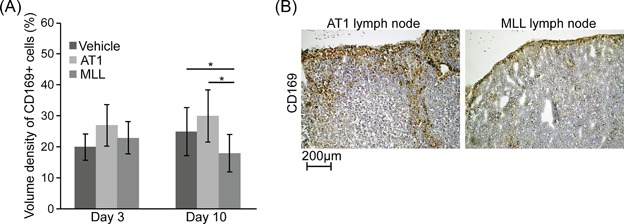
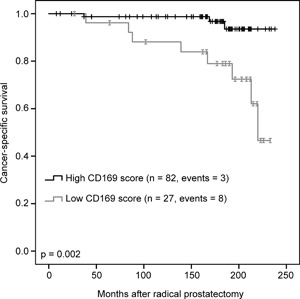
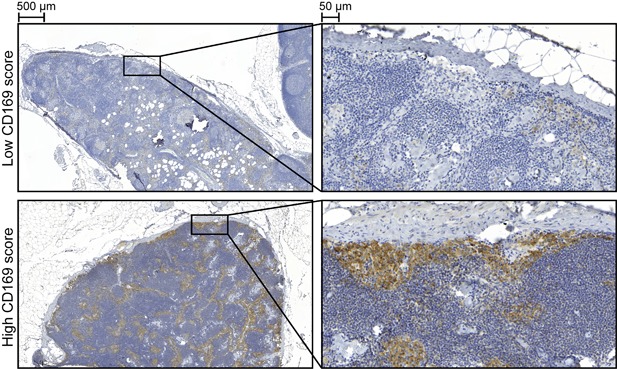
CD169 expression was measured with immunohistochemistry in metastasis-free regional LNs from 109 prostate cancer patients treated with prostatectomy (January 1996 to April 2002). Possible associations of CD169 expression with PSA-relapse, prostate cancer death, Gleason score, and other clinical data were assessed using Kaplan-Meier survival- and Cox regression analysis. In addition, the Dunning rat prostate tumor model was used to examine CD169 expression in pre-metastatic LNs draining either highly metastatic MatLyLu- or poorly metastatic AT1-tumors.
In patients with low CD169 immunostaining in metastasis-free regional LNs, 8 of the 27 patients died from prostate cancer compared with only three of the 82 patients with high immunostaining (P < 0.001). CD169 expression in regional LNs was not associated with PSA-relapse. Rats with highly metastatic tumors had decreased CD169 immunoreactivity in pre-metastatic regional LNs compared with rats with poorly metastatic tumors.
Low expression of CD169 in metastasis-free regional LNs indicates a reduced anti-tumor immune response. If verified in other studies, CD169 expression in regional LNs could, in combination with other factors, potentially be used as a marker of prostate cancer aggressiveness.
肿瘤衍生抗原被区域淋巴结(LN)中的CD169(唾液酸结合免疫球蛋白样凝集素1)窦巨噬细胞捕获,并呈递给效应细胞以诱导抗肿瘤免疫反应。在几种肿瘤类型中,转移前区域LN中CD169表达降低与随后的转移性疾病和不良预后相关,但前列腺癌是否如此尚未得到研究。
对1996年1月至2002年4月接受前列腺切除术的109例前列腺癌患者的无转移区域LN进行免疫组织化学检测,以测量CD169表达。使用Kaplan-Meier生存分析和Cox回归分析评估CD169表达与前列腺特异性抗原(PSA)复发、前列腺癌死亡、Gleason评分及其他临床数据之间的可能关联。此外,使用邓宁大鼠前列腺肿瘤模型检查引流高转移性MatLyLu肿瘤或低转移性AT1肿瘤的转移前LN中的CD169表达。
在无转移区域LN中CD169免疫染色低的患者中,27例中有8例死于前列腺癌,而在82例免疫染色高的患者中只有3例(P<0.001)。区域LN中的CD169表达与PSA复发无关。与低转移性肿瘤的大鼠相比,高转移性肿瘤的大鼠转移前区域LN中的CD169免疫反应性降低。
无转移区域LN中CD169的低表达表明抗肿瘤免疫反应降低。如果在其他研究中得到验证,区域LN中的CD169表达可能与其他因素结合,潜在地用作前列腺癌侵袭性的标志物。