Dugay Frédéric, Llamas-Gutierrez Francisco, Gournay Marjory, Medane Sarah, Mazet François, Chiforeanu Dan Christian, Becker Emmanuelle, Lamy Régine, Léna Hervé, Rioux-Leclercq Nathalie, Belaud-Rotureau Marc-Antoine, Cabillic Florian
Department of Cytogenetics and Cell Biology, CHU de Rennes, Rennes, France.
IRSET UMR INSERM 1085, Faculté de Médecine, Université de Rennes 1, Rennes, France.
Oncotarget. 2017 Jun 8;8(32):53336-53351. doi: 10.18632/oncotarget.18408. eCollection 2017 Aug 8.
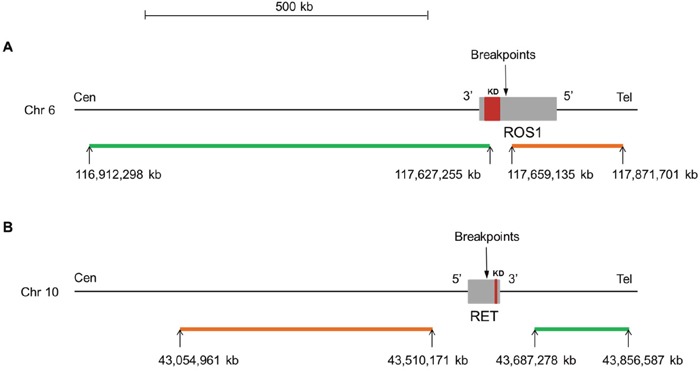
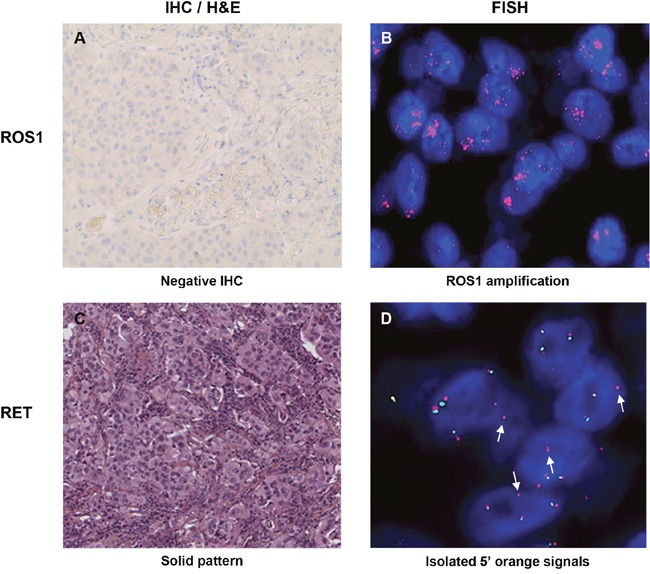
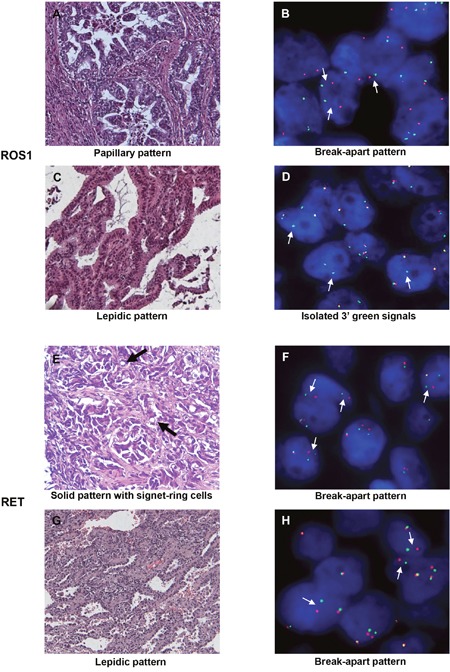
Targeted therapies have substantially changed the management of non-small cell lung cancer (NSCLC) patients with driver oncogenes. Given the high frequency, and aberrations were the first to be detected and paved the way for tyrosine kinase inhibitor (TKI) treatments. Other kinases such as and more recently have emerged as promising targets, and ROS1 and RET TKIs are already available for precision medicine. We screened a large cohort of 713 Caucasian non-squamous NSCLC patients lacking ///// aberrations for and rearrangements using fluorescence hybridization to determine the frequency and clinicopathological characteristics of ROS1- and RET-positive patients. Frequencies of and rearrangements were 2.1% and 2.52%, respectively. Contrary to common belief, both and rearrangements were detected in patients with a history of smoking, and the -positive patients were not younger than the negative patients. Moreover, but not rearrangement was associated with the female gender. Nearly half of the -rearranged patients were successfully treated with ROS1 TKIs. In contrast, only 5/18 RET-positive patients received off-label RET TKIs. Two patients had stable disease, and three experienced disease progression. In addition to the 18 RET-positive cases, 10 showed isolated 5' signals. The clinical relevance is unknown but if the frequency is confirmed by other groups, the question whether these patients are eligible to TKIs will arise. More potent RET TKIs are under development and may improve the response rate in RET-positive patients. Therefore, we recommend the routine implementation of RET testing in non-squamous NSCLC patients, including those with a history of smoking.
靶向治疗已极大地改变了具有驱动癌基因的非小细胞肺癌(NSCLC)患者的治疗管理。鉴于其高频率, 畸变首先被检测到,并为酪氨酸激酶抑制剂(TKI)治疗铺平了道路。其他激酶如 以及最近的 已成为有前景的靶点,并且ROS1和RET TKI已可用于精准医学。我们使用荧光原位杂交技术对713例缺乏 ///// 畸变的白种人非鳞状NSCLC患者的大样本队列进行筛查,以确定ROS1和RET阳性患者的频率及临床病理特征。 和 重排的频率分别为2.1%和2.52%。与普遍看法相反,在有吸烟史的患者中均检测到了 和 重排,且 阳性患者并不比阴性患者年轻。此外, 重排而非 重排与女性性别相关。近一半的 重排患者成功接受了ROS1 TKI治疗。相比之下,18例RET阳性患者中只有5例接受了非标签RET TKI治疗。2例患者病情稳定,3例病情进展。除了18例RET阳性病例外,10例显示孤立的5'信号。其临床相关性尚不清楚,但如果其他研究组证实了该频率,这些患者是否适合使用TKI的问题将会出现。更有效的RET TKI正在研发中,可能会提高RET阳性患者的缓解率。因此,我们建议在非鳞状NSCLC患者中常规开展RET检测,包括有吸烟史的患者。