Dziadziuszko Rafal, Krebs Matthew G, De Braud Filippo, Siena Salvatore, Drilon Alexander, Doebele Robert C, Patel Manish R, Cho Byoung Chul, Liu Stephen V, Ahn Myung-Ju, Chiu Chao-Hua, Farago Anna F, Lin Chia-Chi, Karapetis Christos S, Li Yu-Chung, Day Bann-Mo, Chen David, Wilson Timothy R, Barlesi Fabrice
Medical University of Gdańsk, Gdańsk, Poland.
Division of Cancer Sciences, Faculty of Biology, Medicine and Health, The University of Manchester and The Christie NHS Foundation Trust, Manchester Academic Health Science Centre, Manchester, United Kingdom.
J Clin Oncol. 2021 Apr 10;39(11):1253-1263. doi: 10.1200/JCO.20.03025. Epub 2021 Mar 1.
Genetic rearrangements of the tyrosine receptor kinase ROS proto-oncogene 1 () are oncogenic drivers in non-small-cell lung cancer (NSCLC). We report the results of an updated integrated analysis of three phase I or II clinical trials (ALKA-372-001, STARTRK-1, and STARTRK-2) of the ROS1 tyrosine kinase inhibitor, entrectinib, in fusion-positive NSCLC.
The efficacy-evaluable population included adults with locally advanced or metastatic fusion-positive NSCLC with or without CNS metastases who received entrectinib ≥ 600 mg orally once per day. Co-primary end points were objective response rate (ORR) assessed by blinded independent central review and duration of response (DoR). Secondary end points included progression-free survival (PFS), overall survival (OS), intracranial ORR, intracranial DoR, intracranial PFS, and safety.
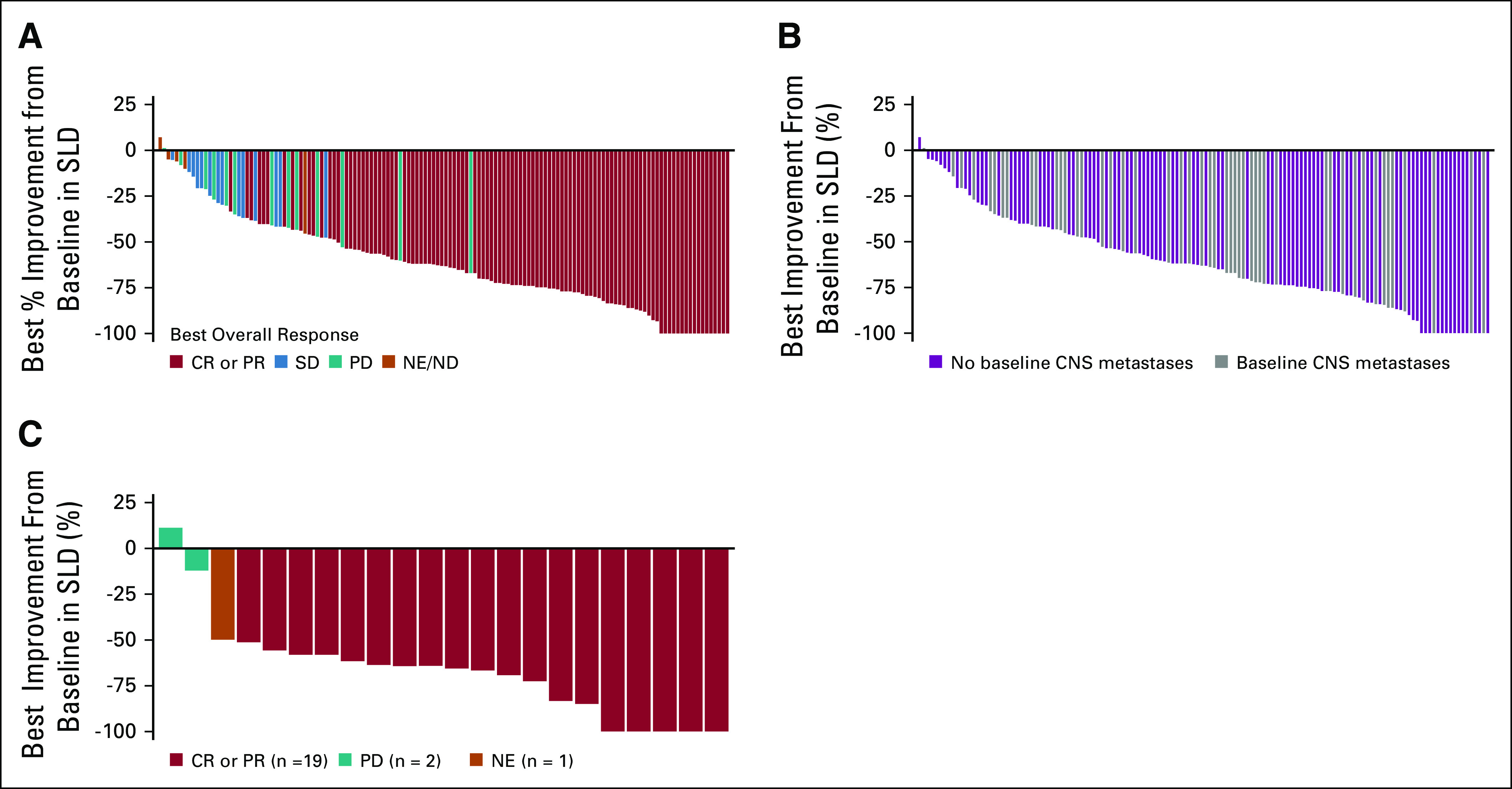
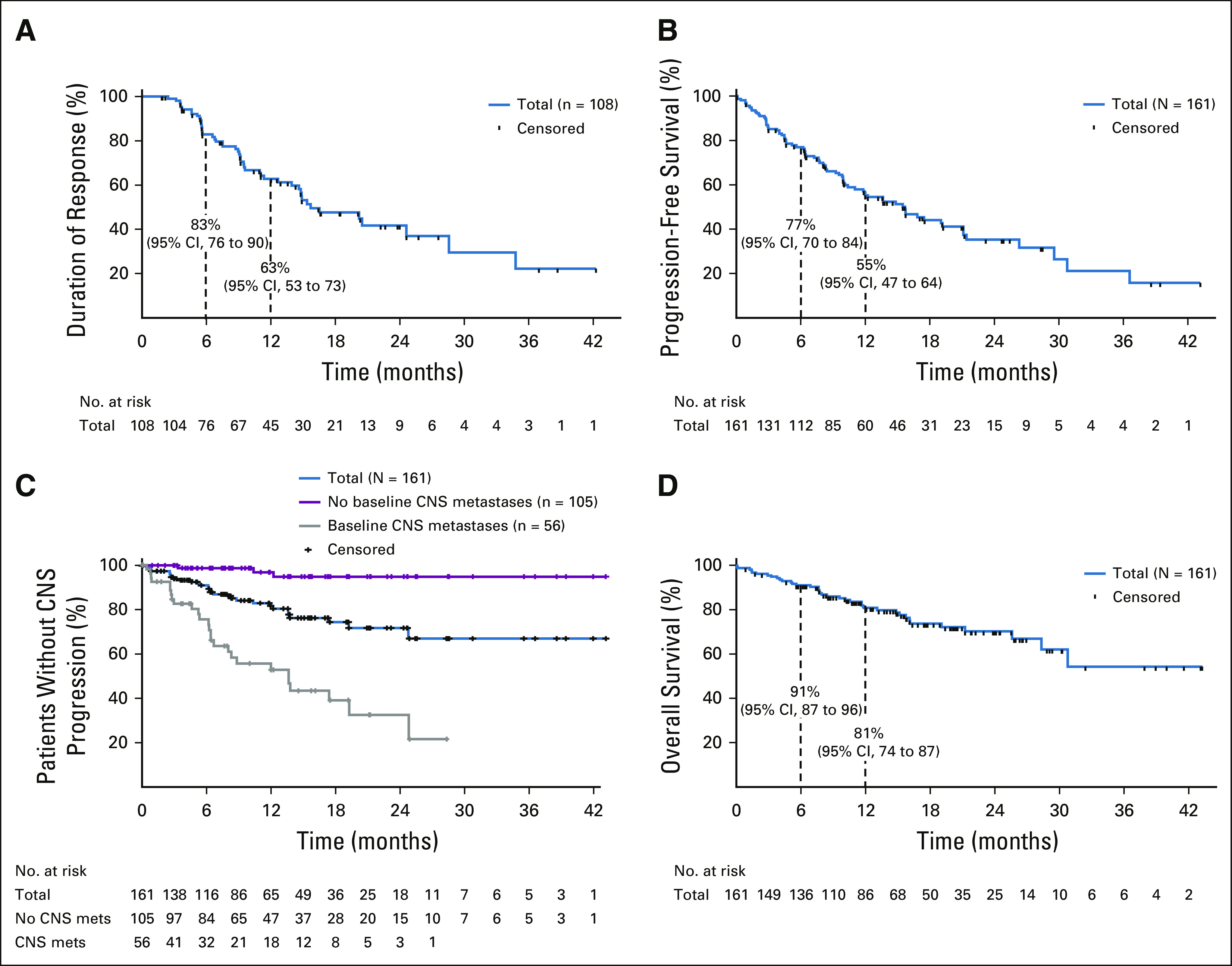
In total, 161 patients with a follow-up of ≥ 6 months were evaluable. The median treatment duration was 10.7 months (IQR, 6.4-17.7). The ORR was 67.1% (n = 108, 95% CI, 59.3 to 74.3), and responses were durable (12-month DoR rate, 63%, median DoR 15.7 months). The 12-month PFS rate was 55% (median PFS 15.7 months), and the 12-month OS rate was 81% (median OS not estimable). In 24 patients with measurable baseline CNS metastases by blinded independent central review, the intracranial ORR was 79.2% (n = 19; 95% CI, 57.9 to 92.9), the median intracranial PFS was 12.0 months (95% CI, 6.2 to 19.3), and the median intracranial DoR was 12.9 months (12-month rate, 55%). The safety profile in this updated analysis was similar to that reported in the primary analysis, and no new safety signals were found.
Entrectinib continued to demonstrate a high level of clinical benefit for patients with fusion-positive NSCLC, including patients with CNS metastases.
酪氨酸受体激酶ROS原癌基因1(ROS1)的基因重排是非小细胞肺癌(NSCLC)的致癌驱动因素。我们报告了ROS1酪氨酸激酶抑制剂恩曲替尼在三项I期或II期临床试验(ALKA-372-001、STARTRK-1和STARTRK-2)中对ROS1融合阳性NSCLC患者进行的最新综合分析结果。
疗效可评估人群包括患有局部晚期或转移性ROS1融合阳性NSCLC且有或无中枢神经系统转移的成年人,他们接受恩曲替尼口服,剂量≥600mg,每日一次。共同主要终点是由盲法独立中央审查评估的客观缓解率(ORR)和缓解持续时间(DoR)。次要终点包括无进展生存期(PFS)、总生存期(OS)、颅内ORR、颅内DoR、颅内PFS和安全性。
总共161例随访时间≥6个月的患者可进行评估。中位治疗持续时间为10.7个月(四分位间距,6.4 - 17.7)。ORR为67.1%(n = 108,95%CI,59.3至74.3),缓解持续时间长(12个月DoR率为63%,中位DoR为15.7个月)。12个月PFS率为55%(中位PFS为15.7个月),12个月OS率为81%(中位OS无法估计)。在24例经盲法独立中央审查有可测量的基线中枢神经系统转移的患者中,颅内ORR为79.2%(n = 19;95%CI,57.9至92.9),中位颅内PFS为12.0个月(95%CI,6.2至19.3),中位颅内DoR为12.9个月(12个月率为55%)。本次更新分析中的安全性概况与初步分析报告的相似,未发现新的安全信号。
恩曲替尼继续对ROS1融合阳性NSCLC患者,包括有中枢神经系统转移的患者,显示出高水平的临床获益。