Center for Patient Care and Outcomes Research, Medical College of Wisconsin, 8701 Watertown Plank Rd, Milwaukee, WI, 53226, USA.
Social Science Research Institute, Duke University, Box 90989, Durham, NC, 27708, USA.
Reprod Health. 2017 Sep 7;14(1):114. doi: 10.1186/s12978-017-0375-5.
Patient-centered care is a pillar of quality health care and is important to patients experiencing infertility. In this study we used empirical, in-depth data on couples' experiences of infertility treatment decision making to inform and revise a conceptual framework for patient-centered fertility treatment that was developed based on health care professionals' conceptualizations of fertility treatment, covering effectiveness, burden, safety, and costs.
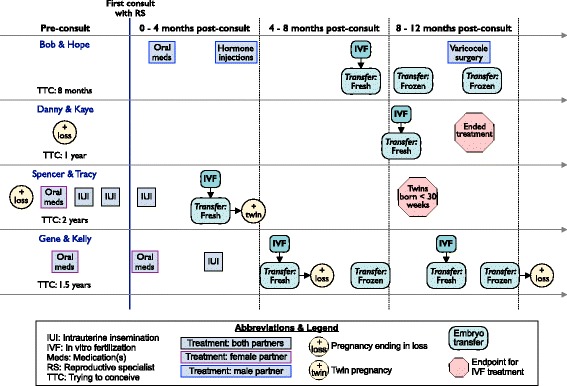
In this prospective, longitudinal mixed methods study, we collected data from both members (separately) of 37 couples who scheduled an initial consult with a reproductive specialist. Data collection occurred 1 week before the initial consultation, 1 week after the initial consultation, and then roughly 2, 4, 8, and 12 months later. Data collection included semi-structured qualitative interviews, self-reported questionnaires, and medical record review. Interviews were recorded, transcribed, and content analyzed in NVivo. A single coder analyzed all transcripts, with > 25% of transcripts coded by a second coder to ensure quality control and consistency.
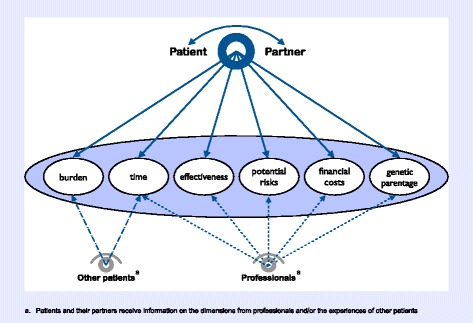
Content analysis of the interview transcripts revealed 6 treatment dimensions: effectiveness, physical and emotional burden, time, cost, potential risks, and genetic parentage. Thus, the revised framework for patient-centered fertility treatment retains much from the original framework, with modification to one dimension (from safety to potential risks) and the addition of two dimensions (time and genetic parentage). For patients and their partners making fertility treatment decisions, tradeoffs are explicitly considered across dimensions as opposed to each dimension being considered on its own.
Patient-centered fertility treatment should account for the dimensions of treatment that patients and their partners weigh when making decisions about how to add a child to their family. Based on the lived experiences of couples seeking specialist medical care for infertility, this revised conceptual framework can be used to inform patient-centered treatment and research on infertility and to develop decision support tools for patients and providers.
以患者为中心的护理是优质医疗保健的支柱,对于经历不孕不育的患者非常重要。在这项研究中,我们使用了关于夫妇在不孕不育治疗决策方面的经验、深入数据,来为一个基于医疗保健专业人员对生育治疗的概念化、涵盖有效性、负担、安全性和成本的生育治疗以患者为中心的概念框架提供信息并进行修订。
在这项前瞻性、纵向混合方法研究中,我们从预约生殖专家首次咨询的 37 对夫妇的双方成员(分别)中收集数据。数据收集在首次咨询前 1 周、首次咨询后 1 周进行,然后大约在 2、4、8 和 12 个月后进行。数据收集包括半结构化定性访谈、自我报告问卷和病历审查。访谈内容被记录下来,并在 NVivo 中进行了转录和内容分析。一名编码员分析了所有的转录本,另外有 25%以上的转录本由第二名编码员进行分析,以确保质量控制和一致性。
对访谈转录本的内容分析揭示了 6 个治疗维度:有效性、身体和情绪负担、时间、成本、潜在风险和遗传亲代。因此,以患者为中心的生育治疗的修订框架保留了许多原始框架的内容,一个维度(从安全性到潜在风险)进行了修改,并增加了两个维度(时间和遗传亲代)。对于正在做出生育治疗决策的患者及其伴侣来说,在不同维度之间明确考虑权衡,而不是单独考虑每个维度。
以患者为中心的生育治疗应该考虑到患者及其伴侣在决定如何为家庭增加孩子时权衡的治疗维度。基于寻求专家医疗护理的夫妇的生活经历,这个修订后的概念框架可用于为以患者为中心的不孕不育治疗和研究提供信息,并为患者和提供者开发决策支持工具。