
超重犬减肥计划的成效:一项国际减肥研究的结果
Success of a weight loss plan for overweight dogs: The results of an international weight loss study.
作者信息
Flanagan John, Bissot Thomas, Hours Marie-Anne, Moreno Bernabe, Feugier Alexandre, German Alexander J
机构信息
Royal Canin Research Center, Aimargues, France.
Institute of Ageing and Chronic Disease, University of Liverpool, Neston, Cheshire, United Kingdom.
出版信息
PLoS One. 2017 Sep 8;12(9):e0184199. doi: 10.1371/journal.pone.0184199. eCollection 2017.
INTRODUCTION
Obesity is a global concern in dogs with an increasing prevalence, and effective weight loss solutions are required that work in different geographical regions. The main objective was to conduct an international, multi-centre, weight loss trial to determine the efficacy of a dietary weight loss intervention in obese pet dogs.
METHODS
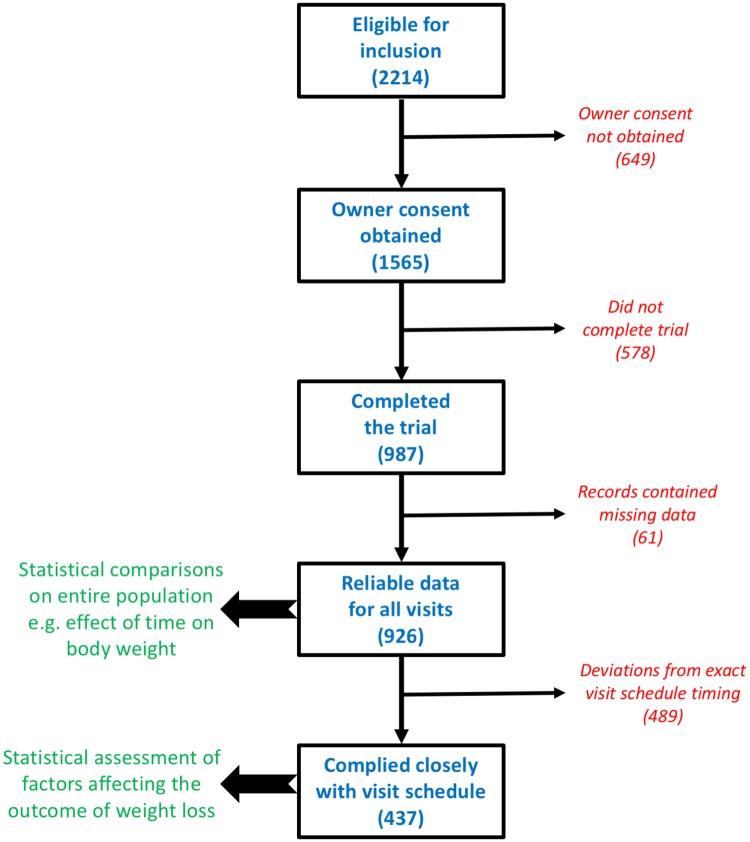
A 3-month prospective observational cohort study of weight loss in 926 overweight dogs was conducted at 340 veterinary practices in 27 countries. Commercially available dry or wet weight loss diets were used, with the initial energy allocation being 250-335 kJ/kg target body weight0.75/day (60-80 kcal/kg target body weight0.75/day) depending on sex and neuter status. The primary outcome measure was percentage weight loss; the main secondary outcomes were changes in activity, quality of life, and food-seeking behaviour, which were subjectively determined from owner descriptions.
RESULTS
At baseline, median (range) age was 74 (12 to 193) months and median body condition score was 8 (range 7-9). 896 of the 926 dogs (97%) lost weight, with mean weight loss being 11.4 ±5.84%. Sexually intact dogs lost more weight than neutered dogs (P = 0.001), whilst female dogs lost more weight than male dogs (P = 0.007), with the difference being more pronounced in North and South American dogs (median [Q1, Q3]: female: 11.5% [8.5%, 14.5%]; male: 9.1% [6.3%, 12.1%], P = 0.053) compared with those from Europe (female: 12.3% [8.9%, 14.9%]; male: 10.9% [8.6%, 15.4%]). Finally, subjective scores for activity (P<0.001) and quality of life (P<0.001) increased sequentially, whilst scores for food-seeking behaviour decreased sequentially (P<0.001) during the study.
CONCLUSION
This is the largest international multi-centre weight loss study conducted to date in obese dogs. Most dogs lost a clinically significant amount of weight, although there were notable differences between dogs of different sex, neuter status and in different geographical locations.
引言
肥胖是全球犬类面临的一个问题,其患病率不断上升,因此需要能在不同地理区域发挥作用的有效减肥方案。主要目的是开展一项国际多中心减肥试验,以确定饮食减肥干预对肥胖宠物犬的疗效。
方法
在27个国家的340家兽医诊所对926只超重犬进行了为期3个月的减肥前瞻性观察队列研究。使用市售的干型或湿型减肥日粮,根据性别和去势状态,初始能量分配为250 - 335千焦/千克目标体重^0.75/天(60 - 80千卡/千克目标体重^0.75/天)。主要结局指标是体重减轻百分比;主要次要结局是活动、生活质量和觅食行为的变化,这些是根据主人描述主观确定的。
结果
基线时,中位(范围)年龄为74(12至193)个月,中位身体状况评分为8(范围7 - 9)。926只犬中的896只(97%)体重减轻,平均体重减轻11.4±5.84%。未绝育犬比绝育犬体重减轻更多(P = 0.001),而雌性犬比雄性犬体重减轻更多(P = 0.007),与欧洲犬相比,这种差异在北美和南美犬中更为明显(中位[第一四分位数,第三四分位数]:雌性:11.5%[8.5%,14.5%];雄性:9.1%[6.3%,12. /天)。主要结局指标是体重减轻百分比;主要次要结局是活动、生活质量和觅食行为的变化,这些是根据主人描述主观确定的。
结果
基线时,中位(范围)年龄为74(12至193)个月,中位身体状况评分为8(范围月,中位身体状况评分为8(范围7 - 9)。926只犬中的896只(97%)体重减轻,平均体重减轻11.4±5.84%。未绝育犬比绝育犬体重减轻更多(P = 0.001),而雌性犬比雄性犬体重减轻更多(P = 0.007),与欧洲犬相比,这种差异在北美和南美犬中更为明显(中位[第一四分位数,第三四分位数]:雌性:11.5%[8.5%,14.5%];雄性:9.1%[6.3%,12.1%],P = 0.053)。最后,在研究期间,活动(P<0.001)和生活质量(P<0.001)的主观评分依次增加,而觅食行为评分依次降低(P<0.001)。
结论
这是迄今为止在肥胖犬中开展的最大规模的国际多中心减肥研究。大多数犬体重减轻了具有临床意义的量,尽管不同性别犬、去势状态不同的犬以及不同地理位置的犬之间存在显著差异。 1%],P = 0.053)。最后,在研究期间,活动(P<0.001)和生活质量(P<0.001)的主观评分依次增加,而觅食行为评分依次降低(P<0.001)。
结论
这是迄今为止在肥胖犬中开展的最大规模的国际多中心减肥研究。大多数犬体重减轻了具有临床意义的量,尽管不同性别犬、去势状态不同的犬以及不同地理位置的犬之间存在显著差异。



 Zotero 插件