DAILAB (DBT-AIST International Laboratory for Advanced Biomedicine), Bioinformatics Centre, Department of Microbiology, School of Life Sciences, Sikkim University, Gangtok, 737102, India.
National Centre for Microbial Resource, National Centre for Cell Science, Pune, 411021, India.
Sci Rep. 2017 Sep 8;7(1):10967. doi: 10.1038/s41598-017-11609-y.
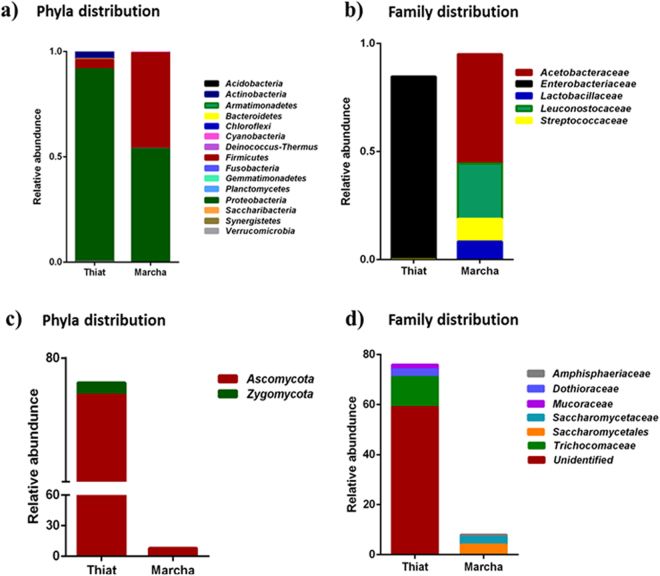
Marcha and thiat are traditionally prepared amylolytic starters use for production of various ethnic alcoholic beverages in Sikkim and Meghalaya states in India. In the present study we have tried to investigate the bacterial and fungal community composition of marcha and thiat by using high throughput sequencing. Characterization of bacterial community depicts phylum Proteobacteria is the most dominant in both marcha (91.4%) and thiat (53.8%), followed by Firmicutes, and Actinobacteria. Estimates of fungal community composition showed Ascomycota as the dominant phylum. Presence of Zygomycota in marcha distinguishes it from the thiat. The results of NGS analysis revealed dominance of yeasts in marcha whereas molds out numbers in case of thiat. This is the first report on microbial communities of traditionally prepared amylolytic starters of India using high throughput sequencing.
玛查和蒂亚特是传统的淀粉分解菌,用于印度锡金邦和梅加拉亚邦各种民族酒精饮料的生产。在本研究中,我们试图通过高通量测序来研究玛查和蒂亚特的细菌和真菌群落组成。细菌群落的特征描述表明,在玛查(91.4%)和蒂亚特(53.8%)中,变形菌门是最主要的门,其次是厚壁菌门和放线菌门。真菌群落组成的估计显示子囊菌门是主要的门。玛查中存在的接合菌门将其与蒂亚特区分开来。NGS 分析的结果表明,在玛查中酵母占优势,而在蒂亚特中霉菌占优势。这是使用高通量测序首次报道印度传统制备的淀粉分解菌的微生物群落。