Department of Psychology, University of Cambridge, Downing Street, Cambridge, CB2 3EB, UK.
Service de Psychiatrie et Addictologie, CHU de Martinique, Fort de France Cedex, France.
Eur J Neurosci. 2017 Nov;46(10):2620-2628. doi: 10.1111/ejn.13689. Epub 2017 Oct 6.
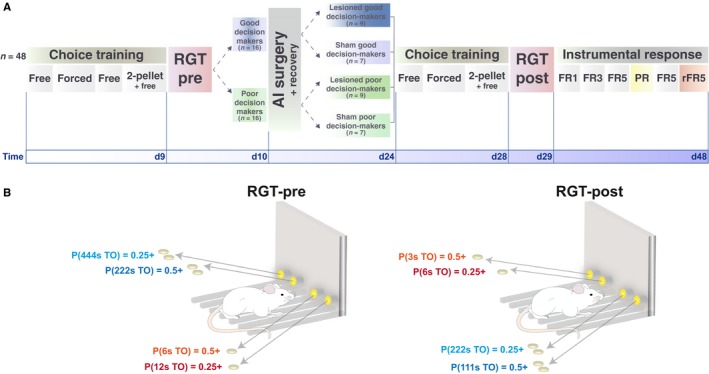
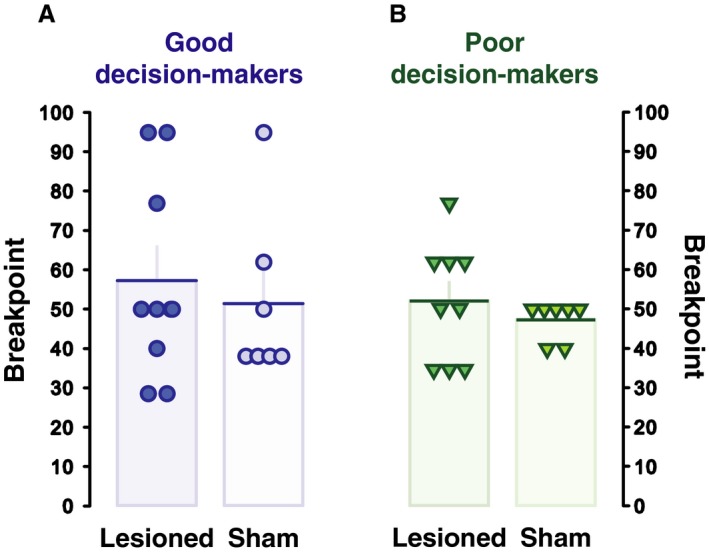
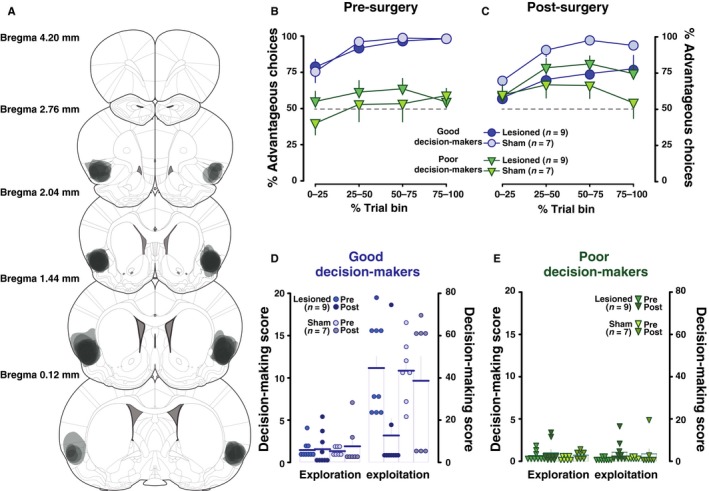
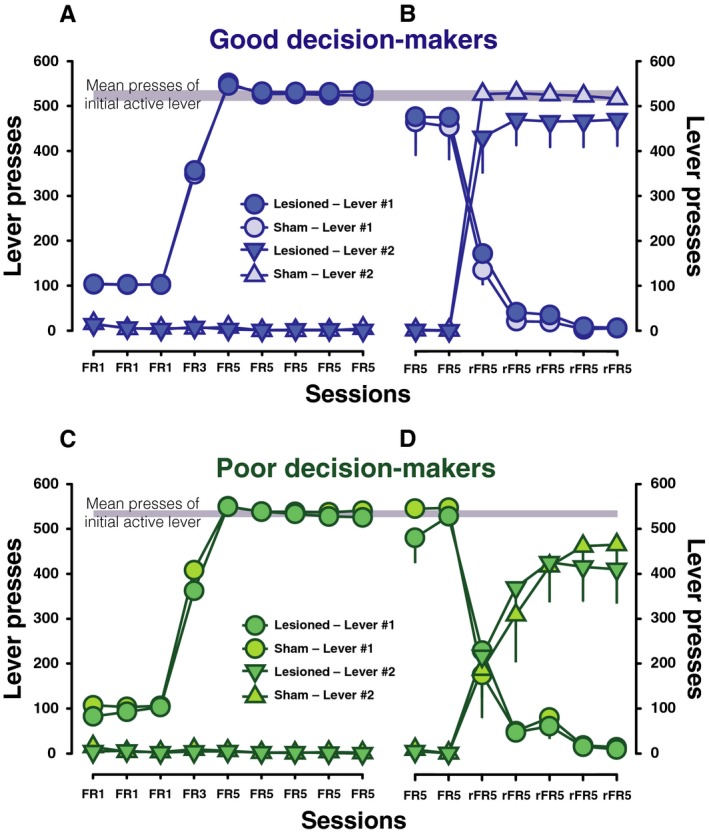
Deficits in cost-benefit decision-making, as assessed in the Iowa Gambling Task (IGT), are commonly observed in neuropsychiatric disorders such as addiction. There is considerable variation in the maximization of rewards on such tasks, both in the general population and in rodent models, suggesting individual differences in decision-making may represent a key endophenotype for vulnerability to neuropsychiatric disorders. Increasing evidence suggests that the insular cortex, which is involved in interoception and emotional processes in humans, may be a key neural locus in the control of decision-making processes. However, the extent to which the insula contributes to individual differences in cost-benefit decision-making remains unknown. Using male Sprague Dawley rats, we first assessed individual differences in the performance over the course of a single session on a rodent analogue of the IGT (rGT). Rats were matched for their ability to maximize reward and received bilateral excitotoxic or sham lesions of the anterior insula cortex (AIC). Animals were subsequently challenged on a second rGT session with altered contingencies. Finally, animals were also assessed for instrumental conditioning and reversal learning. AIC lesions produced bidirectional alterations on rGT performance; rats that had performed optimally prior to surgery subsequently showed impairments, and animals that had performed poorly showed improvements in comparison with sham-operated controls. These bidirectional effects were not attributable to alterations in behavioural flexibility or in motivation. These data suggest that the recruitment of the AIC during decision-making may be state-dependent and help guide response selection towards subjectively favourable options.
在成本效益决策方面的缺陷,如在爱荷华赌博任务(IGT)中所评估的,在神经精神疾病中很常见,如成瘾。在这种任务中,奖励的最大化存在相当大的差异,无论是在普通人群还是在啮齿动物模型中,这表明决策中的个体差异可能代表对神经精神疾病易感性的一个关键内表型。越来越多的证据表明,参与人类内脏感知和情绪过程的脑岛,可能是控制决策过程的关键神经位置。然而,脑岛在多大程度上导致成本效益决策的个体差异仍不清楚。使用雄性 Sprague Dawley 大鼠,我们首先在大鼠 IGT (rGT)的单次会话中评估了个体差异。根据其最大化奖励的能力对大鼠进行匹配,并接受双侧兴奋性毒性或假手术前脑岛皮层(AIC)损伤。随后,动物在第二个 rGT 会议上接受改变的条件作用挑战。最后,还对动物进行了工具性条件作用和反转学习评估。AIC 损伤对 rGT 表现产生了双向改变;术前表现最佳的大鼠随后表现出损伤,而表现较差的大鼠与假手术对照组相比表现出改善。这些双向作用不能归因于行为灵活性或动机的改变。这些数据表明,AIC 在决策过程中的招募可能是状态依赖性的,并有助于指导对主观有利选项的反应选择。