Department of Clinical Epidemiology, Institute of Cardiovascular Diseases, First Affiliated Hospital of China Medical University, Shenyang, Liaoning, China (mainland).
Med Sci Monit. 2017 Sep 11;23:4376-4381. doi: 10.12659/msm.906628.
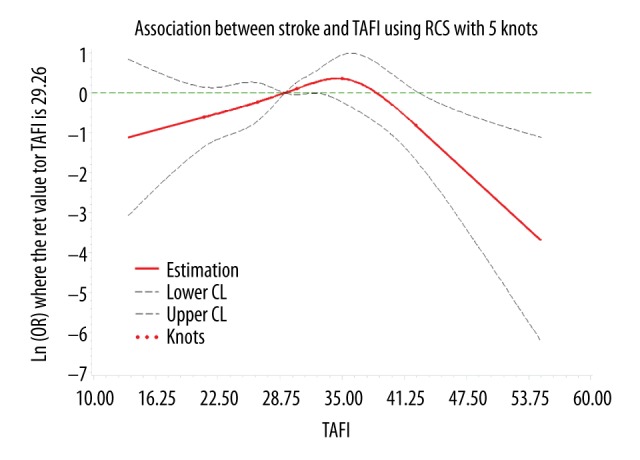
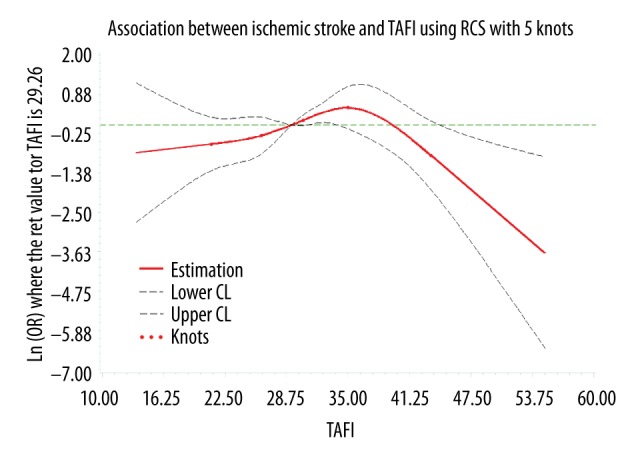
BACKGROUND Because TAFI (thrombin-activatable fibrinolysis inhibitor) antigen varies widely among different populations, we performed this case-control study to explore the relationship between TAFI levels and stroke in a Chinese population. MATERIAL AND METHODS Our population-based case-control study included 217 stroke patients and 218 healthy controls. The plasma TAFI level was measured by immune turbidimetry. Univariate and multivariate logistic regression analyses were used to analyze the association between different TAFI levels and stroke and its subtypes. Restricted cubic spline (RCS) combined with logistic regression analysis were used to explore the dose-response relationship between TAFI levels and stroke. RESULTS The plasma TAFI levels of cases were much higher than in the control group (p=0.038) and this difference persisted even after adjustment (OR=2.2). In the elderly (aged over 60) and female subgroups, TAFI levels in stroke patients were higher than those in controls, and the results were also noted in ischemic stroke. The dose-response curve showed that, as a whole, with the increase of TAFI levels, the relative risk of stroke first increased and then decreased (p=0.0127). Similarly, in general, with the increase of TAFI levels, the curve showed that the relative risk of ischemic stroke first increased and then decreased (p=0.0110). CONCLUSIONS There was a definite correlation between TAFI levels and stroke in this Chinese population, and with the increase of TAFI levels, the relative risk of stroke or ischemic stroke first increased and then decreased.
由于 TAFI(凝血酶激活的纤溶抑制物)抗原在不同人群中差异很大,我们进行了这项病例对照研究,以探讨中国人群中 TAFI 水平与中风之间的关系。
我们的基于人群的病例对照研究纳入了 217 例中风患者和 218 例健康对照者。采用免疫比浊法测定血浆 TAFI 水平。采用单变量和多变量逻辑回归分析来分析不同 TAFI 水平与中风及其亚型之间的关系。采用受限立方样条(RCS)结合逻辑回归分析来探讨 TAFI 水平与中风之间的剂量反应关系。
病例组的血浆 TAFI 水平明显高于对照组(p=0.038),且调整后仍存在差异(OR=2.2)。在老年(年龄>60 岁)和女性亚组中,中风患者的 TAFI 水平高于对照组,缺血性中风也有类似结果。剂量反应曲线显示,总体而言,随着 TAFI 水平的升高,中风的相对风险先增加后降低(p=0.0127)。同样,一般而言,随着 TAFI 水平的升高,曲线显示缺血性中风的相对风险先增加后降低(p=0.0110)。
在该中国人群中,TAFI 水平与中风之间存在明确的相关性,随着 TAFI 水平的升高,中风或缺血性中风的相对风险先增加后降低。