Wollesen B, Schulz S, Seydell L, Delbaere K
Human Movement Science, University of Hamburg, Mollerstr. 10, Turmweg, 20148, Hamburg, Germany.
Department of Health Science, Neuroscience Research Australia, University of New South Wales, Margarete Ainsworth Building, Barker Street, Randwick, Sydney, NSW, 2031, Australia.
BMC Geriatr. 2017 Sep 11;17(1):213. doi: 10.1186/s12877-017-0610-5.
Older adults with concerns of falling show decrements of gait stability under single (ST) and dual task (DT) conditions. To compare the effects of a DT training integrating task managing strategies for independent living older adults with and without concern about falling (CoF) to a non-training control group on walking performance under ST and DT conditions.
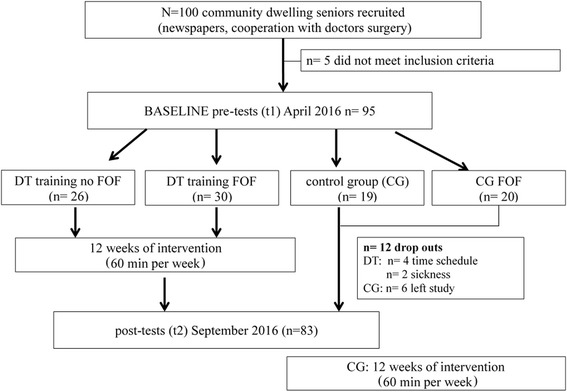
Single center parallel group single blind randomized controlled trial with group-based interventions (DT-managing balance training) compared to a control group (Ninety-five independent living older adults; 71.5 ± 5.2 years). A progressive DT training (12 sessions; 60 min each; 12 weeks) including task-managing strategies was compared to a non-training control group.
group based intervention for independent living elderly in a gym. ST and DT walking (visual verbal Stroop task) were measured on a treadmill. Gait parameters (step length, step width, and gait line) and cognitive performance while walking were compared with a 2x2x2 Repeated Measures Analyses of Variance.
Participants in the intervention group showed an increased step length under ST and DT conditions following the intervention, for both people with and without CoF compared to their respective control groups. Foot rolling movement and cognitive performance while walking however only improved in participants without CoF.
The results showed that DT managing training can improve walking performance under ST and DT conditions in people with and without CoF. Additional treatment to directly address CoF, such as cognitive behavioural therapy, should be considered to further improve the cautious gait pattern (as evidenced by reduced foot rolling movements).
The study was retrospectively registered in the German Clinical Trials Register (DRKS; Identification number DRKS00012382 , 11.05.2017).
担心跌倒的老年人在单任务(ST)和双任务(DT)条件下步态稳定性会下降。为了比较针对有和没有跌倒担忧(CoF)的独立生活老年人的双任务训练(整合任务管理策略)与非训练对照组在ST和DT条件下对步行性能的影响。
单中心平行组单盲随机对照试验,采用基于组的干预措施(双任务管理平衡训练)与对照组进行比较(95名独立生活的老年人;71.5±5.2岁)。将包括任务管理策略的渐进性双任务训练(12节课程;每节60分钟;12周)与非训练对照组进行比较。
在健身房对独立生活的老年人进行基于组的干预。在跑步机上测量ST和DT步行(视觉言语斯特鲁普任务)。使用2×2×2重复测量方差分析比较步态参数(步长、步宽和步态线)以及步行时的认知表现。
干预组的参与者在干预后,无论有无CoF,在ST和DT条件下的步长均增加,与各自的对照组相比。然而,只有没有CoF的参与者在步行时的足部滚动运动和认知表现有所改善。
结果表明,双任务管理训练可以改善有和没有CoF的人在ST和DT条件下的步行性能。应考虑采用额外的治疗方法直接解决CoF问题,如认知行为疗法,以进一步改善谨慎的步态模式(足部滚动运动减少证明)。
该研究已在德国临床试验注册中心(DRKS;识别号DRKS00012382,2017年5月11日)进行回顾性注册。