Khan Mohammad Jobair, Fong Kenneth N K, Wong Thomson Wai-Lung, Tsang William Wai-Nam, Chen Cynthia Huijun, Chan Wai-Chi, Winser Stanley
Rehabilitation Sciences, The Hong Kong Polytechnic University, Hong Kong, China
Rehabilitation Sciences, The Hong Kong Polytechnic University, Hong Kong, China.
BMJ Open. 2025 Jun 24;15(6):e089915. doi: 10.1136/bmjopen-2024-089915.
Falls are common causes of disability, reduced disability-adjusted life years and death in older adults. Balance deficits and cognitive impairment are common causes of falls. Dual-task training is a new strategy that can potentially improve balance and cognitive function, leading to decreased falls. The effectiveness and cost-effectiveness of self-administered dual-task (sDT) training to improve balance and prevent falls is not known. We developed sDT training combining physical and cognitive tasks to improve balance and reduce falls. The proposed randomised controlled trial (RCT) with economic evaluation is to test the effectiveness and cost-effectiveness of the sDT compared with self-administered single-task training (sST) in this population.
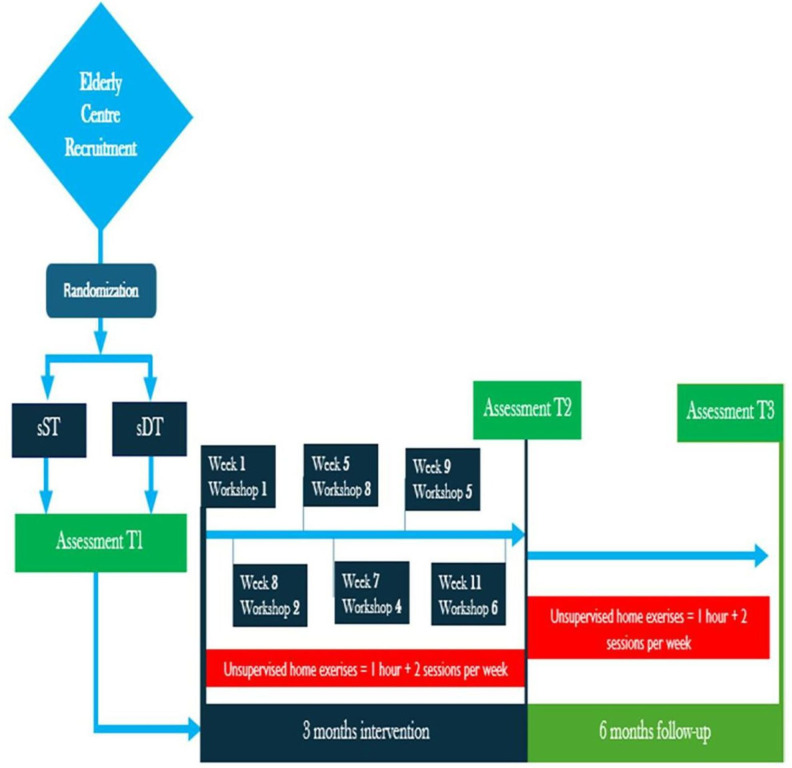
In this RCT, we will recruit 190 community-dwelling older adults with a history of at least one fall over the last 6 months from 11 elderly centres. The older adults will be randomly assigned to the sDT (n=95) and sST groups (n=95). Each group will be offered in six training workshops to teach the participants either sDT or sST depending on the group allocation. Each workshop will last an hour and will be held once every 2 weeks for 3 months. Besides, the participants will be instructed to repeat the exercises at home two times weekly for 3 months. Following the intervention phase, the participants will continue unsupervised home-based exercises for 6 months. Assessments will be performed before, after and 6 months after completing the intervention. A fall calendar and cost diary will be provided to each older adult to record the number of falls and fall-related costs during and after the intervention to assess fall incidence and cost-effectiveness. Effectiveness will be assessed using a negative binomial regression model following the intention-to-treat principle for falls and a linear mixed model for the additional measure and cost-effectiveness using a Markov model.
This study has ethical approval from the PolyU Institutional Review Board for conducting research on human subjects (Ref: HSEARS20210322005). The results will be disseminated through seminars for individuals and health practitioners, international conferences and published in peer-reviewed journals.
NCT05533333.
跌倒在老年人中是导致残疾、残疾调整生命年减少和死亡的常见原因。平衡能力不足和认知障碍是跌倒的常见原因。双重任务训练是一种新策略,有可能改善平衡和认知功能,从而减少跌倒。自我管理的双重任务(sDT)训练对改善平衡和预防跌倒的有效性及成本效益尚不清楚。我们开发了结合身体和认知任务的sDT训练,以改善平衡并减少跌倒。拟进行的带有经济评估的随机对照试验(RCT)旨在测试sDT与自我管理的单一任务训练(sST)相比在该人群中的有效性和成本效益。
在这项RCT中,我们将从11个老年中心招募190名过去6个月内至少有过一次跌倒史的社区居住老年人。这些老年人将被随机分配到sDT组(n = 95)和sST组(n = 95)。根据分组情况,每组将参加六个训练工作坊,向参与者教授sDT或sST。每个工作坊持续一小时,每2周举行一次,为期3个月。此外,将指导参与者在3个月内每周在家重复练习两次。在干预阶段之后,参与者将继续进行6个月的无监督居家锻炼。评估将在干预前、干预后以及完成干预6个月后进行。将为每位老年人提供一份跌倒日历和成本日记,以记录干预期间及之后的跌倒次数和与跌倒相关的成本,以评估跌倒发生率和成本效益。将按照意向性分析原则,使用负二项回归模型评估跌倒的有效性,使用线性混合模型评估额外测量指标的有效性,并使用马尔可夫模型评估成本效益。
本研究已获得理大机构审查委员会对人体研究的伦理批准(参考号:HSEARS20210322005)。研究结果将通过面向个人和健康从业者的研讨会、国际会议进行传播,并发表在同行评审期刊上。
NCT05533333。