Department of Zoology and Wildlife Conservation, College of Natural and Applied Sciences, University of Dar-es-salaam, P.O.Box 35165, Dar-es-salaam, Tanzania.
Public Health Strategic Partnerships Associate, Arysta Life Science, 12 Denys Road, River Club, 2191, South Africa.
Malar J. 2017 Sep 11;16(1):364. doi: 10.1186/s12936-017-2022-6.
Insecticide resistance is the major emerging challenge facing the malaria vector control programmes in Tanzania. Proper monitoring and detection is of paramount importance guiding the vector control programmes. This paper presents the effect of mosquito aging on insecticide resistance status in Anopheles arabiensis populations in dry and rainy seasons in northern Tanzania.
Anopheles gambiae s.l. larvae were sampled from rice fields in both dry and rainy seasons and reared in the insectary to adults. The emerged females in batches of 2, 3, 5, and 10 days old were exposed to six insecticides (deltamethrin, permethrin, lambda-cyhalothrin, DDT, bendiocarb and pirimiphos-methyl) to see the effects of age on insecticide resistance. Mosquitoes were exposed to insecticides using WHO standard susceptibility test kits. Knockdown was recorded during the 1-h exposure, while mortality and resistance ratio were recorded 24 h later. Mosquito specimens were identified to species level using the polymerase chain reaction (PCR) method.
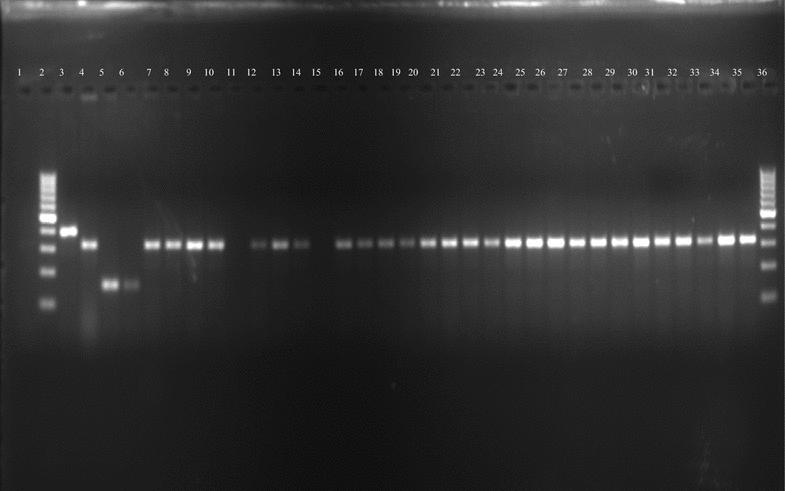
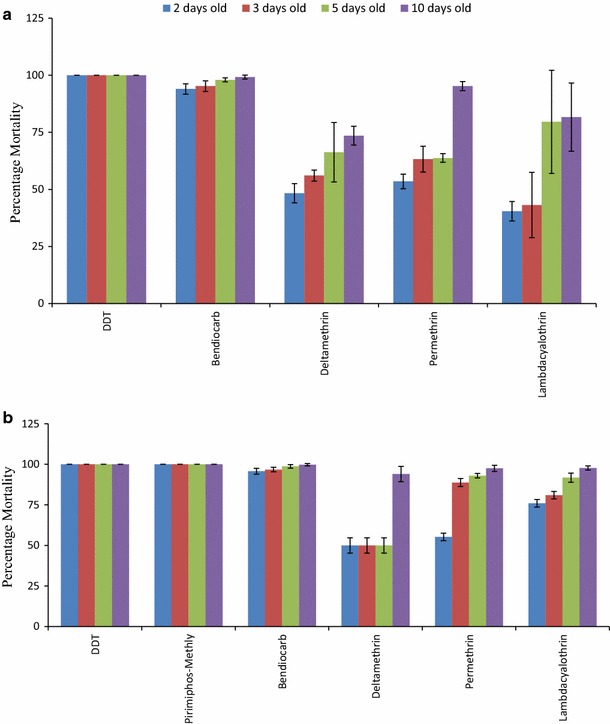
Among the 326 specimens processed by PCR, 323 (99.1%) were identified as Anopheles arabiensis. There was reduced mortality (ranging from 61 to 97.7%) when adults reared from larvae were exposed to all pyrethroids and bendiocarb in both dry and rainy seasons, while they were fully susceptible to DDT and pirimiphos-methyl. There was a significant increase in mortality rate with increase in mosquito's age in both dry and rainy seasons following exposure to pyrethroids (DF = 1, P < 0.05). Mosquitoes showed significantly higher mortality rates in the rainy season than in the dry season after being exposed to pyrethroids (DF = 1, P < 0.05). Higher mortality rates (94.0-99.8%) were observed in all ages and seasons when mosquitoes were exposed to bendiocarb compared with pyrethroids. Pirimiphos-methyl was only tested in the rainy season so no comparison with dry season mosquitoes could be made.
Results showed that An. arabiensis were resistant to pyrethroids in both seasons and that the young age groups exhibited higher levels of resistance compared with the older age groups. Mosquitoes were full susceptible to DDT and pirimiphos-methyl irrespective of the season and age.
杀虫剂耐药性是坦桑尼亚疟疾媒介控制项目面临的主要新挑战。适当的监测和检测对于指导媒介控制项目至关重要。本文介绍了在坦桑尼亚北部旱季和雨季,蚊虫老化对阿拉伯按蚊种群杀虫剂耐药状况的影响。
从旱季和雨季的稻田中采集冈比亚按蚊幼虫,并在昆虫饲养室中饲养至成虫。将新羽化的 2、3、5 和 10 天龄的雌性分批次暴露于 6 种杀虫剂(溴氰菊酯、氯菊酯、高效氯氟氰菊酯、滴滴涕、丁醚脲和吡虫啉),以观察年龄对杀虫剂耐药性的影响。使用世界卫生组织标准敏感性测试试剂盒对蚊子进行杀虫剂暴露。在 1 小时暴露期间记录击倒情况,24 小时后记录死亡率和抗性比值。使用聚合酶链反应(PCR)方法将蚊子标本鉴定到种水平。
通过 PCR 处理的 326 个标本中,323 个(99.1%)鉴定为阿拉伯按蚊。在旱季和雨季,从幼虫中饲养的成虫暴露于所有拟除虫菊酯和丁醚脲时,死亡率均降低(范围为 61%至 97.7%),而对滴滴涕和吡虫啉完全敏感。在旱季和雨季,随着蚊虫年龄的增加,暴露于拟除虫菊酯后死亡率显著增加(DF=1,P<0.05)。在旱季和雨季,与暴露于拟除虫菊酯相比,暴露于丁醚脲后,蚊子的死亡率明显更高(DF=1,P<0.05)。与拟除虫菊酯相比,在所有年龄组和季节中,当蚊子暴露于丁醚脲时,死亡率(94.0%-99.8%)更高。吡虫啉仅在雨季进行了测试,因此无法与旱季的蚊子进行比较。
结果表明,阿拉伯按蚊在两个季节均对拟除虫菊酯产生耐药性,且年轻的年龄组比年老的年龄组表现出更高的耐药水平。无论季节和年龄如何,蚊子对滴滴涕和吡虫啉均完全敏感。