Chiu David Kung-Chun, Tse Aki Pui-Wah, Xu Iris Ming-Jing, Di Cui Jane, Lai Robin Kit-Ho, Li Lynna Lan, Koh Hui-Yu, Tsang Felice Ho-Ching, Wei Larry Lai, Wong Chun-Ming, Ng Irene Oi-Lin, Wong Carmen Chak-Lui
Department of Pathology, The University of Hong Kong, Hong Kong, Hong Kong.
State Key Laboratory for Liver Research, The University of Hong Kong, Hong Kong, Hong Kong.
Nat Commun. 2017 Sep 11;8(1):517. doi: 10.1038/s41467-017-00530-7.
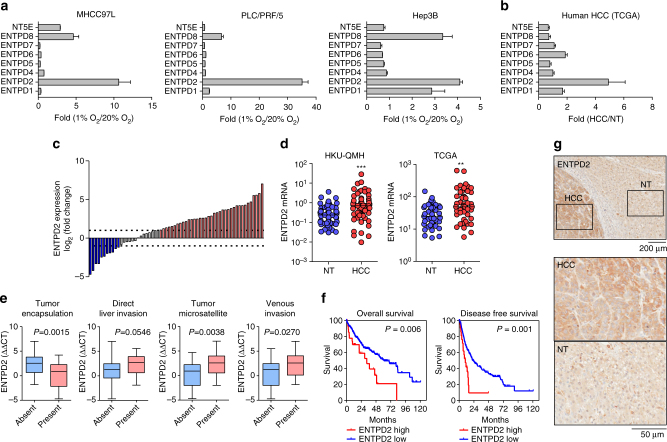
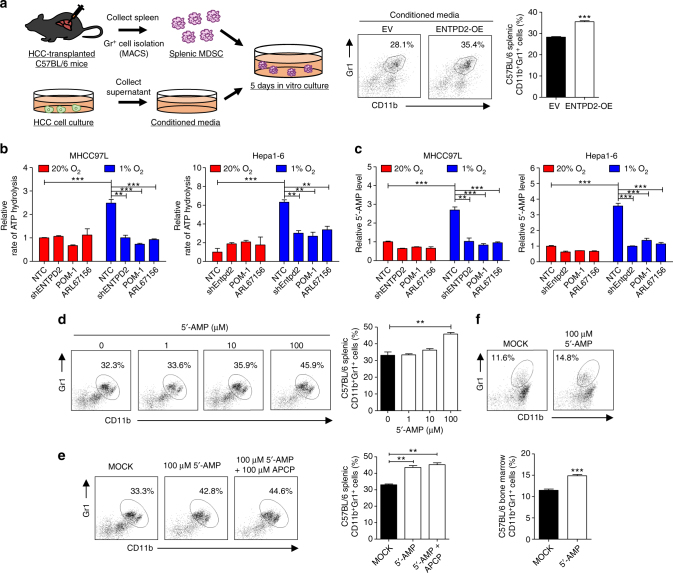
Myeloid-derived suppressor cells (MDSCs) possess immunosuppressive activities, which allow cancers to escape immune surveillance and become non-responsive to immune checkpoints blockade. Here we report hypoxia as a cause of MDSC accumulation. Using hepatocellular carcinoma (HCC) as a cancer model, we show that hypoxia, through stabilization of hypoxia-inducible factor-1 (HIF-1), induces ectoenzyme, ectonucleoside triphosphate diphosphohydrolase 2 (ENTPD2/CD39L1), in cancer cells, causing its overexpression in HCC clinical specimens. Overexpression of ENTPD2 is found as a poor prognostic indicator for HCC. Mechanistically, we demonstrate that ENTPD2 converts extracellular ATP to 5'-AMP, which prevents the differentiation of MDSCs and therefore promotes the maintenance of MDSCs. We further find that ENTPD2 inhibition is able to mitigate cancer growth and enhance the efficiency and efficacy of immune checkpoint inhibitors. Our data suggest that ENTPD2 may be a good prognostic marker and therapeutic target for cancer patients, especially those receiving immune therapy.Myeloid-derived suppressor cells (MDSCs) promote tumor immune escape. Here, the authors show that in hepatocellular carcinoma, hypoxia induces the expression of ENTPD2 on cancer cells leading to elevated extracellular 5'-AMP, which in turn promote the maintenance of MDSCs by preventing their differentiation.
髓源性抑制细胞(MDSCs)具有免疫抑制活性,这使得癌症能够逃避免疫监视并对免疫检查点阻断无反应。在此,我们报告缺氧是MDSC积累的一个原因。以肝细胞癌(HCC)作为癌症模型,我们发现缺氧通过稳定缺氧诱导因子-1(HIF-1),诱导癌细胞中的胞外酶——胞外核苷三磷酸二磷酸水解酶2(ENTPD2/CD39L1),导致其在HCC临床标本中过度表达。ENTPD2的过度表达被发现是HCC的一个不良预后指标。从机制上讲,我们证明ENTPD2将细胞外ATP转化为5'-AMP,这阻止了MDSCs的分化,因此促进了MDSCs的维持。我们进一步发现,抑制ENTPD2能够减轻癌症生长,并提高免疫检查点抑制剂的效率和疗效。我们的数据表明,ENTPD2可能是癌症患者,尤其是接受免疫治疗的患者的一个良好预后标志物和治疗靶点。髓源性抑制细胞(MDSCs)促进肿瘤免疫逃逸。在此,作者表明,在肝细胞癌中,缺氧诱导癌细胞上ENTPD2的表达,导致细胞外5'-AMP升高,进而通过阻止MDSCs的分化促进其维持。