Draghiciu Oana, Lubbers Joyce, Nijman Hans W, Daemen Toos
Department of Medical Microbiology; Tumor Virology and Cancer Immunotherapy; University of Groningen; University Medical Center Groningen ; Groningen, The Netherlands.
Department of Gynecology; University of Groningen; University Medical Center Groningen ; Groningen, The Netherlands.
Oncoimmunology. 2015 Feb 3;4(1):e954829. doi: 10.4161/21624011.2014.954829. eCollection 2015 Jan.
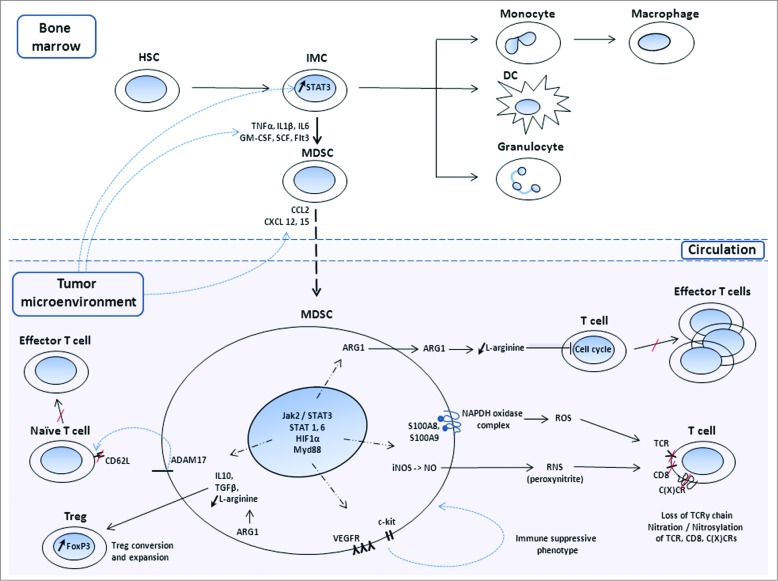
Myeloid-derived suppressor cells (MDSCs) contribute to tumor-mediated immune escape and negatively correlate with overall survival of cancer patients. Nowadays, a variety of methods to target MDSCs are being investigated. Based on the intervention stage of MDSCs, namely development, expansion and activation, function and turnover, these methods can be divided into: (I) prevention or differentiation to mature cells, (II) blockade of MDSC expansion and activation, (III) inhibition of MDSC suppressive activity or (IV) depletion of intratumoral MDSCs. This review describes effective mono- or multimodal-therapies that target MDSCs for the benefit of cancer treatment.
髓源性抑制细胞(MDSCs)促成肿瘤介导的免疫逃逸,且与癌症患者的总生存期呈负相关。如今,多种靶向MDSCs的方法正在研究中。基于MDSCs的干预阶段,即发育、扩增与激活、功能及更新,这些方法可分为:(I)预防或分化为成熟细胞,(II)阻断MDSC的扩增与激活,(III)抑制MDSC的抑制活性,或(IV)清除肿瘤内的MDSCs。本综述描述了为癌症治疗之益而靶向MDSCs的有效单药或多模式疗法。