Harris Michael S, Capretta Natalie R, Henning Shirley C, Feeney Laura, Pitt Mark A, Moberly Aaron C
Department of Otolaryngology-Head and Neck Surgery The Ohio State University Wexner Medical Center Columbus Ohio.
DeVault Otologic Research Laboratory Indiana University School of Medicine Indianapolis Indiana U.S.A.
Laryngoscope Investig Otolaryngol. 2016 Jun 6;1(3):42-48. doi: 10.1002/lio2.20. eCollection 2016 Jun.
OBJECTIVES/HYPOTHESIS: Aural rehabilitation is not standardized for adults after cochlear implantation. Most cochlear implant (CI) centers in the United States do not routinely enroll adult CI users in focused postoperative rehabilitation programs due to poor reimbursement and lack of data supporting (or refuting) the efficacy of any one specific approach. Consequently, patients generally assume a self-driven approach toward rehabilitation. This exploratory pilot study examined rehabilitation strategies pursued by adults with CIs and associated these strategies with speech recognition and CI-specific quality of life (QOL).
Cross-sectional study of 23 postlingually deafened adults with CIs.
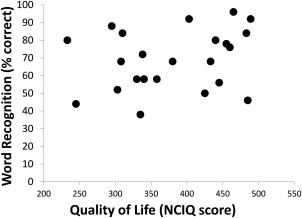
Participants responded to an open-ended questionnaire regarding rehabilitation strategies. A subset underwent in-depth interviews. Thematic content analysis was applied to the questionnaires and interview transcripts. Participants also underwent word recognition testing and completed a CI-related QOL measure. Participants were classified as having good or poor performance (upper or lower quartile for speech recognition) and high or low QOL (upper or lower quartile for QOL). Rehabilitation themes were compared and contrasted among groups.
Five rehabilitation themes were identified: 1) Preimplant expectations of postoperative performance, 2) personal motivation, 3) social support, 4) specific rehabilitation strategies, and 5) patient-perceived role of the audiologist. Patients with good speech recognition and high QOL tended to pursue more active rehabilitation and had greater social support. Patient expectations and motivation played significant roles in postoperative QOL.
Postoperative patient-driven rehabilitation strategies are highly variable but appear to relate to outcomes. Larger-scale extensions of this pilot study are needed.
目的/假设:人工耳蜗植入术后成人的听觉康复尚未标准化。由于报销不佳以及缺乏支持(或反驳)任何一种特定方法有效性的数据,美国大多数人工耳蜗(CI)中心通常不会让成年CI使用者常规参加有针对性的术后康复项目。因此,患者通常采取自我驱动的康复方法。这项探索性试点研究调查了成年CI使用者所采用的康复策略,并将这些策略与语音识别以及CI特定的生活质量(QOL)相关联。
对23名语后聋成年CI使用者进行横断面研究。
参与者回答了一份关于康复策略的开放式问卷。一部分参与者接受了深入访谈。对问卷和访谈记录进行了主题内容分析。参与者还接受了单词识别测试,并完成了一项与CI相关的生活质量测量。参与者被分类为表现良好或不佳(语音识别的上四分位数或下四分位数)以及生活质量高或低(生活质量的上四分位数或下四分位数)。对各组之间的康复主题进行了比较和对比。
确定了五个康复主题:1)植入前对术后表现的期望,2)个人动机,3)社会支持,4)特定的康复策略,以及5)患者对听力学家角色的认知。语音识别良好且生活质量高的患者倾向于采取更积极的康复措施,并且有更大的社会支持。患者的期望和动机在术后生活质量中起着重要作用。
术后患者驱动的康复策略差异很大,但似乎与结果相关。需要对这项试点研究进行更大规模的扩展。