Kashiwagi Tomoko, Okada Yukiko, Nomoto Ken
AbbVie GK, Mita 3-5-27, Minato-ku, Tokyo, 108-6302, Japan.
Paediatr Drugs. 2018 Feb;20(1):97-104. doi: 10.1007/s40272-017-0264-y.
The aim of this study was to assess the safety and effectiveness of palivizumab for the prevention of lower respiratory tract infection (LRI) caused by respiratory syncytial virus (RSV) in children with immunocompromised conditions or Down syndrome.
In this multicenter, post-marketing surveillance study (December 2013 to December 2015), children aged ≤24 months with immunocompromised conditions or Down syndrome (without hemodynamically significant congenital heart disease) receiving palivizumab immunoprophylaxis during two RSV seasons were observed until 30 days after the final palivizumab injection. Safety [adverse events (AEs), serious AEs (SAEs), adverse drug reactions (ADRs), serious ADRs (SADRs)] and effectiveness (frequency, incidence, and duration of hospitalization due to RSV infections) were assessed.
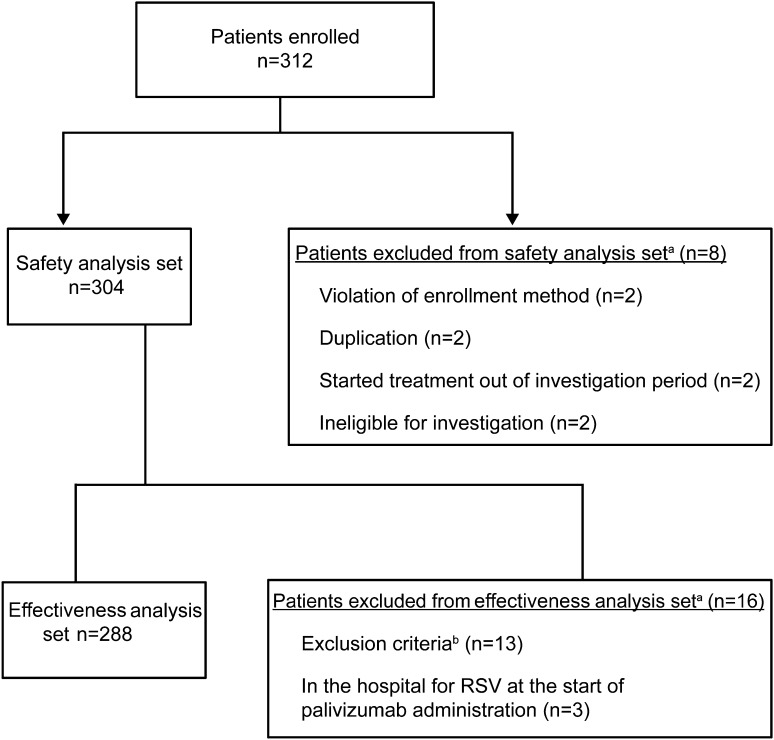
Of 304 patients receiving palivizumab, 167 (54.9%) had immunocompromised conditions, and 138 (45.4%) had Down syndrome; 260 (85.5%) completed palivizumab immunoprophylaxis. The annual mean (±standard deviation) number of doses was 5.3 (±2.4) per season. Overall, 220 AEs occurred in 99 patients (32.6%), including 89 SAEs in 53 patients (17.4%). Of these, 33 AEs in 25 patients (8.22%) were considered ADRs, and 13 ADRs in 11 patients (3.62%) were considered SADRs. In four patients, five SADRs (nephroblastoma and asthma in the same patient, septic shock, device-related infection, and drug-induced liver injury) were previously unreported; however, none were considered drug-related. During the observation period, five RSV infections occurred and two patients required hospitalization.
Palivizumab was generally safe and effective for the prevention of LRI caused by RSV in newborns, infants, and children with immunocompromised conditions or Down syndrome up to the age of 24 months.
本研究旨在评估帕利珠单抗预防免疫功能低下或患有唐氏综合征的儿童因呼吸道合胞病毒(RSV)引起的下呼吸道感染(LRI)的安全性和有效性。
在这项多中心上市后监测研究(2013年12月至2015年12月)中,观察年龄≤24个月、免疫功能低下或患有唐氏综合征(无血流动力学显著先天性心脏病)且在两个RSV流行季节接受帕利珠单抗免疫预防的儿童,直至最后一次注射帕利珠单抗后30天。评估安全性[不良事件(AE)、严重不良事件(SAE)、药物不良反应(ADR)、严重药物不良反应(SADR)]和有效性(RSV感染导致的住院频率、发生率和持续时间)。
在接受帕利珠单抗治疗的304例患者中,167例(54.9%)免疫功能低下,138例(45.4%)患有唐氏综合征;260例(85.5%)完成了帕利珠单抗免疫预防。每个季节的年平均(±标准差)剂量数为5.3(±2.4)。总体而言,99例患者(32.6%)发生了220次AE,其中53例患者(17.4%)发生了89次SAE。其中,25例患者(8.22%)发生的33次AE被视为ADR,11例患者(3.62%)发生的13次ADR被视为SADR。在4例患者中,有5次SADR(同一患者发生肾母细胞瘤和哮喘、感染性休克、器械相关感染和药物性肝损伤)此前未报告;然而,均不认为与药物有关。在观察期内,发生了5次RSV感染,2例患者需要住院治疗。
帕利珠单抗对于预防新生儿、婴儿以及24个月以下免疫功能低下或患有唐氏综合征的儿童因RSV引起的LRI总体上是安全有效的。