Department of Medicine, University Medical Centre Hamburg-Eppendorf, 20246 Hamburg, Germany.
Int J Mol Sci. 2017 Sep 12;18(9):1954. doi: 10.3390/ijms18091954.
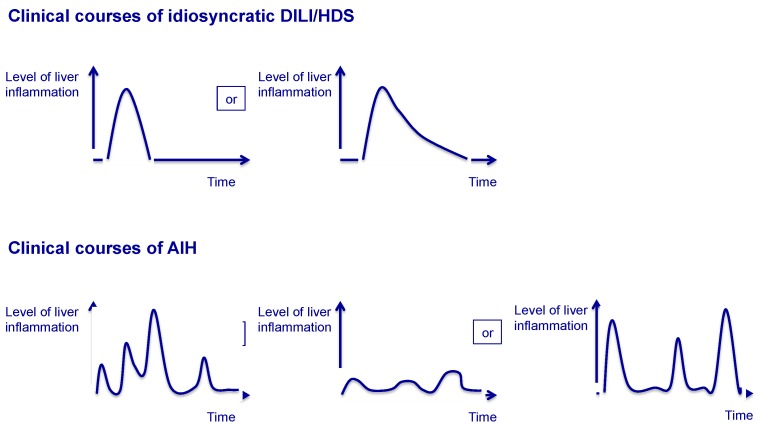
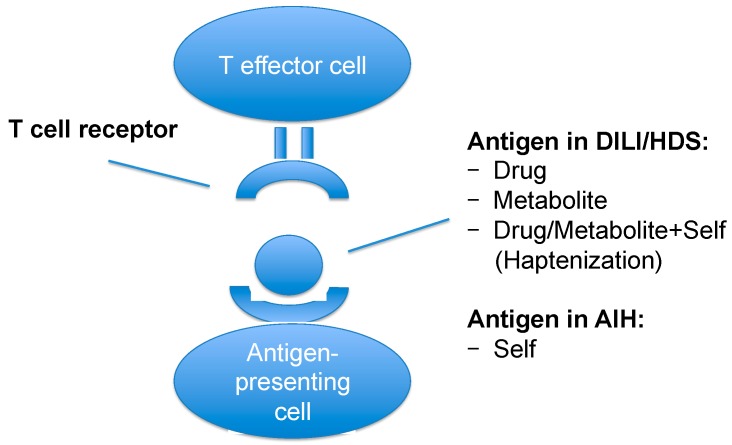
Idiosyncratic drug-induced liver injury (DILI) and hepatic injury due to herbal and dietary supplements (HDS) can adapt clinical characteristics of autoimmune hepatitis (AIH), such as the appearance of autoantibodies and infiltration of the liver by immune competent cells. To describe these cases of DILI/HDS, the poorly-defined term "autoimmune(-like)" DILI/HDS came up. It is uncertain if these cases represent a subgroup of DILI/HDS with distinct pathomechanistic and prognostic features different from "classical" DILI/HDS. Besides, due to the overlap of clinical characteristics of "immune-mediated" DILI/HDS and AIH, both entities are not easy to differentiate. However, the demarcation is important, especially with regard to treatment: AIH requires long-term, mostly lifelong immunosuppression, whereas DILI/HDS does not. Only through exact diagnostic evaluation, exclusion of differential diagnoses and prolonged follow-up can the correct diagnosis reliably be made. Molecular mechanisms have not been analysed for the subgroup of "autoimmune(-like)" DILI/HDS yet. However, several pathogenetic checkpoints of DILI/HDS in general and AIH are shared. An analysis of these shared mechanisms might hint at relevant molecular processes of "autoimmune(-like)" DILI/HDS.
特发性药物性肝损伤 (DILI) 和草药及膳食补充剂 (HDS) 引起的肝损伤可能具有自身免疫性肝炎 (AIH) 的临床特征,例如自身抗体的出现和免疫活性细胞浸润肝脏。为了描述这些 DILI/HDS 病例,出现了定义不明确的术语“自身免疫 (样) ”DILI/HDS。这些病例是否代表具有与“经典”DILI/HDS 不同的独特发病机制和预后特征的 DILI/HDS 亚组尚不确定。此外,由于“免疫介导”DILI/HDS 和 AIH 的临床特征重叠,两者不易区分。然而,区分很重要,尤其是在治疗方面:AIH 需要长期、通常是终身的免疫抑制治疗,而 DILI/HDS 则不需要。只有通过准确的诊断评估、排除鉴别诊断和长期随访,才能可靠地做出正确的诊断。对于“自身免疫 (样) ”DILI/HDS 亚组,尚未分析其分子机制。然而,DILI/HDS 一般和 AIH 的几个发病机制检查点是共有的。对这些共同机制的分析可能暗示了“自身免疫 (样) ”DILI/HDS 的相关分子过程。