Popolin Cecília P, Reis João P B, Becceneri Amanda B, Graminha Angélica E, Almeida Márcio A P, Corrêa Rodrigo S, Colina-Vegas Legna A, Ellena Javier, Batista Alzir A, Cominetti Márcia R
Departmento de Gerontologia, Universidade Federal de São Carlos, São Carlos, São Paulo, Brazil.
Departmento de Química, Universidade Federal de São Carlos, São Carlos, São Paulo, Brazil.
PLoS One. 2017 Sep 12;12(9):e0183275. doi: 10.1371/journal.pone.0183275. eCollection 2017.
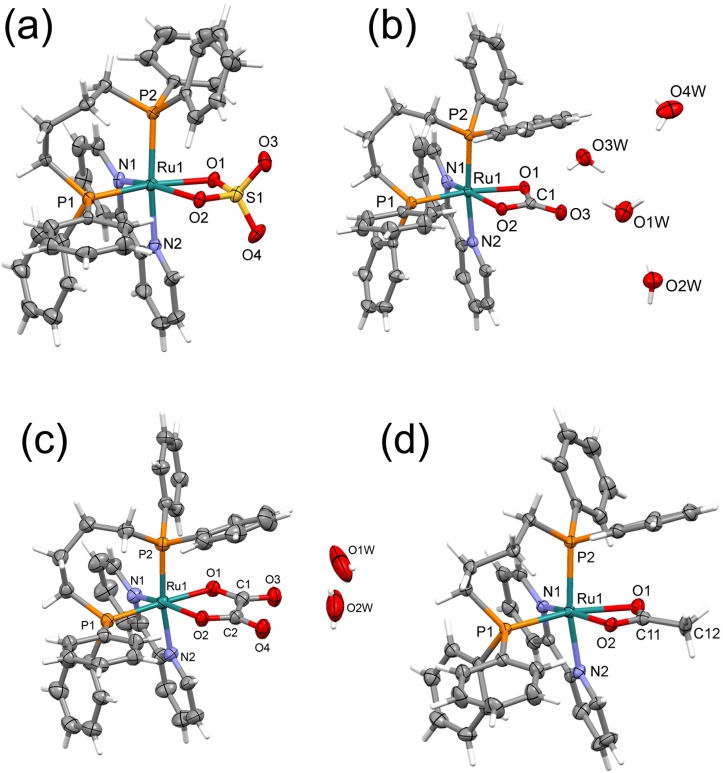
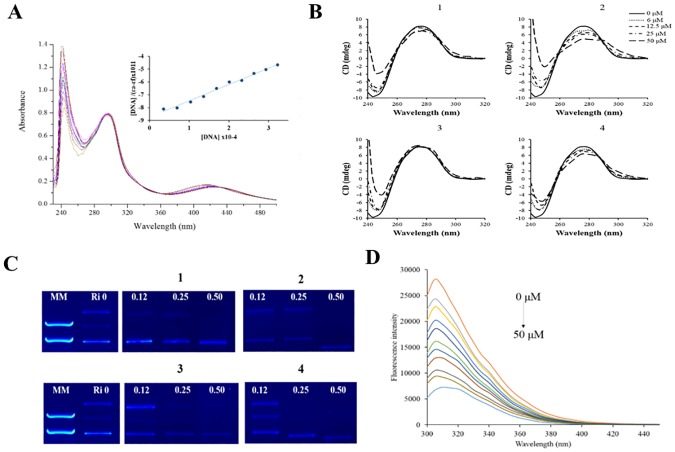
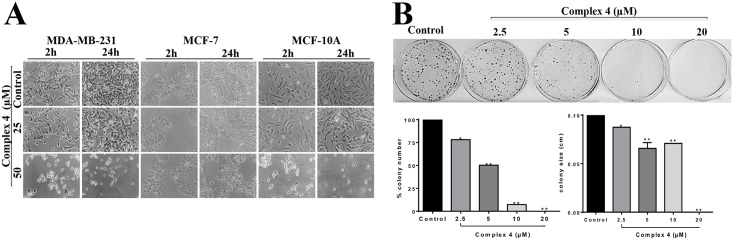
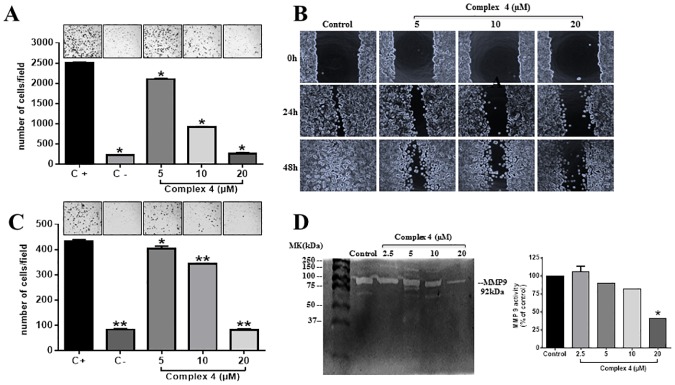
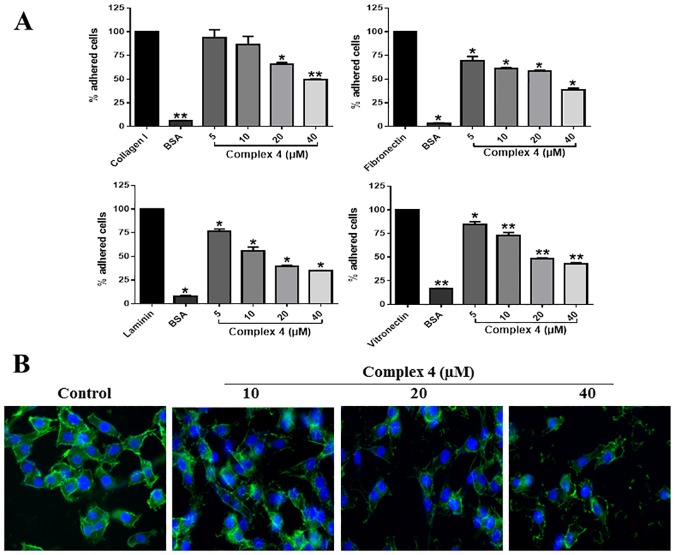
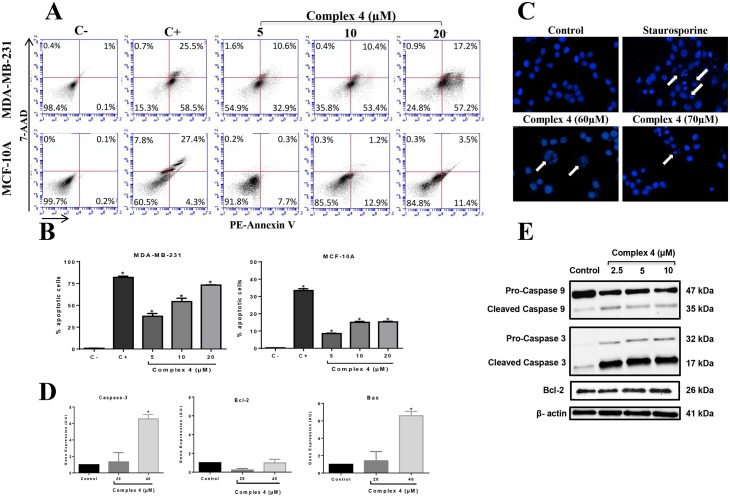
Triple-negative breast cancer (TNBC) is a highly aggressive breast cancer subtype. The high rate of metastasis associated to the fact that these cells frequently display multidrug resistance, make the treatment of metastatic disease difficult. Development of antitumor metal-based drugs was started with the discovery of cisplatin, however, the severe side effects represent a limitation for its clinical use. Ruthenium (Ru) complexes with different ligands have been successfully studied as prospective antitumor drugs. In this work, we demonstrated the activity of a series of biphosphine bipyridine Ru complexes (1) [Ru(SO4)(dppb)(bipy)], (2) [Ru(CO3)(dppb)(bipy)], (3) [Ru(C2O4)(dppb)(bipy)] and (4) [Ru(CH3CO2)(dppb)(bipy)]PF6 [where dppb = 1,4-bis(diphenylphosphino)butane and bipy = 2,2'-bipyridine], on proliferation of TNBC (MDA-MB-231), estrogen-dependent breast tumor cells (MCF-7) and a non-tumor breast cell line (MCF-10A). Complex (4) was most effective among the complexes and was selected to be further investigated on effects on tumor cell adhesion, migration, invasion and in apoptosis. Moreover, DNA and HSA binding properties of this complex were also investigated. Results show that complex (4) was more efficient inhibiting proliferation of MDA-MB-231 cells over non-tumor cells. In addition, complex (4) was able to inhibit MDA-MB231 cells adhesion, migration and invasion and to induce apoptosis and inhibit MMP-9 secretion in TNBC cells. Complex (4) should be further investigated in vivo in order to stablish its potential to improve breast cancer treatment.
三阴性乳腺癌(TNBC)是一种侵袭性很强的乳腺癌亚型。这些细胞经常表现出多药耐药性,导致转移率很高,使得转移性疾病的治疗变得困难。抗肿瘤金属基药物的研发始于顺铂的发现,然而,其严重的副作用限制了它的临床应用。含有不同配体的钌(Ru)配合物已作为潜在的抗肿瘤药物被成功研究。在这项工作中,我们展示了一系列双膦联吡啶钌配合物(1)[Ru(SO4)(dppb)(bipy)]、(2)[Ru(CO3)(dppb)(bipy)]、(3)[Ru(C2O4)(dppb)(bipy)]和(4)[Ru(CH3CO2)(dppb)(bipy)]PF6 [其中dppb = 1,4 - 双(二苯基膦基)丁烷,bipy = 2,2'-联吡啶]对三阴性乳腺癌(MDA - MB - 231)、雌激素依赖性乳腺肿瘤细胞(MCF - 7)和非肿瘤乳腺细胞系(MCF - 10A)增殖的影响。配合物(4)在这些配合物中最有效,被选择进一步研究其对肿瘤细胞黏附、迁移、侵袭以及凋亡的影响。此外,还研究了该配合物与DNA和人血清白蛋白的结合特性。结果表明,配合物(4)在抑制MDA - MB - 231细胞增殖方面比非肿瘤细胞更有效。此外,配合物(4)能够抑制MDA - MB231细胞的黏附、迁移和侵袭,并诱导三阴性乳腺癌细胞凋亡以及抑制MMP - 9的分泌。配合物(4)应在体内进一步研究,以确定其改善乳腺癌治疗的潜力。