Jilani Noraisyah Abdul Kadir, Zakariah Emma Izzati, Ariffin Eda Yuhana, Sapari Suhaila, Nokarajoo Devika, Yamin Bohari, Hasbullah Siti Aishah
Department of Chemical Sciences. Faculty Science and Technology, Universiti Kebangsaan Malaysia 43600 Bangi Selangor Darul Ehsan Malaysia
RSC Adv. 2023 Jan 11;13(3):2104-2114. doi: 10.1039/d2ra05701h. eCollection 2023 Jan 6.
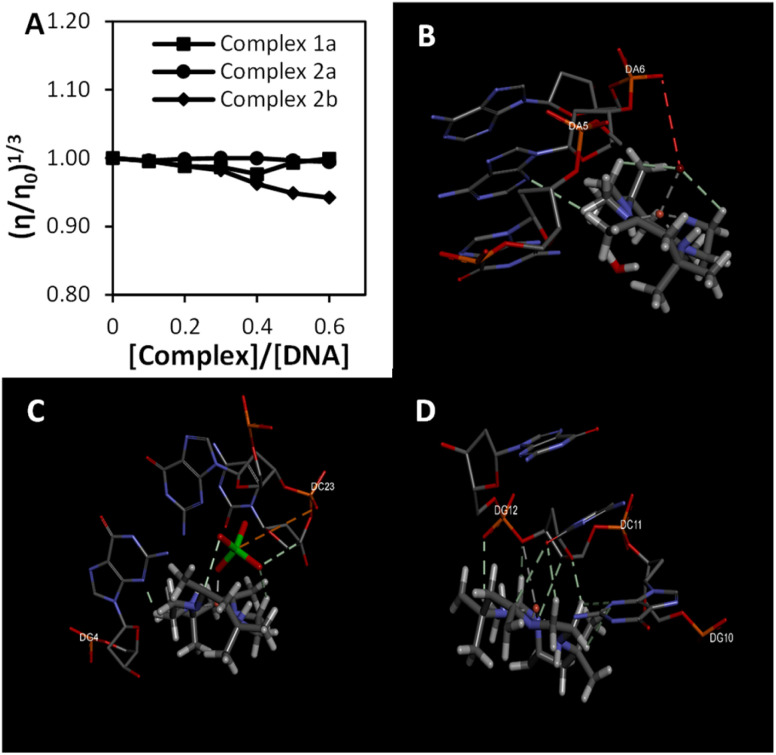
Three copper(ii) tetraaza complexes [Cu(ii)LBr]Br (1a), Cu(ii)L(CIO) (2a) and Cu(ii)L (2b), where L = 5,5,7,12,12,14-hexamethyl-1,4,8,11-tetraazacyclotetradeca-7,14-diene were prepared and confirmed by FTIR, HNMR and CNMR. The binding interaction of complex (1a, 2a, 2b) with calf thymus DNA (CT-DNA) was investigated using UV-vis absorption, luminescence titrations, viscosity measurements and molecular docking. The findings suggested that complex 1a, 2a and 2b bind to DNA by electrostatic interaction, and the strengths of the interaction were arranged according to 2b > 1a > 2a. The differences in binding strengths were certainly caused by the complexes' dissimilar charges and counter anions. Complex 2b, with the biggest binding strength towards the DNA, was further applied in developing the porcine sensor. The developed sensor exhibits a broad linear dynamic range, low detection limit, good selectivity, and reproducibility. Analysis of real samples showed that the biosensor had excellent selectivity towards the pork meat compared to chicken and beef meat.
制备了三种铜(II)四氮杂配合物[Cu(II)LBr]Br(1a)、[Cu(II)L(ClO)](ClO)(2a)和[Cu(II)L](ClO)(2b),其中L = 5,5,7,12,12,14-六甲基-1,4,8,11-四氮杂环十四碳-7,14-二烯,并通过傅里叶变换红外光谱(FTIR)、核磁共振氢谱(HNMR)和核磁共振碳谱(CNMR)进行了确认。使用紫外可见吸收光谱、荧光滴定、粘度测量和分子对接研究了配合物(1a、2a、2b)与小牛胸腺DNA(CT-DNA)的结合相互作用。研究结果表明,配合物1a、2a和2b通过静电相互作用与DNA结合,相互作用强度顺序为2b > 1a > 2a。结合强度的差异肯定是由配合物不同的电荷和抗衡阴离子引起的。对DNA具有最大结合强度的配合物2b进一步应用于开发猪肉传感器。所开发的传感器具有宽线性动态范围、低检测限、良好的选择性和重现性。实际样品分析表明,与鸡肉和牛肉相比,该生物传感器对猪肉具有优异的选择性。