Dahlstrom Kristina R, Anderson Karen S, Field Matthew S, Chowell Diego, Ning Jing, Li Nan, Wei Qingyi, Li Guojun, Sturgis Erich M
Department of Head and Neck Surgery, The University of Texas MD Anderson Cancer Center, Houston, Texas.
Center for Personalized Diagnostics, Biodesign Institute, Arizona State University, Tempe, Arizona.
Cancer. 2017 Dec 15;123(24):4886-4894. doi: 10.1002/cncr.30955. Epub 2017 Sep 12.
Because of the current epidemic of human papillomavirus (HPV)-related oropharyngeal cancer (OPC), a screening strategy is urgently needed. The presence of serum antibodies to HPV-16 early (E) antigens is associated with an increased risk for OPC. The purpose of this study was to evaluate the diagnostic accuracy of antibodies to a panel of HPV-16 E antigens in screening for OPC.
This case-control study included 378 patients with OPC, 153 patients with nonoropharyngeal head and neck cancer (non-OPC), and 782 healthy control subjects. The tumor HPV status was determined with p16 immunohistochemistry and HPV in situ hybridization. HPV-16 E antibody levels in serum were identified with an enzyme-linked immunosorbent assay. A trained binary logistic regression model based on the combination of all E antigens was predefined and applied to the data set. The sensitivity and specificity of the assay for distinguishing HPV-related OPC from controls were calculated. Logistic regression analysis was used to calculate odds ratios with 95% confidence intervals for the association of head and neck cancer with the antibody status.
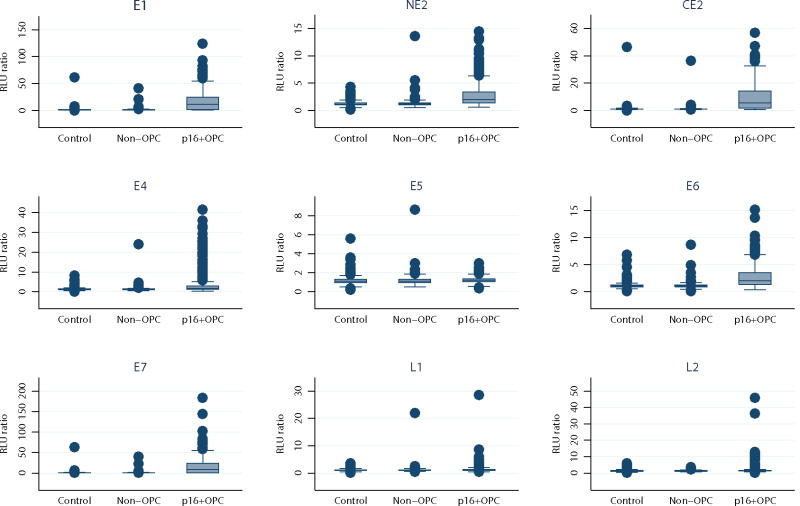
Of the 378 patients with OPC, 348 had p16-positive OPC. HPV-16 E antibody levels were significantly higher among patients with p16-positive OPC but not among patients with non-OPC or among controls. Serology showed high sensitivity and specificity for HPV-related OPC (binary classifier: 83% sensitivity and 99% specificity for p16-positive OPC).
A trained binary classification algorithm that incorporates information about multiple E antibodies has high sensitivity and specificity and may be advantageous for risk stratification in future screening trials. Cancer 2017;123:4886-94. © 2017 American Cancer Society.
鉴于目前人乳头瘤病毒(HPV)相关口咽癌(OPC)的流行情况,迫切需要一种筛查策略。血清中HPV - 16早期(E)抗原抗体的存在与OPC风险增加相关。本研究的目的是评估一组HPV - 16 E抗原抗体在OPC筛查中的诊断准确性。
这项病例对照研究纳入了378例OPC患者、153例非口咽头颈癌(非OPC)患者和782名健康对照者。通过p16免疫组化和HPV原位杂交确定肿瘤的HPV状态。采用酶联免疫吸附测定法检测血清中HPV - 16 E抗体水平。预先定义了一个基于所有E抗原组合的经过训练的二元逻辑回归模型,并将其应用于数据集。计算该检测方法区分HPV相关OPC与对照的敏感性和特异性。采用逻辑回归分析计算头颈癌与抗体状态关联的比值比及95%置信区间。
在378例OPC患者中,348例为p16阳性OPC。p16阳性OPC患者的HPV - 16 E抗体水平显著更高,但非OPC患者和对照者中则不然。血清学检测对HPV相关OPC显示出高敏感性和特异性(二元分类器:对p16阳性OPC的敏感性为83%,特异性为99%)。
一种纳入多种E抗体信息的经过训练的二元分类算法具有高敏感性和特异性,可能有利于未来筛查试验中的风险分层。《癌症》2017年;123:4886 - 94。©2017美国癌症协会。