Cell Bench Research Center, Korea Advanced Institute of Science and Technology (KAIST), 291 Daehak-ro, Yuseong-gu, Daejeon 34141, Republic of Korea.
National Cancer Center, 323323 Ilsan-ro, Ilsandong-gu, Goyang-si Gyeonggi-do, 10408, Republic of Korea.
Theranostics. 2017 Jul 22;7(13):3179-3191. doi: 10.7150/thno.19686. eCollection 2017.
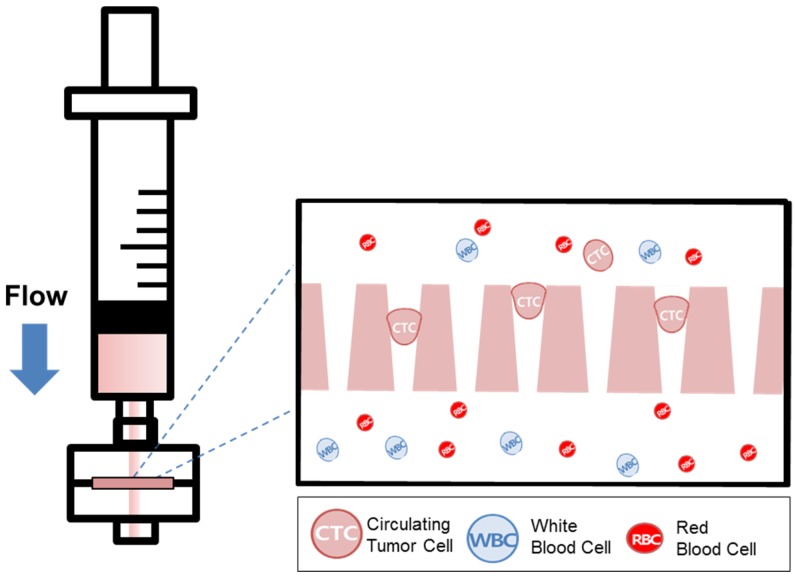
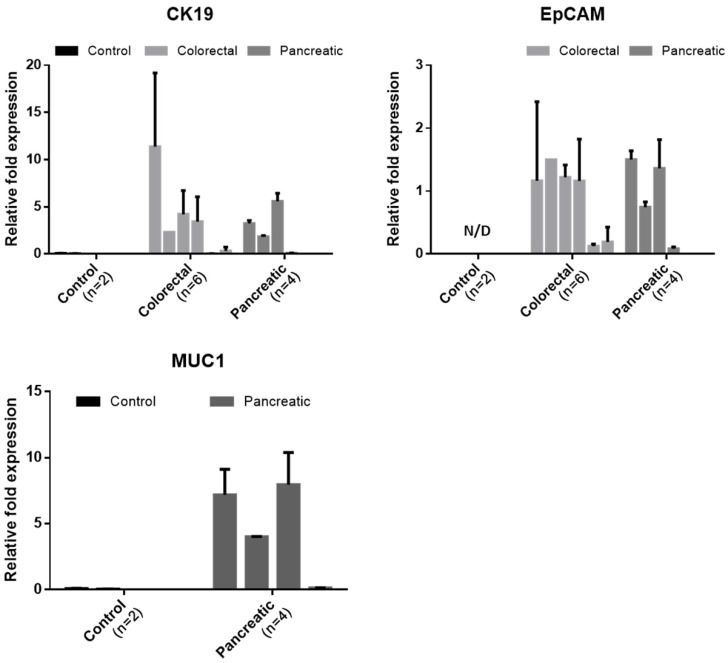
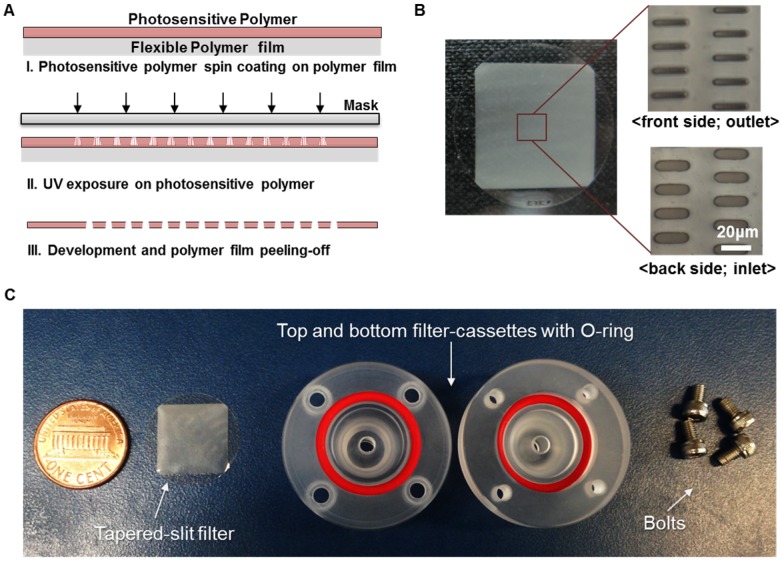
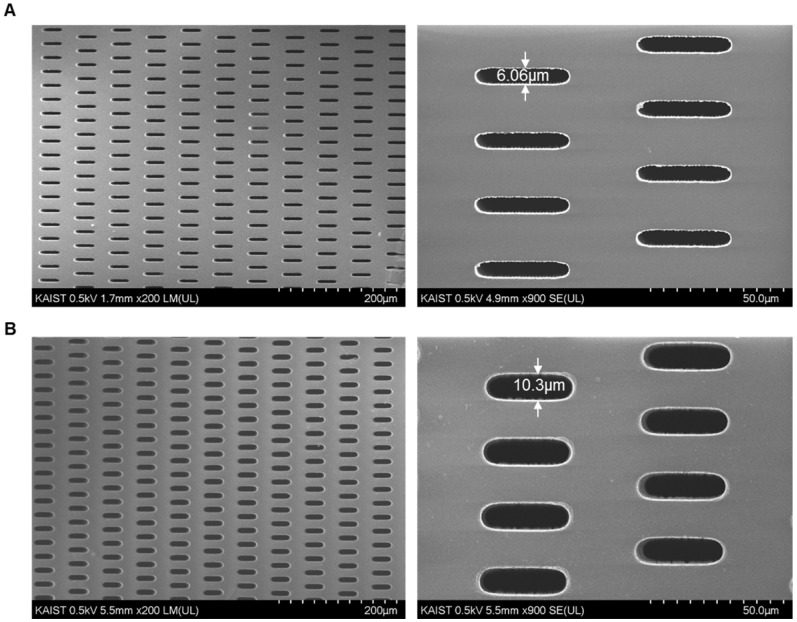
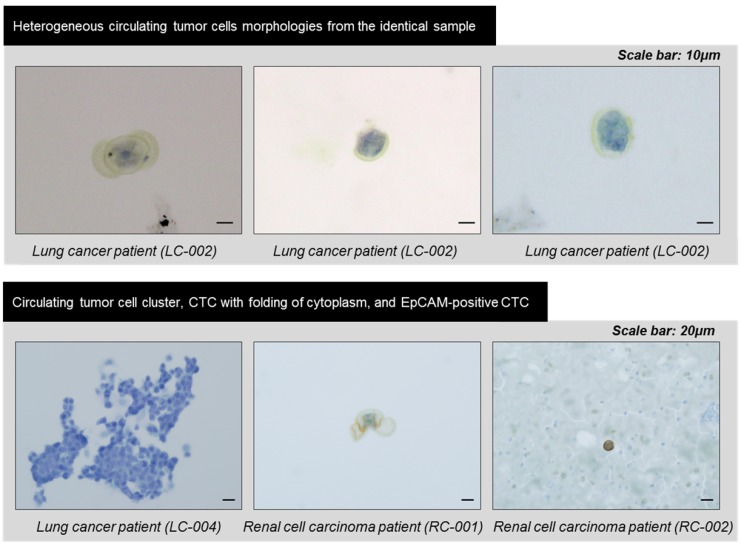
We present a clinical device for simple, rapid, and viable isolation of circulating tumor cells (CTCs) from cancer patient bloods. In spite of the clinical importance of CTCs, the lack of easy and non-biased isolation methods is a big hurdle for implementing CTC into clinical use. The present device made of photosensitive polymer was designed to attach to conventional syringe to isolate the CTCs at minimal resources. Its unique tapered-slits on the filter are capable not only to isolate the cell based on their size and deformability, but also to increase sample flow rate, thus achieving label-free rapid viable CTC isolation. We verified our device performance using 9 different types of cancer cells at the cell concentration from 5 to 100cells/ml, showing that the device capture 77.7% of the CTCs while maintaining their viability of 80.6%. We extended our study using the 18 blood samples from lung, colorectal, pancreatic and renal cancer patients and captured 1-172 CTCs or clustered CTCs by immunofluorescent or immunohistochemical staining. The captured CTCs were also molecularly assayed by RT-PCR with three cancer-associated genes (CK19, EpCAM, and MUC1). Those comprehensive studies proved to use our device for cancer study, thereby inaugurating further in-depth CTC-based clinical researches.
我们提出了一种临床设备,用于从癌症患者的血液中简单、快速、有效地分离循环肿瘤细胞(CTC)。尽管 CTCs 具有重要的临床意义,但缺乏简单且无偏的分离方法是将 CTCs 应用于临床的一大障碍。本设备由光敏聚合物制成,设计用于与常规注射器配合使用,以最少的资源分离 CTCs。其独特的过滤片上的锥形狭缝不仅能够根据细胞的大小和变形性来分离细胞,还能够增加样品流速,从而实现无标记的快速、活的 CTC 分离。我们使用浓度为 5 到 100 个细胞/ml 的 9 种不同类型的癌细胞验证了我们的设备性能,结果表明该设备捕获了 77.7%的 CTCs,同时保持了 80.6%的活力。我们使用来自肺癌、结直肠癌、胰腺癌和肾癌患者的 18 份血液样本扩展了我们的研究,并通过免疫荧光或免疫组织化学染色捕获了 1-172 个 CTC 或聚集的 CTC。还通过 RT-PCR 对捕获的 CTC 进行了三种与癌症相关的基因(CK19、EpCAM 和 MUC1)的分子分析。这些综合研究证明了我们的设备可用于癌症研究,从而为进一步深入的基于 CTC 的临床研究开辟了道路。