Dastur Rashna Sam, Gaitonde Pradnya Satish, Kachwala Munira, Nallamilli Babi R R, Ankala Arunkanth, Khadilkar Satish V, Atchayaram Nalini, Gayathri N, Meena A K, Rufibach Laura, Shira Sarah, Hegde Madhuri
Centre for Advanced Molecular Diagnostics in Neuromuscular Disorders, Atlanta, Georgia, USA.
Department of Human Genetics, Emory University School of Medicine, Atlanta, Georgia, USA.
Ann Indian Acad Neurol. 2017 Jul-Sep;20(3):302-308. doi: 10.4103/aian.AIAN_129_17.
Limb-girdle muscular dystrophy (LGMD) is the most common adult-onset class of muscular dystrophies in India, but a majority of suspected LGMDs in India remain unclassified to the genetic subtype level. The next-generation sequencing (NGS)-based approaches have allowed molecular characterization and subtype diagnosis in a majority of these patients in India.
(I) To select probable dysferlinopathy (LGMD2B) cases from other LGMD subtypes using two screening methods (i) to determine the status of protein expression in blood (peripheral blood mononuclear cell) by monocyte assay (ii) using a predictive algorithm called automated LGMD diagnostic assistant (ALDA) to obtain possible LGMD subtypes based on clinical symptoms. (II) Identification of gene pathogenic variants by NGS for 34 genes associated with LGMD or LGMD like muscular dystrophies, in cases showing: absence of protein by the monocyte assay and/or a typical dysferlinopathy phenotype, with medium to high predictive scores using the ALDA tool.
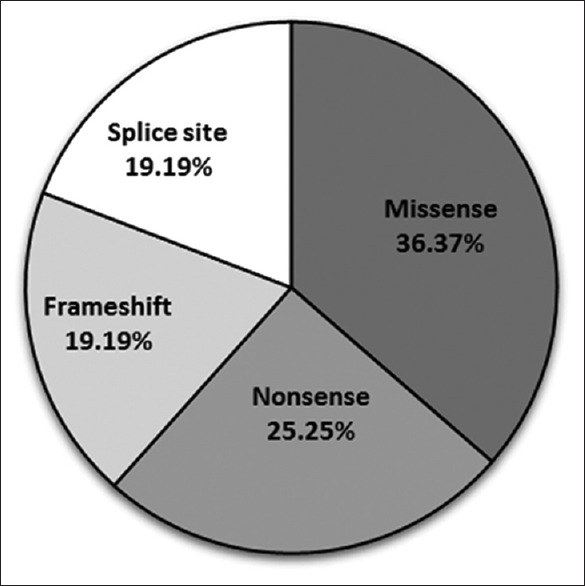
Out of the 125 patients screened by NGS, 96 were confirmed with two variants, of which 84 were homozygous. Single pathogenic variants were seen in 4 patients, whereas 25 showed no variants in the gene.
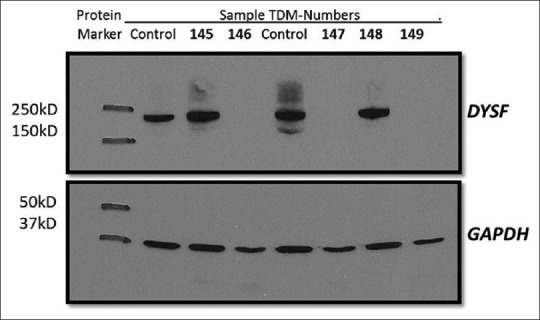
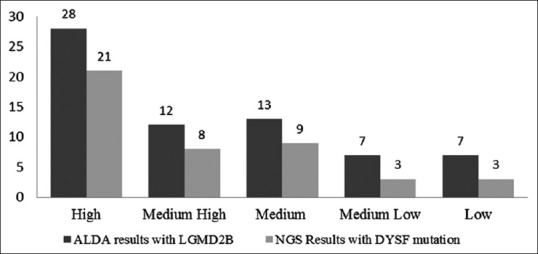
In this study, 98.2% of patients with absence of the protein showed one or more variants in the gene and hence has a high predictive significance in diagnosing dysferlinopathies. However, collection of blood samples from all over India for protein analysis is expensive. Our analysis shows that the use of the "ALDA tool" could be a cost-effective alternative method. Identification of pathogenic variants by NGS is the ultimate method for diagnosing dysferlinopathies though follow-up with the monocyte assay can be useful to understand the phenotype in relation to the protein expression and also be a useful biomarker for future clinical trials.
肢带型肌营养不良症(LGMD)是印度最常见的成人起病型肌营养不良症,但印度大多数疑似LGMD病例在基因亚型水平上仍未分类。基于下一代测序(NGS)的方法已使印度的大多数此类患者能够进行分子特征分析和亚型诊断。
(I)使用两种筛查方法从其他LGMD亚型中选择可能的dysferlinopathy(LGMD2B)病例:(i)通过单核细胞测定确定血液(外周血单核细胞)中蛋白质的表达状态;(ii)使用一种名为自动LGMD诊断助手(ALDA)的预测算法,根据临床症状获得可能的LGMD亚型。(II)对于显示以下情况的病例,通过NGS鉴定与LGMD或LGMD样肌营养不良症相关的34个基因的基因致病变异:单核细胞测定中蛋白质缺失和/或典型的dysferlinopathy表型,使用ALDA工具预测得分中等到高。
在通过NGS筛查的125例患者中,96例被确认为有两个变异,其中84例为纯合子。4例患者中发现单个致病变异,而25例在该基因中未显示变异。
在本研究中,98.2%的蛋白质缺失患者在该基因中显示一个或多个变异,因此在诊断dysferlinopathy方面具有很高的预测意义。然而,从印度各地采集血样进行蛋白质分析成本高昂。我们的分析表明,使用“ALDA工具”可能是一种经济有效的替代方法。通过NGS鉴定致病基因变异是诊断dysferlinopathy的最终方法,尽管单核细胞测定的后续研究有助于了解与该蛋白质表达相关的表型,并且对未来临床试验也是一种有用的生物标志物。