Yang Chien-Wen, Li Huijun, Thomas Lisa, Ramos Manuel, Liu Po-Hong, Roe Thomas, Valadri Ravinder, Kiel Michael C, Su Vincent Yi-Fong, Shi Qi
Department of Internal Medicine, The Wright Center for Graduate Medical Education (WCGME), Scranton Hematology & Oncology Associates of Northeast Pennsylvania Department of Epidemiology, Harvard T.H. Chan School of Public Health Commonwealth Health Physician Network Great Valley Cardiology Department of Family Medicine, WCGME Department of Science, Marywood University, Scranton, PA Faculty of Medicine, National Yang-Ming University, Taipei, Taiwan.
Medicine (Baltimore). 2017 Sep;96(37):e8027. doi: 10.1097/MD.0000000000008027.
Troponin I is one of the most commonly tested biochemical markers in the emergency room (ER) and in the hospital setting. Besides coronary artery disease (CAD), demand ischemia with underlying tachycardia, anemia, hypertensive emergency, congestive heart failure, kidney disease, sepsis, and pulmonary embolism have also been reported to cause troponin I elevations. Few reports have excluded patients with CAD, and no study has summarized the proportion of these factors relative to an increased troponin I level.
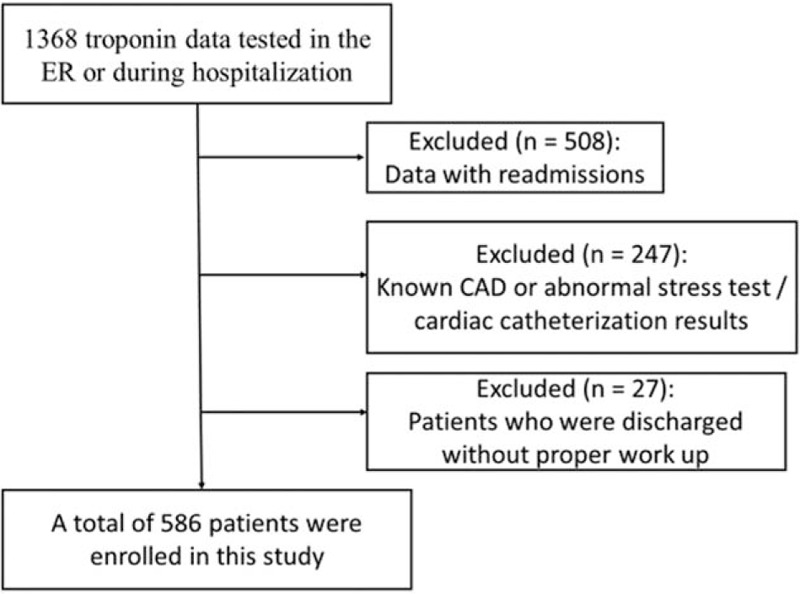
The aim of this retrospective study was to investigate the level of contribution of causative factors in troponin I elevation. Charts of patients tested for troponin I during an ER visit or during hospitalization were collected. Patients with known CAD, abnormal stress tests, cardiac catheterizations, or discharge without an adequate cardiac evaluation were excluded. Logistic regression was used to identify predictors of elevated troponin I levels.
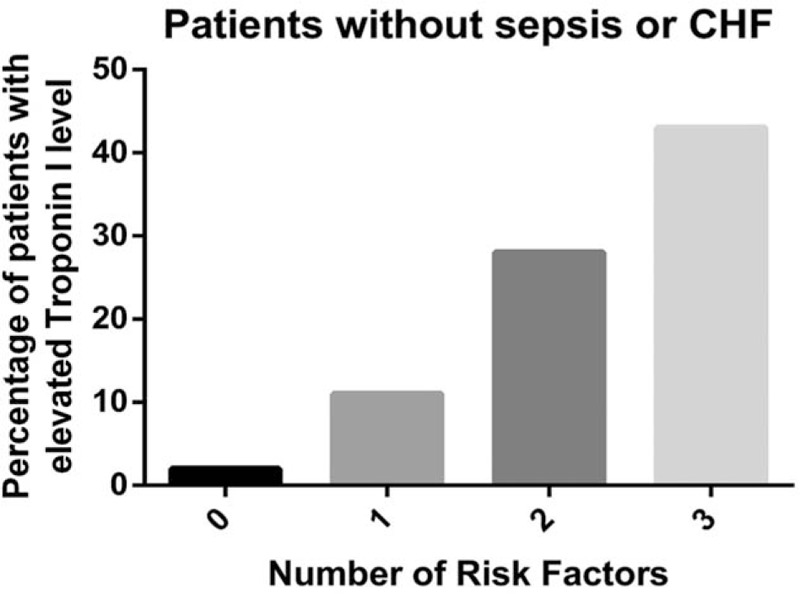
A total of 586 patients were investigated in this study. Age, hemoglobin (Hb), heart rate (HR), glomerularfiltration rate, atrial fibrillation, congestive heart failure (CHF), and sepsis were significant predictors of elevated troponin I by analysis in univariate logistic regression (all P < .001). In multivariate logistic regression, sepsis, CHF, age, Hb, and HR were independent predictors of troponin I (all P < .01). A simple clinical scoring system was generated with 1 score on patients with age ≥ 60, Hb < 10 g/dL, and HR ≥ 100 beats per minute (bpm). The prevalence of elevated troponin I was 4%, 16%, 38%, and 50% for patients with scores of 0, 1, 2, and 3, respectively. In patients without sepsis and CHF, the chances of elevated troponin I were 2%, 11%, 28%, and 43%.
Sepsis was found to be the strongest independent cause of elevated troponin I levels in non-CAD patients. The scoring system composed of age, hemoglobin (Hb), and heart rate (HR) can assist clinical evaluation of elevated troponin I test in non-CAD patients.
肌钙蛋白I是急诊室(ER)和医院环境中最常检测的生化标志物之一。除了冠状动脉疾病(CAD)外,潜在心动过速、贫血、高血压急症、充血性心力衰竭、肾脏疾病、脓毒症和肺栓塞等需求性缺血也被报道可导致肌钙蛋白I升高。很少有报告排除CAD患者,且没有研究总结这些因素相对于肌钙蛋白I水平升高的比例。
这项回顾性研究的目的是调查导致肌钙蛋白I升高的因素的贡献程度。收集了在ER就诊期间或住院期间检测肌钙蛋白I的患者病历。排除已知患有CAD、应激试验异常、心脏导管检查或未进行充分心脏评估而出院的患者。采用逻辑回归来确定肌钙蛋白I水平升高的预测因素。
本研究共调查了586例患者。在单变量逻辑回归分析中,年龄、血红蛋白(Hb)、心率(HR)、肾小球滤过率、心房颤动、充血性心力衰竭(CHF)和脓毒症是肌钙蛋白I升高的显著预测因素(所有P<0.001)。在多变量逻辑回归中,脓毒症、CHF、年龄、Hb和HR是肌钙蛋白I的独立预测因素(所有P<0.01)。生成了一个简单的临床评分系统,年龄≥60岁、Hb<10g/dL且心率≥100次/分钟(bpm)的患者得1分。得分分别为0、1、2和3的患者中肌钙蛋白I升高的患病率分别为4%、16%、38%和50%。在没有脓毒症和CHF的患者中,肌钙蛋白I升高的几率分别为2%、11%、28%和43%。
脓毒症被发现是非CAD患者肌钙蛋白I水平升高的最强独立原因。由年龄、血红蛋白(Hb)和心率(HR)组成的评分系统可协助对非CAD患者肌钙蛋白I检测升高进行临床评估。