Department of Clinical and Experimental Neuroimaging, National Center for Geriatrics and Gerontology, Aichi, Japan.
Department of Radiology, Fujita Health University School of Medicine, Aichi, Japan.
J Alzheimers Dis. 2017;60(3):877-887. doi: 10.3233/JAD-170395.
The value of fluorine-18-fluorodeoxyglucose positron emission tomography (18F-FDG-PET) and magnetic resonance imaging (MRI) for predicting conversion of mild cognitive impairment (MCI) to Alzheimer's disease (AD) in longer-term is unclear.
To evaluate longer-term prediction of MCI to AD conversion using 18F-FDG-PET and MRI in a multicenter study.
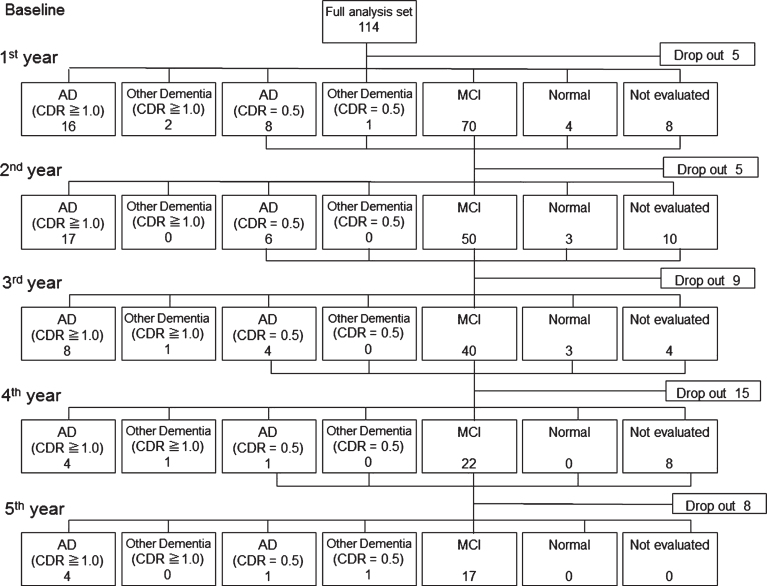
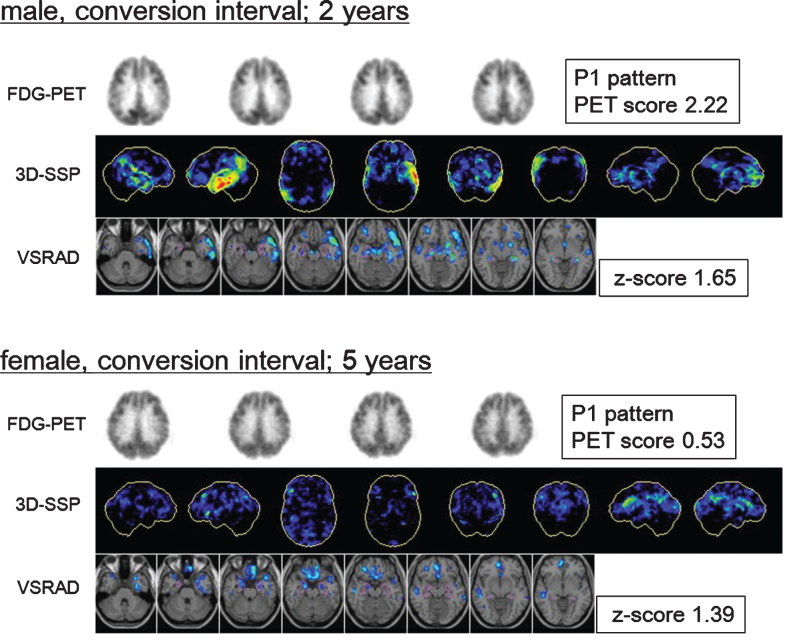
One-hundred and fourteen patients with MCI were followed for 5 years. They underwent clinical and neuropsychological examinations, 18F-FDG-PET, and MRI at baseline. PET images were visually classified into predefined dementia patterns. PET scores were calculated as a semi quantitative index. For structural MRI, z-scores in medial temporal area were calculated by automated volume-based morphometry (VBM).
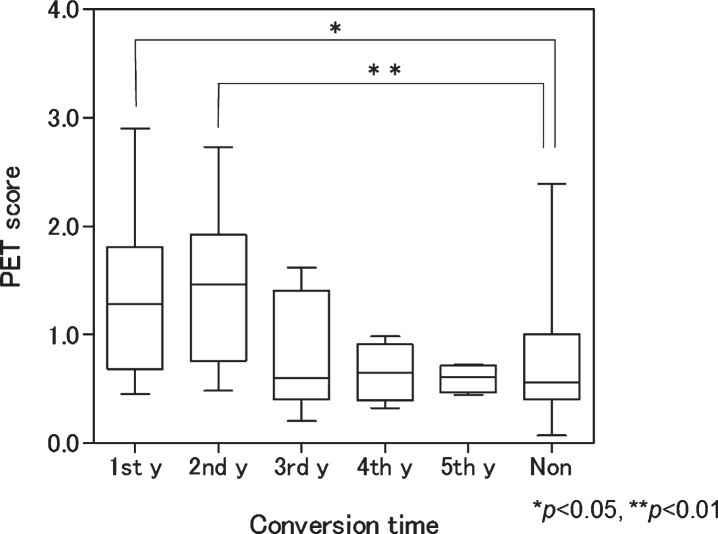
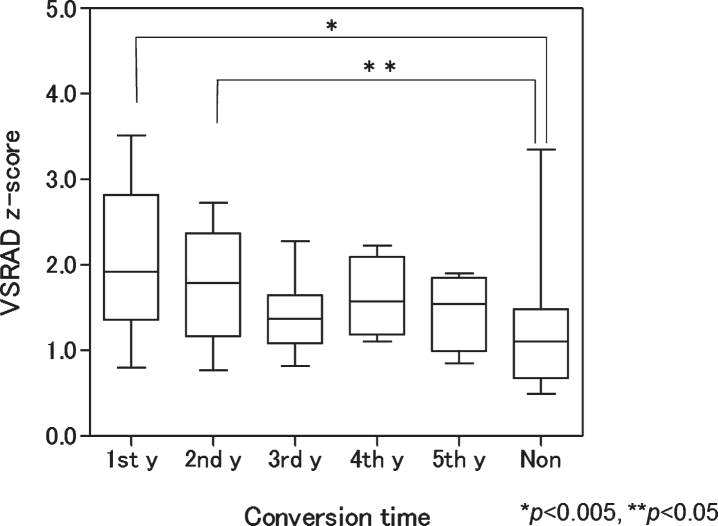
Overall, 72% patients with amnestic MCI progressed to AD during the 5-year follow-up. The diagnostic accuracy of PET scores over 5 years was 60% with 53% sensitivity and 84% specificity. Visual interpretation of PET images predicted conversion to AD with an overall 82% diagnostic accuracy, 94% sensitivity, and 53% specificity. The accuracy of VBM analysis presented little fluctuation through 5 years and it was highest (73%) at the 5-year follow-up, with 79% sensitivity and 63% specificity. The best performance (87.9% diagnostic accuracy, 89.8% sensitivity, and 82.4% specificity) was with a combination identified using multivariate logistic regression analysis that included PET visual interpretation, educational level, and neuropsychological tests as predictors.
18F-FDG-PET visual assessment showed high performance for predicting conversion to AD from MCI, particularly in combination with neuropsychological tests. PET scores showed high diagnostic specificity. Structural MRI focused on the medial temporal area showed stable predictive value throughout the 5-year course.
氟-18-氟代脱氧葡萄糖正电子发射断层扫描(18F-FDG-PET)和磁共振成像(MRI)在预测轻度认知障碍(MCI)向阿尔茨海默病(AD)转化方面的长期价值尚不清楚。
在一项多中心研究中,评估 18F-FDG-PET 和 MRI 对 MCI 向 AD 转化的长期预测。
114 例 MCI 患者随访 5 年。他们在基线时接受了临床和神经心理学检查、18F-FDG-PET 和 MRI。PET 图像根据预先设定的痴呆模式进行视觉分类。PET 评分被计算为半定量指标。对于结构 MRI,通过基于自动容积的形态计量学(VBM)计算内侧颞区的 z 分数。
总体而言,72%的遗忘型 MCI 患者在 5 年内进展为 AD。5 年内 PET 评分的诊断准确性为 60%,敏感性为 53%,特异性为 84%。PET 图像的视觉解读预测 AD 转化率为 82%,总敏感性为 94%,特异性为 53%。VBM 分析的准确性在 5 年内波动不大,在 5 年随访时最高(73%),敏感性为 79%,特异性为 63%。使用多元逻辑回归分析识别的最佳组合(包括 PET 视觉解读、教育水平和神经心理学测试作为预测指标)的表现最佳(诊断准确性 87.9%,敏感性 89.8%,特异性 82.4%)。
18F-FDG-PET 视觉评估对预测 MCI 向 AD 转化具有较高的性能,特别是与神经心理学测试相结合时。PET 评分具有较高的诊断特异性。以内侧颞区为重点的结构 MRI 在整个 5 年过程中具有稳定的预测价值。