
Rab11家族在人胎盘中的表达:在母胎界面的定位。
Rab11 family expression in the human placenta: Localization at the maternal-fetal interface.
作者信息
Taglauer Elizabeth S, Artemiuk Patrycja A, Hanscom Sara R, Lindsay Andrew J, Wuebbolt Danielle, Breathnach Fionnuala M, Tully Elizabeth C, Khan Amir R, McCaffrey Mary W
机构信息
Division of Newborn Medicine, Boston Children's Hospital, Boston, Massachusetts, United States of America.
School of Biochemistry and Immunology, Trinity College, Dublin, Ireland.
出版信息
PLoS One. 2017 Sep 18;12(9):e0184864. doi: 10.1371/journal.pone.0184864. eCollection 2017.
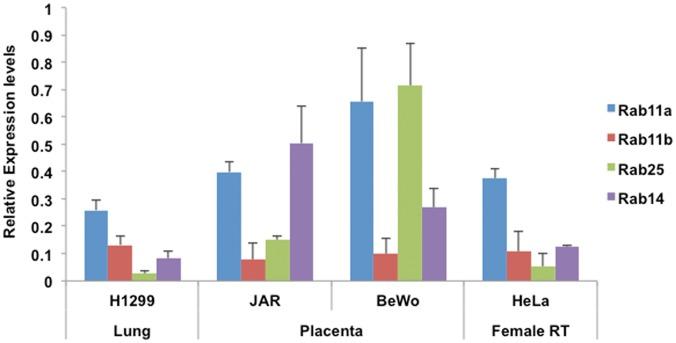
Rab proteins are a family of small GTPases involved in a variety of cellular processes. The Rab11 subfamily in particular directs key steps of intracellular functions involving vesicle trafficking of the endosomal recycling pathway. This Rab subfamily works through a series of effector proteins including the Rab11-FIPs (Rab11 Family-Interacting Proteins). While the Rab11 subfamily has been well characterized at the cellular level, its function within human organ systems is still being explored. In an effort to further study these proteins, we conducted a preliminary investigation of a subgroup of endosomal Rab proteins in a range of human cell lines by Western blotting. The results from this analysis indicated that Rab11a, Rab11c(Rab25) and Rab14 were expressed in a wide range of cell lines, including the human placental trophoblastic BeWo cell line. These findings encouraged us to further analyse the localization of these Rabs and their common effector protein, the Rab Coupling Protein (RCP), by immunofluorescence microscopy and to extend this work to normal human placental tissue. The placenta is a highly active exchange interface, facilitating transfer between mother and fetus during pregnancy. As Rab11 proteins are closely involved in transcytosis we hypothesized that the placenta would be an interesting human tissue model system for Rab investigation. By immunofluorescence microscopy, Rab11a, Rab11c(Rab25), Rab14 as well as their common FIP effector RCP showed prominent expression in the placental cell lines. We also identified the expression of these proteins in human placental lysates by Western blot analysis. Further, via fluorescent immunohistochemistry, we noted abundant localization of these proteins within key functional areas of primary human placental tissues, namely the outer syncytial layer of placental villous tissue and the endothelia of fetal blood vessels. Overall these findings highlight the expression of the Rab11 family within the human placenta, with novel localization at the maternal-fetal interface.
Rab蛋白是一类参与多种细胞过程的小GTP酶。特别是Rab11亚家族指导细胞内功能的关键步骤,涉及内体循环途径的囊泡运输。这个Rab亚家族通过一系列效应蛋白发挥作用,包括Rab11-FIPs(Rab11家族相互作用蛋白)。虽然Rab11亚家族在细胞水平上已得到充分表征,但其在人体器官系统中的功能仍在探索中。为了进一步研究这些蛋白,我们通过蛋白质印迹法对一系列人类细胞系中的内体Rab蛋白亚组进行了初步研究。该分析结果表明,Rab11a、Rab11c(Rab25)和Rab14在包括人胎盘滋养层BeWo细胞系在内的多种细胞系中均有表达。这些发现促使我们通过免疫荧光显微镜进一步分析这些Rab蛋白及其共同效应蛋白Rab偶联蛋白(RCP)的定位,并将这项工作扩展到正常人类胎盘组织。胎盘是一个高度活跃的交换界面,在怀孕期间促进母体与胎儿之间的物质转移。由于Rab11蛋白密切参与转胞吞作用,我们推测胎盘将是一个用于研究Rab蛋白的有趣的人体组织模型系统。通过免疫荧光显微镜观察,Rab11a、Rab11c(Rab25)、Rab14以及它们共同的FIP效应蛋白RCP在胎盘细胞系中均有显著表达。我们还通过蛋白质印迹分析在人胎盘裂解物中鉴定了这些蛋白的表达。此外,通过荧光免疫组织化学,我们注意到这些蛋白在人胎盘组织的关键功能区域,即胎盘绒毛组织外合体层和胎儿血管内皮中大量定位。总体而言,这些发现突出了Rab11家族在人胎盘中的表达,在母胎界面有新的定位。



 Zotero 插件