Guo Chunyu, Wu Yue, Xu Li, Li Mao, Wang Zi, Ni Ni, Guo Wenyi
Department of Ophthalmology, Ninth People's Hospital, Shanghai JiaoTong University School of Medicine, No. 639, Zhizaoju Road, Shanghai, 200011, People's Republic of China.
BMC Ophthalmol. 2017 Sep 18;17(1):170. doi: 10.1186/s12886-017-0565-5.
Surgeries are inevitable for treating primary congenital glaucoma (PCG) and risk factors of surgical failure play a key role in surgical decision making. The aim of this study was to investigate the influence of delay of surgery and preoperative speed of progression (SP) on the surgical outcomes in these patients.
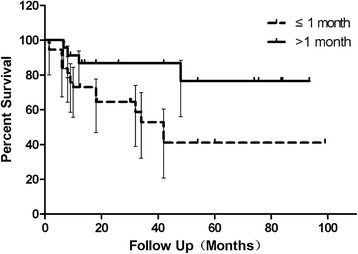
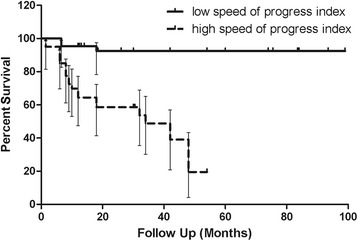
Medical records of 83 eyes of 51 PCG patients with trabeculotomy within 3 years were retrospectively observed. Surgical outcomes, demographic and clinical data were compared after separating the eyes into two groups based on the interval (between onset of PCG and trabeculotomy) and SP index (SPI) respectively. Student's t-test, Wilcoxon rank-sum test, Pearson's chi-square test and Kaplan-Meier survival analysis were used in the statistical analysis.
Comparative analysis showed better outcomes in the group with longer interval and lower SPIs. Better intraocular pressure (IOP) control was found in patients with lower SPI at 1, 3, 6, 12 and 24 months postoperatively (19.54 ± 4.84 mmHg vs. 24.75 ± 8.87 mmHg, p = 0.004; 19.88 ± 7.78 mmHg vs. 23.19 ± 6.74 mmHg, p = 0.089; 17.45 ± 6.23 mmHg vs. 21.31 ± 7.28 mmHg, p = 0.031; 15.09 ± 6.21 mmHg vs. 19.18 ± 6.66 mmHg, p = 0.008; 14.95 ± 2.95 mmHg vs. 18.10 ± 3.96 mmHg, p = 0.004). The correlation between SPI and IOP at 1, 3, 6, 12 and 24 months postoperatively was 0.328 (CI = 0.105 to 0.529, p = 0.005), 0.192 (CI = -0.070 to 0.429, p = 0.149), 0.261 (CI = 0.010 to 0.481, p = 0.042), 0.046 (CI = -0.183 to 0.270, p = 0.70), and 0.230 (CI = -0.072 to 0.493, p = 0.134), respectively. Patients with lower SPI were less likely to fail (χ2 = 22.71, p = 0.000, OR: 0.174; 95%CI: 0.059-0.510). Kaplan-Meier analysis showed a much slower decline of success rate in patients with lower SPI (χ2 = 25.52, p = 0.000).
In PCG patients, lower preoperative SPI was associated with better short-term IOP control and success rate. Evaluation of preoperative SPI may help with surgical decision. However, early detection and treatment are important given the same SPI.
手术是治疗原发性先天性青光眼(PCG)的必然选择,手术失败的风险因素在手术决策中起着关键作用。本研究旨在探讨手术延迟和术前进展速度(SP)对这些患者手术效果的影响。
回顾性观察51例PCG患者83只眼在3年内行小梁切开术的病历。根据PCG发病至小梁切开术的间隔时间和SP指数(SPI)将患眼分为两组,比较手术效果、人口统计学和临床数据。统计分析采用Student's t检验、Wilcoxon秩和检验、Pearson卡方检验和Kaplan-Meier生存分析。
对比分析显示,间隔时间较长和SPI较低的组手术效果更好。术后1、3、6、12和24个月,SPI较低的患者眼压(IOP)控制更好(分别为19.54±4.84 mmHg对24.75±8.87 mmHg,p = 0.004;19.88±7.78 mmHg对23.19±6.74 mmHg,p = 0.089;17.45±6.23 mmHg对21.31±7.28 mmHg,p = 0.031;15.09±6.21 mmHg对19.18±6.66 mmHg,p = 0.008;14.95±2.95 mmHg对18.10±3.96 mmHg,p = 0.004)。术后1、3、6、12和24个月,SPI与IOP的相关性分别为0.328(CI = 0.105至0.529,p = 0.005)、0.192(CI = -0.070至0.429,p = 0.149)、0.261(CI = 0.010至0.481,p = 0.042)、0.046(CI = -0.183至0.270,p = 0.70)和0.230(CI = -0.072至0.493,p = 0.134)。SPI较低的患者失败可能性较小(χ2 = 22.71,p = 0.000,OR:0.174;95%CI:0.059 - 0.510)。Kaplan-Meier分析显示,SPI较低的患者成功率下降慢得多(χ2 = 25.52,p = 0.000)。
在PCG患者中,术前SPI较低与更好的短期IOP控制和成功率相关。术前SPI评估可能有助于手术决策。然而,在SPI相同的情况下,早期发现和治疗很重要。