Roloff Gregory W, Lai Catherine, Hourigan Christopher S, Dillon Laura W
Myeloid Malignances Section, Hematology Branch, National Heart, Lung, and Blood Institute, National Institutes of Health, Bethesda, MD 20892, USA.
J Clin Med. 2017 Sep 19;6(9):87. doi: 10.3390/jcm6090087.
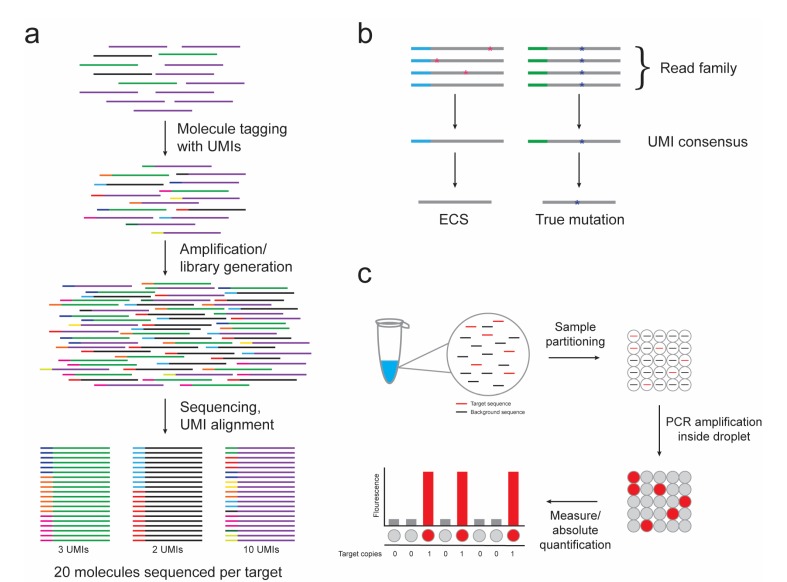
Outcomes for those diagnosed with acute myeloid leukemia (AML) remain poor. It has been widely established that persistent residual leukemic burden, often referred to as measurable or minimal residual disease (MRD), after induction therapy or at the time of hematopoietic stem cell transplant (HSCT) is highly predictive for adverse clinical outcomes and can be used to identify patients likely to experience clinically evident relapse. As a result of inherent genetic and molecular heterogeneity in AML, there is no uniform method or protocol for MRD measurement to encompass all cases. Several techniques focusing on identifying recurrent molecular and cytogenetic aberrations or leukemia-associated immunophenotypes have been described, each with their own strengths and weaknesses. Modern technologies enabling the digital quantification and tracking of individual DNA or RNA molecules, next-generation sequencing (NGS) platforms, and high-resolution imaging capabilities are among several new avenues under development to supplement or replace the current standard of flow cytometry. In this review, we outline emerging modalities positioned to enhance MRD detection and discuss factors surrounding their integration into clinical practice.
急性髓系白血病(AML)患者的预后仍然很差。已经广泛证实,诱导治疗后或造血干细胞移植(HSCT)时持续存在的残留白血病负担,通常称为可测量或微小残留病(MRD),对不良临床结局具有高度预测性,可用于识别可能发生临床明显复发的患者。由于AML存在内在的遗传和分子异质性,目前尚无统一的MRD检测方法或方案适用于所有病例。已经描述了几种专注于识别复发性分子和细胞遗传学异常或白血病相关免疫表型的技术,每种技术都有其自身的优缺点。能够对单个DNA或RNA分子进行数字定量和跟踪的现代技术、下一代测序(NGS)平台以及高分辨率成像能力是正在开发的几种新途径,以补充或取代当前的流式细胞术标准。在本综述中,我们概述了旨在增强MRD检测的新兴模式,并讨论了将其整合到临床实践中的相关因素。