Department of Psychotherapy and Psychosomatic Medicine, University Hospital Dresden, Technische Universität Dresden, Fetscherstr. 74, 01307 Dresden, Germany; Center for Social and Affective Neuroscience, Linköping University, Linköping, Sweden.
Center for Social and Affective Neuroscience, Linköping University, Linköping, Sweden; Department of Psychology, University of Gothenburg, Box 500, SE 40530, Gothenburg, Sweden.
Dev Cogn Neurosci. 2019 Feb;35:81-86. doi: 10.1016/j.dcn.2017.07.009. Epub 2017 Aug 18.
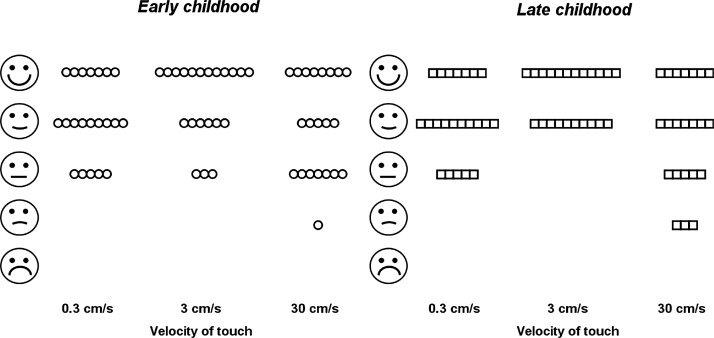
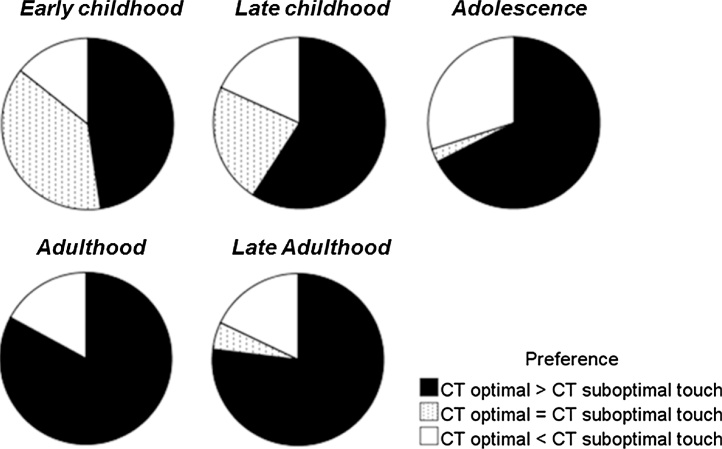
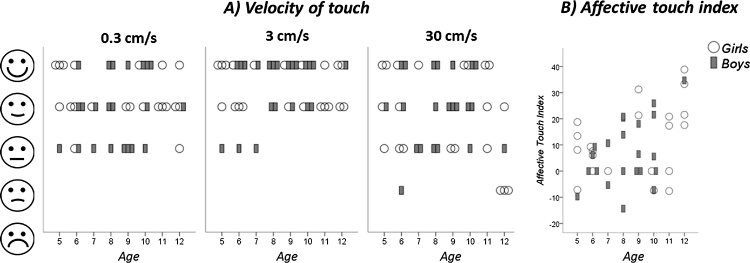
Affective touch plays an important role in children's social interaction and is involved in shaping the development of the social brain. The positive affective component of touch is thought to be conveyed via a group of unmyelinated, low-threshold mechanoreceptive afferents, known as C-tactile fibers that are optimally activated by gentle, slow, stroking touch. Touch targeting these C-tactile fibers has been shown to decrease the heart rate in infants. The current study investigated the relationship between age and psychophysical ratings in response to affective touch. A total of n=43 participants (early childhood: aged 5-8 years, 9 girls, 12 boys; late childhood: aged 9-12 years, 12 girls, 10 boys) were presented with C-tactile optimal and sub-optimal stroking velocities and rated touch pleasantness on an affective pictorial scale. For both age groups, we found that children preferred C-tactile-targeted stimulation. A comparison with previously published data showed that the children's preference for C-tactile-targeted stimulation was similar to those obtained in adolescents and adults. We speculate that the effect of C-tactile-targeted touch, which is linked with pleasantness, shapes the children's preference for C-tactile over non-C-tactile-targeted stimulation, and that C-tactile afferent stimulation is important for social development.
情感触觉在儿童的社会互动中起着重要作用,并且参与塑造社会大脑的发育。触觉的积极情感成分被认为是通过一组未髓鞘化、低阈值机械感受器传入纤维来传递的,这些传入纤维被称为 C 触觉纤维,它们被轻柔、缓慢、轻抚的触摸最佳激活。针对这些 C 触觉纤维的触摸已被证明可以降低婴儿的心率。本研究调查了年龄与情感触觉反应的心理物理评分之间的关系。共有 n=43 名参与者(幼儿期:年龄 5-8 岁,9 名女孩,12 名男孩;儿童晚期:年龄 9-12 岁,12 名女孩,10 名男孩)接受了 C 触觉最佳和次佳的stroking 速度,并在情感图片量表上对触摸的愉悦感进行了评分。对于两个年龄组,我们发现儿童更喜欢 C 触觉靶向刺激。与之前发表的数据进行比较表明,儿童对 C 触觉靶向刺激的偏好与青少年和成年人获得的偏好相似。我们推测,与愉悦感相关的 C 触觉靶向触摸的效果塑造了儿童对 C 触觉而非非 C 触觉靶向刺激的偏好,并且 C 触觉传入刺激对社会发展很重要。