Kaur Parwinder, Appels Rudi, Bayer Philipp E, Keeble-Gagnere Gabriel, Wang Jiankang, Hirakawa Hideki, Shirasawa Kenta, Vercoe Philip, Stefanova Katia, Durmic Zoey, Nichols Phillip, Revell Clinton, Isobe Sachiko N, Edwards David, Erskine William
Centre for Plant Genetics and Breeding, The University of Western Australia, CrawleyWA, Australia.
School of Agriculture and Environment, The University of Western Australia, CrawleyWA, Australia.
Front Plant Sci. 2017 Sep 5;8:1463. doi: 10.3389/fpls.2017.01463. eCollection 2017.
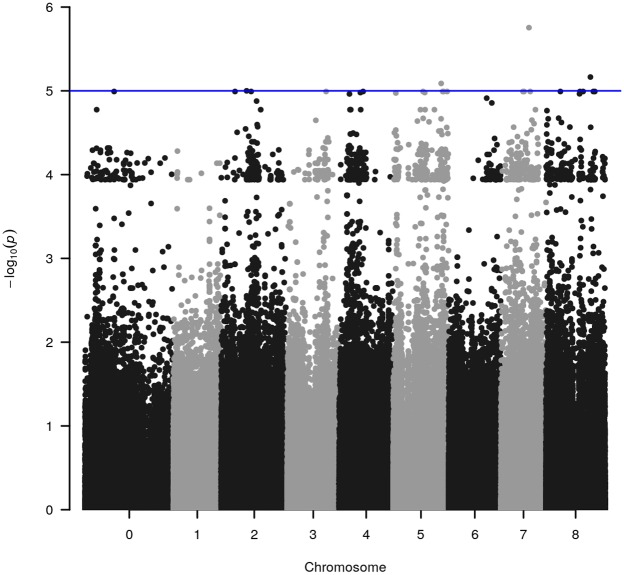
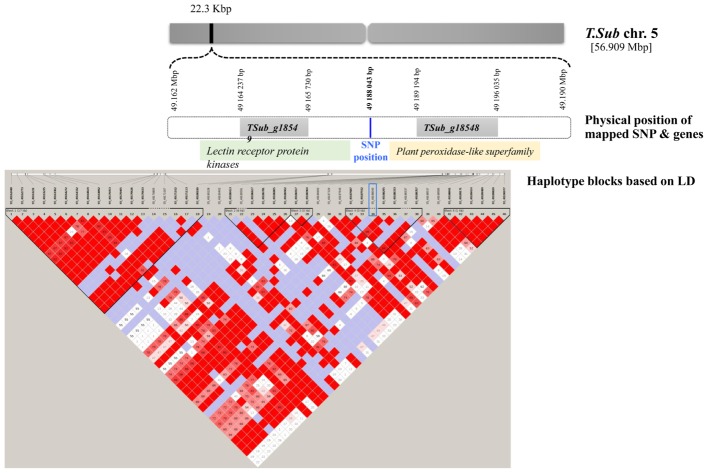
Mitigating methane production by ruminants is a significant challenge to global livestock production. This research offers a new paradigm to reduce methane emissions from ruminants by breeding climate-clever clovers. We demonstrate wide genetic diversity for the trait methanogenic potential in Australia's key pasture legume, subterranean clover ( L.). In a bi-parental population the broadsense heritability in methanogenic potential was moderate ( = 0.4) and allelic variation in a region of Chr 8 accounted for 7.8% of phenotypic variation. In a genome-wide association study we identified four loci controlling methanogenic potential assessed by an fermentation system. Significantly, the discovery of a single nucleotide polymorphism (SNP) on Chr 5 in a defined haplotype block with an upstream putative candidate gene from a plant peroxidase-like superfamily (TSub_g18548) and a downstream lectin receptor protein kinase (TSub_g18549) provides valuable candidates for an assay for this complex trait. In this way haplotype variation can be tracked to breed pastures with reduced methanogenic potential. Of the quantitative trait loci candidates, the DNA-damage-repair/toleration DRT100-like protein (TSub_g26967), linked to avoid the severity of DNA damage induced by secondary metabolites, is considered central to enteric methane production, as are disease resistance (TSub_g26971, TSub_g26972, and TSub_g18549) and ribonuclease proteins (TSub_g26974, TSub_g26975). These proteins are good pointers to elucidate the genetic basis of microbial fermentability and enteric methanogenic potential in subterranean clover. The genes identified allow the design of a suite of markers for marker-assisted selection to reduce rumen methane emission in selected pasture legumes. We demonstrate the feasibility of a plant breeding approach without compromising animal productivity to mitigate enteric methane emissions, which is one of the most significant challenges to global livestock production.
减少反刍动物甲烷排放是全球畜牧业面临的一项重大挑战。本研究提供了一种新的范例,即通过培育适应气候的三叶草来减少反刍动物的甲烷排放。我们证明,在澳大利亚主要的豆科牧草——地下三叶草(Trifolium subterraneum L.)中,产甲烷潜力这一性状存在广泛的遗传多样性。在一个双亲群体中,产甲烷潜力的广义遗传力适中(H² = 0.4),8号染色体一个区域的等位基因变异占表型变异的7.8%。在一项全基因组关联研究中,我们确定了四个通过体外发酵系统评估的控制产甲烷潜力的基因座。重要的是,在5号染色体上一个定义的单倍型块中发现了一个单核苷酸多态性(SNP),其上游有一个来自植物过氧化物酶样超家族的假定候选基因(TSub_g18548),下游有一个凝集素受体蛋白激酶(TSub_g18549),这为该复杂性状的检测提供了有价值的候选基因。通过这种方式,可以追踪单倍型变异,培育出产甲烷潜力降低的牧场。在数量性状基因座候选基因中,与避免次生代谢物引起的DNA损伤严重程度相关的DNA损伤修复/耐受性DRT100样蛋白(TSub_g26967),被认为是肠道甲烷产生的核心,抗病性(TSub_g26971、TSub_g26972和TSub_g18549)和核糖核酸酶蛋白(TSub_g26974、TSub_g26975)也是如此。这些蛋白质是阐明地下三叶草微生物发酵能力和肠道产甲烷潜力遗传基础的良好指标。所鉴定的基因使得能够设计一套标记用于标记辅助选择,以减少选定豆科牧草瘤胃甲烷排放。我们证明了一种不影响动物生产力的植物育种方法来减轻肠道甲烷排放的可行性,这是全球畜牧业面临的最重大挑战之一。