Ding Dongbing, Song Yang, Yao Yao, Zhang Songbai
Department of Gastrointestinal Surgery, Jingmen First People's Hospital, Jingmen, Hubei 448000, P.R. China.
Department of Gastrointestinal Surgery, The Second Affiliated Hospital of Dalian Medical University, Dalian 116023, P.R. China.
Oncol Lett. 2017 Sep;14(3):2982-2990. doi: 10.3892/ol.2017.6547. Epub 2017 Jul 8.
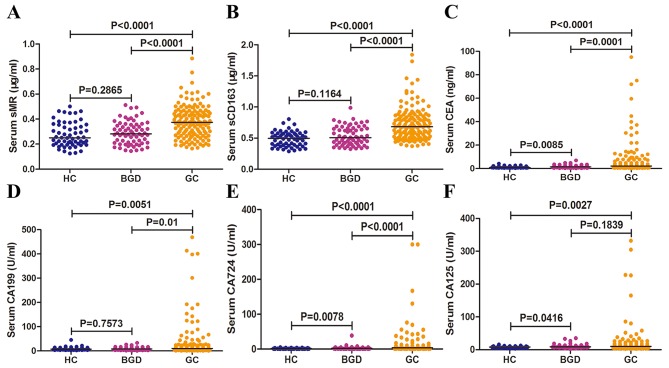
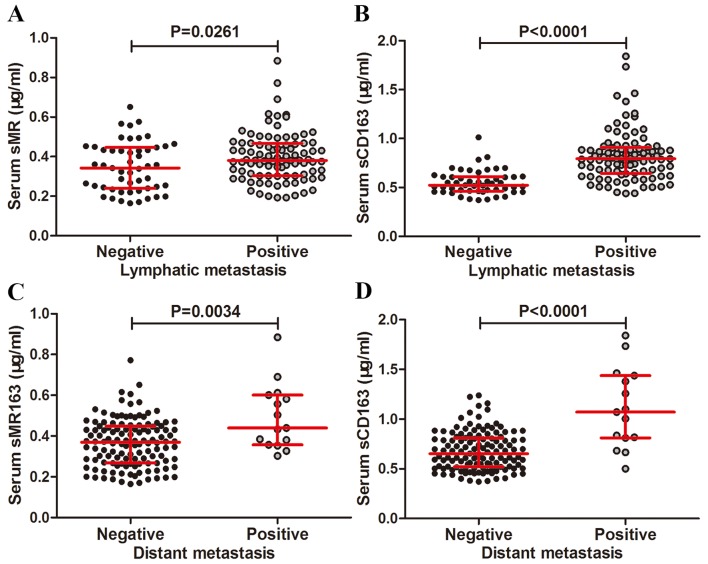
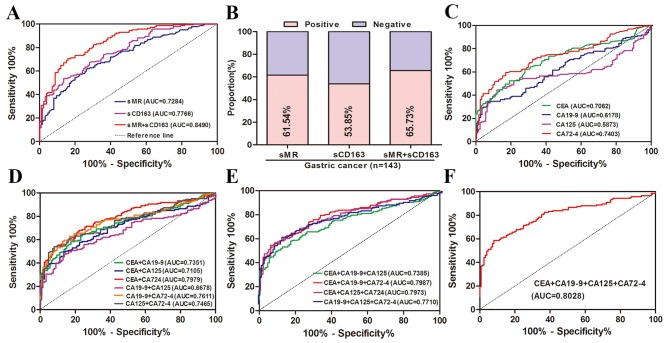
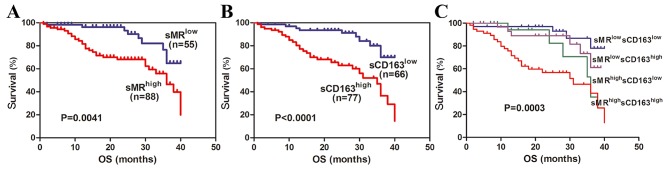
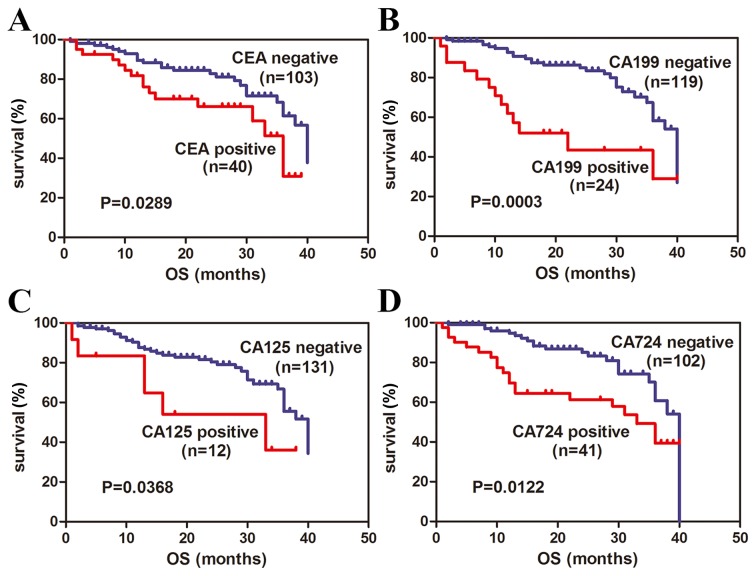
Soluble mannose receptor (sMR) and soluble haemoglobin scavenger receptor (sCD163) are macrophage activation markers which have previously been demonstrated to be increased in patients with inflammation, auto-immunity and malignancies. To investigate the clinical diagnostic and prognostic significance of preoperative serum sMR and sCD163, the present study investigated 143 gastric cancer (GC) patients, 66 subjects with benign gastric disease and 59 healthy controls, using an ELISA assay. Preoperative serum levels of sMR and sCD163 ranged from 0.165 to 0.885 µg/ml (median=0.374 µg/ml) and from 0.291 to 1.760 µg/ml (median=0.628 µg/ml) in GC patients, respectively. The expression levels of sMR and sCD163 were elevated compared with all controls (P<0.0001). Receiver operating characteristic analyses suggested that the optimum diagnostic cut-offs for sMR and sCD163 were 0.3405 µg/ml [area under curve (AUC) 0.7284, sensitivity 61.54%, and specificity 73.60%] and 0.6645 µg/ml (AUC 0.7766, sensitivity 53.85%, and specificity 86.40%), respectively. Notably, the measurement of serum sMR and sCD163 levels in conjugation, markedly enhanced the diagnostic accuracy (AUC 0.8490, sensitivity 70.63% and specificity 84.00%). Preoperative serum sMR and sCD163 levels correlated significantly with serum carcinoembryonic antigen, CA199, CA724 and CA125 concentrations in GC patients (P<0.05), however this association was not observed with sMR and CA724. High preoperative serum sMR and sCD163 levels correlated significantly with shorter overall survival (P=0.0041; P<0.0001, respectively) and were demonstrated to act as adverse prognostic factors (P=0.006; P<0.001, respectively). Furthermore, preoperative serum sMR and sCD163 levels correlated positively with the degree of lymphatic and distant metastasis of GC. In conclusion, preoperative serum sMR and sCD163 may be novel diagnostic and prognostic markers for GC and further studies are required in order to elucidate the underlying molecular mechanisms of sMR and CD163 in the development and progression of GC.
可溶性甘露糖受体(sMR)和可溶性血红蛋白清除受体(sCD163)是巨噬细胞活化标志物,此前已证实在炎症、自身免疫和恶性肿瘤患者中其水平会升高。为了研究术前血清sMR和sCD163的临床诊断和预后意义,本研究采用酶联免疫吸附测定法对143例胃癌(GC)患者、66例良性胃病患者和59名健康对照者进行了调查。GC患者术前血清sMR和sCD163水平分别为0.165至0.885μg/ml(中位数=0.374μg/ml)和0.291至1.760μg/ml(中位数=0.628μg/ml)。与所有对照组相比,sMR和sCD163的表达水平均升高(P<0.0001)。受试者工作特征分析表明,sMR和sCD163的最佳诊断临界值分别为0.3405μg/ml[曲线下面积(AUC)0.7284,灵敏度61.54%,特异性73.60%]和0.6645μg/ml(AUC 0.7766,灵敏度53.85%,特异性86.40%)。值得注意的是,联合检测血清sMR和sCD163水平可显著提高诊断准确性(AUC 0.8490,灵敏度70.63%,特异性84.00%)。GC患者术前血清sMR和sCD163水平与血清癌胚抗原、CA199、CA724和CA125浓度显著相关(P<0.05),但sMR与CA724之间未观察到这种关联。术前血清sMR和sCD163高水平与较短的总生存期显著相关(分别为P=0.0041;P<0.0001),并被证明是不良预后因素(分别为P=0.006;P<0.001)。此外,术前血清sMR和sCD163水平与GC的淋巴转移和远处转移程度呈正相关。总之,术前血清sMR和sCD163可能是GC新的诊断和预后标志物,需要进一步研究以阐明sMR和CD163在GC发生发展中的潜在分子机制。