Kjærgaard Anders G, Rødgaard-Hansen Sidsel, Dige Anders, Krog Jan, Møller Holger J, Tønnesen Else
Aarhus University Hospital, Department of Anaesthesiology and Intensive Care, Aarhus C, Denmark; Randers Regional Hospital, Department of Anaesthesiology and Intensive Care, Randers, Denmark.
Aarhus University Hospital, Department of Clinical Biochemistry, Aarhus C, Denmark.
PLoS One. 2014 Mar 17;9(3):e92331. doi: 10.1371/journal.pone.0092331. eCollection 2014.
The diagnosis of sepsis is challenging and there is an unmet need for sensitive and specific diagnostic and prognostic biomarkers. Following activation of macrophages and monocytes, the haptoglobin-haemoglobin receptor (CD163) and the mannose receptor (MR) are shed into the circulation (sCD163 and sMR).
We investigated monocyte expression of CD163 and MR, and levels of sCD163 and sMR in septic and non-septic patients, and in healthy controls. We hypothesised that these receptors are elevated during sepsis and can be used diagnostic and prognostic.
Twenty-one patients with severe sepsis or septic shock and 15 critically ill non-septic patients were included in this prospective observational study at three ICUs at Aarhus University Hospital and Randers Regional Hospital, Denmark. Fifteen age- and gender-matched healthy volunteers served as controls. Levels of sCD163 and sMR were measured using a sandwich ELISA and monocyte expression of CD163 and MR was evaluated by flow cytometry during the first four days of ICU stay. The diagnostic and prognostic values of the receptors were assessed using AUROC curves.
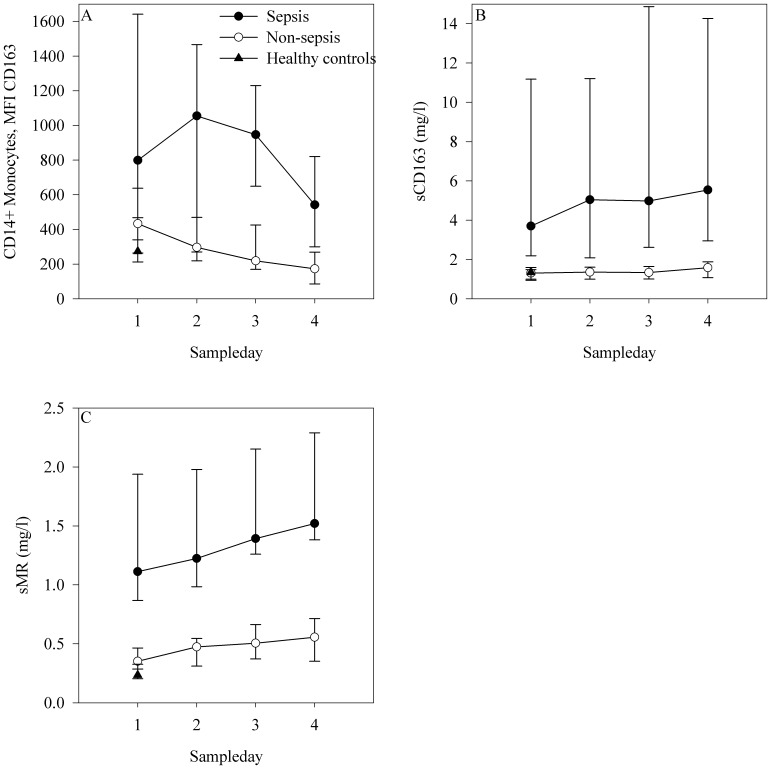
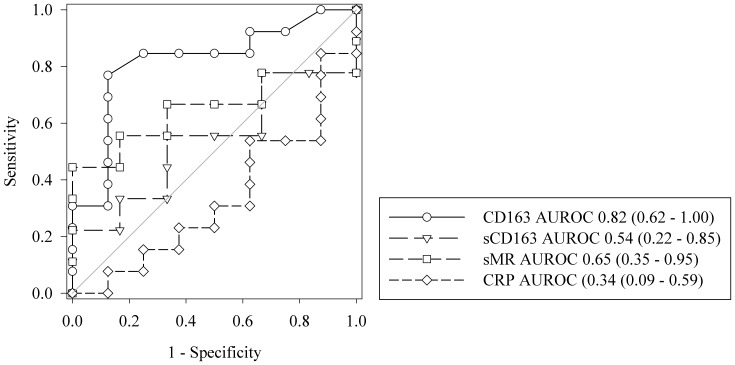
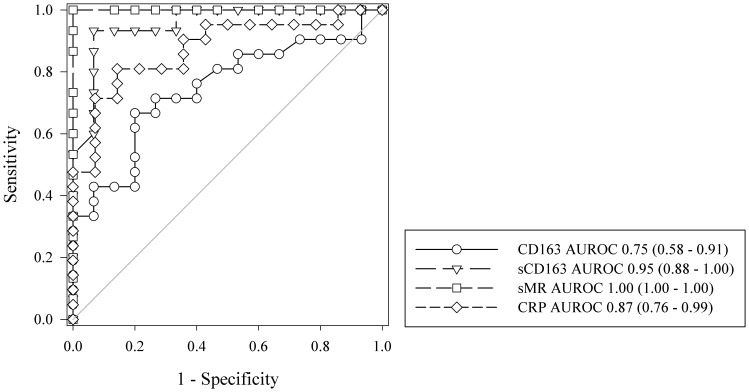
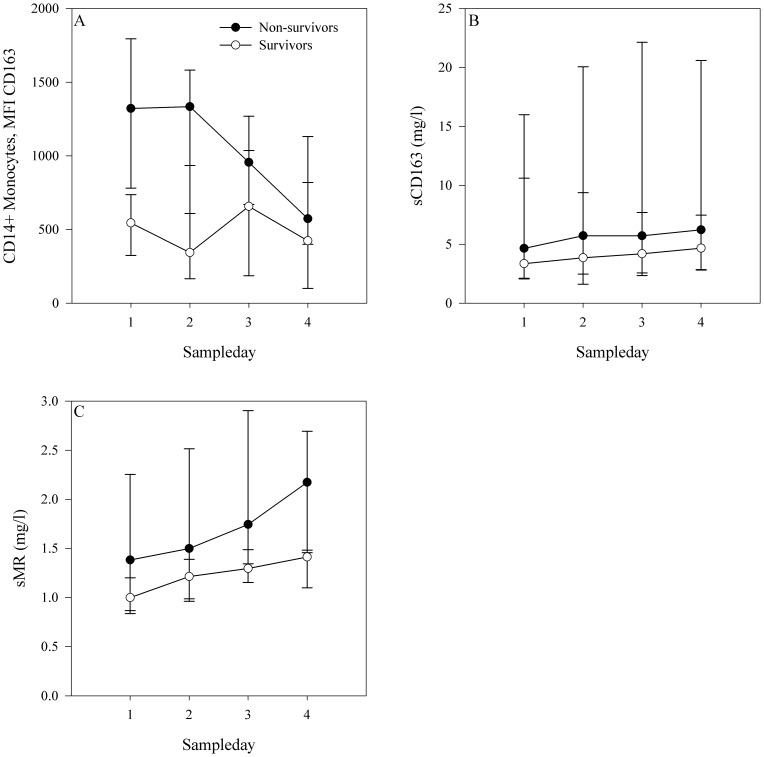
At ICU admission and during the observation period, monocyte expression of CD163 and levels of sCD163 and sMR were significantly higher in septic patients compared with non-septic patients and healthy controls (p<0.01 for all comparisons). Monocytes did not express MR. The diagnostic values estimated by AUROC were 1.00 for sMR, 0.95 for sCD163, 0.87 for CRP, and 0.75 for monocyte-bound CD163. Among the septic patients, monocyte expression of CD163 was higher in non-survivors compared with survivors at ICU admission (p = 0.02) and during the observation period (p = 0.006). The prognostic value of monocyte-bound CD163 estimated by AUROC at ICU admission was 0.82.
The macrophage-specific markers CD163, sCD163, and sMR are increased in septic patients. Particularly sMR is a promising new biomarker of sepsis.
脓毒症的诊断具有挑战性,对敏感且特异的诊断和预后生物标志物存在未满足的需求。巨噬细胞和单核细胞激活后,触珠蛋白 - 血红蛋白受体(CD163)和甘露糖受体(MR)会释放到循环中(可溶性CD163和可溶性MR)。
我们研究了脓毒症患者、非脓毒症患者及健康对照者中单核细胞CD163和MR的表达,以及可溶性CD163和可溶性MR的水平。我们假设这些受体在脓毒症期间会升高,可用于诊断和预后评估。
在丹麦奥胡斯大学医院和兰讷斯地区医院的三个重症监护病房进行的这项前瞻性观察研究中,纳入了21例严重脓毒症或脓毒性休克患者以及15例重症非脓毒症患者。15名年龄和性别匹配的健康志愿者作为对照。在重症监护病房住院的前四天,使用夹心ELISA法测量可溶性CD163和可溶性MR的水平,通过流式细胞术评估单核细胞CD163和MR的表达。使用曲线下面积(AUROC)曲线评估这些受体的诊断和预后价值。
在重症监护病房入院时及观察期间,脓毒症患者单核细胞CD163的表达以及可溶性CD163和可溶性MR的水平显著高于非脓毒症患者和健康对照者(所有比较p<0.01)。单核细胞不表达MR。AUROC估计的诊断价值为:可溶性MR为1.00,可溶性CD163为0.95,C反应蛋白(CRP)为0.87,单核细胞结合的CD163为0.75。在脓毒症患者中,重症监护病房入院时(p = 0.02)及观察期间(p = 0.006),非存活者单核细胞CD163的表达高于存活者。重症监护病房入院时AUROC估计的单核细胞结合CD163的预后价值为0.82。
脓毒症患者中巨噬细胞特异性标志物CD163、可溶性CD163和可溶性MR升高。特别是可溶性MR是一种有前景的新型脓毒症生物标志物。