Sun Lei, Ke Jia, He Zhen, Chen Zexian, Huang Qinghua, Ai Wenjia, Wang Guoqiang, Wei Yisheng, Zou Xiangcai, Zhang Shi, Lan Ping, Hong Chuyuan
Department of Gastrointestinal Surgery, The Second Affiliated Hospital of Guangzhou Medical University, Guangzhou City, Guangdong Province, PR China.
Department of Colorectal Surgery, The Sixth Affiliated Hospital of Sun Yat-Sen University, Guangzhou City, Guangdong Province, PR China.
J Cancer. 2017 Aug 23;8(14):2802-2808. doi: 10.7150/jca.19142. eCollection 2017.
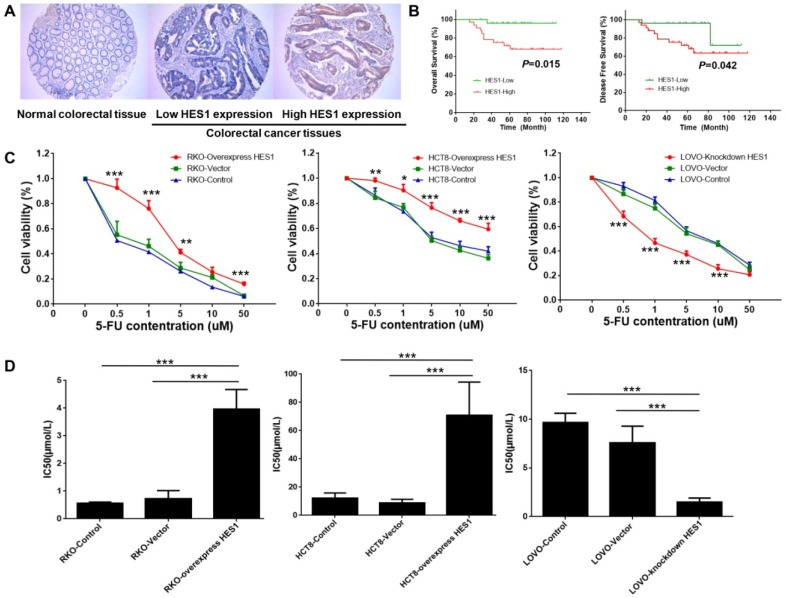
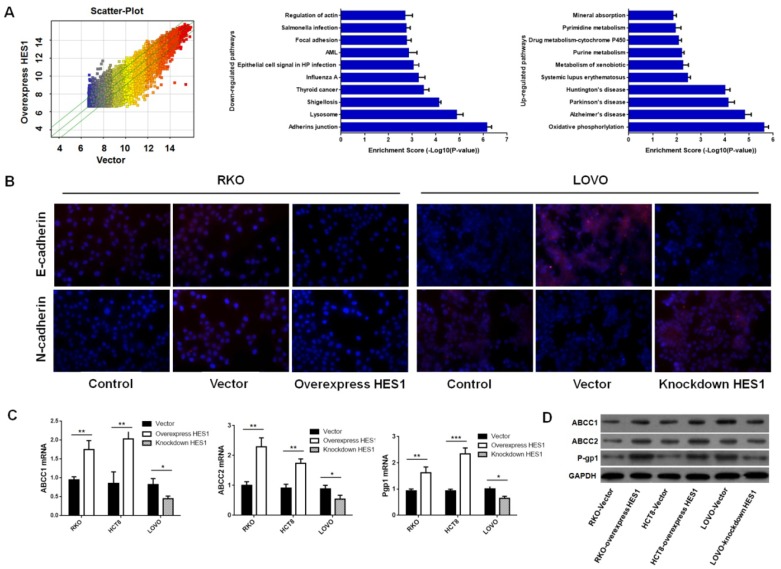
Hairy enhancer of split-1 (HES1) is a downstream transcriptional factor of Notch signaling pathway, which was found to be related to chemoresistance. This study was aimed to investigate the role of HES1 in chemoresistance of colorectal cancer (CRC). Tissue microarray was used to analyze the clinical significance of HES1 in radical resected (R0) stage II/III CRC patients that received adjuvant chemotherapy. 5-fluorouracil (5-Fu) chemoresistance was examined in CRC cell lines (RKO and HCT8, LOVO) with stable over-expression and inhibition of HES1 gene by cytotoxicity test. Gene expression microarray was used to investigate the enriched pathways and different expressed of genes in cells with over-expressed HES1. Expression changes of the chemoresistance related genes were confirmed by qPCR and western blot analysis. Stage II CRC patients with higher HES1 expression showed higher recurrence rate after chemotherapy. Colon cancer cell lines which over-expressed HES1 were more resistant to 5-Fu treatment . Gene expression microarray revealed that HES1 was related to the signaling pathways of epithelial-mesenchymal transition (EMT) and drug metabolism. Immunofluorescence assay showed HES1 over-expression lead to depressed E-cadherin and elevated N-cadherin. QPCR and western blot analysis confirmed that ABCC1, ABCC2 and P-gp1 were induced after HES1 over-expression. HES1 promotes chemoresistance to 5-Fu by prompting EMT and inducing of several ABC transporter genes. HES1 might be a novel therapeutic target in CRC treatment.
分裂增强子-1(HES1)是Notch信号通路的下游转录因子,已发现其与化疗耐药性相关。本研究旨在探讨HES1在结直肠癌(CRC)化疗耐药中的作用。采用组织芯片分析HES1在接受辅助化疗的根治性切除(R0)II/III期CRC患者中的临床意义。通过细胞毒性试验检测了稳定过表达和抑制HES1基因的CRC细胞系(RKO、HCT8、LOVO)对5-氟尿嘧啶(5-Fu)的化疗耐药性。利用基因表达芯片研究HES1过表达细胞中富集的通路和基因差异表达情况。通过qPCR和蛋白质免疫印迹分析证实化疗耐药相关基因的表达变化。HES1表达较高的II期CRC患者化疗后复发率较高。过表达HES1的结肠癌细胞系对5-Fu治疗更具耐药性。基因表达芯片显示HES1与上皮-间质转化(EMT)和药物代谢信号通路相关。免疫荧光分析显示HES1过表达导致E-钙黏蛋白表达降低,N-钙黏蛋白表达升高。qPCR和蛋白质免疫印迹分析证实HES1过表达后ABCC1、ABCC2和P-糖蛋白1被诱导。HES1通过促进EMT和诱导多个ABC转运蛋白基因来促进对5-Fu的化疗耐药。HES1可能是CRC治疗中的一个新的治疗靶点。