Awata Takuya, Shimada Akira, Maruyama Taro, Oikawa Yoichi, Yasukawa Nobuyuki, Kurihara Susumu, Miyashita Yumi, Hatano Masako, Ikegami Yuichi, Matsuda Masafumi, Niwa Masataka, Kazama Youichiro, Tanaka Shoichiro, Kobayashi Tetsuro
Department of Diabetes, Endocrinology and Metabolism, International University of Health and Welfare Hospital, Iguchi, Nasushiobara-shi, Tochigi, Japan.
Department of Endocrinology and Diabetes, Faculty of Medicine, Saitama Medical University, Saitama, Japan.
Diabetes Ther. 2017 Oct;8(5):1123-1134. doi: 10.1007/s13300-017-0299-7. Epub 2017 Sep 19.
We tested the hypothesis that dipeptidyl peptidase-4 (DPP-4) inhibitors are effective in preserving the β-cell function for long-term periods in patients with slowly progressive type 1 diabetes (SPIDDM) or latent autoimmune diabetes in adults (LADA).
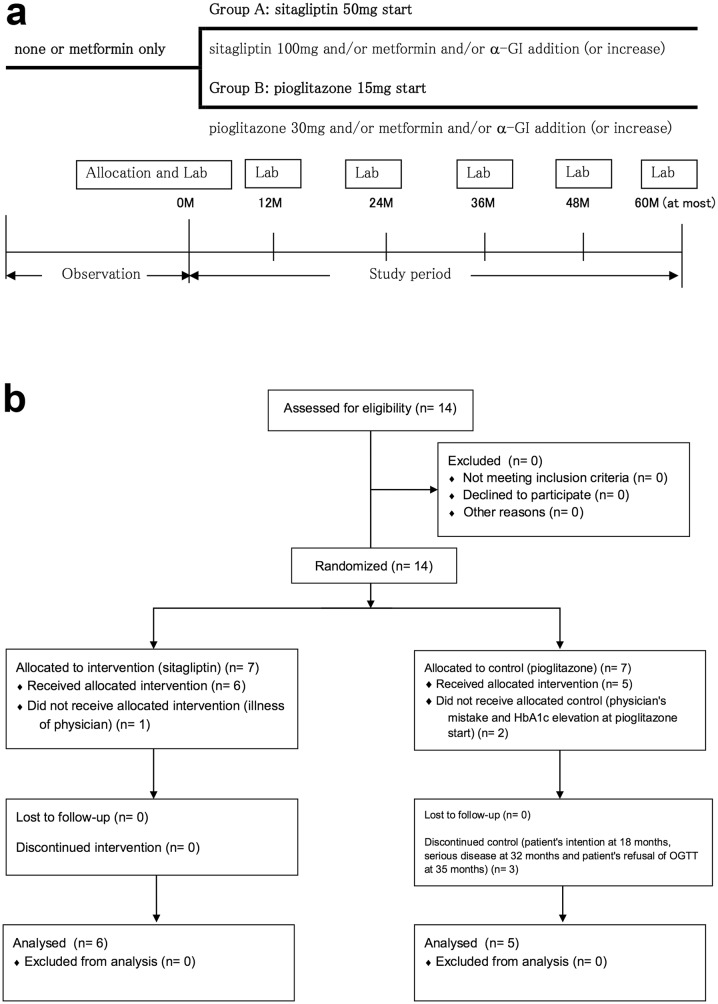
In the present open-label, randomized, controlled trial, 14 non-insulin-requiring diabetic patients with glutamic acid decarboxylase autoantibodies (GADAb) were randomly assigned to receive either sitagliptin (S group) or pioglitazone (P group). As a historical control, the Tokyo Study, in which non-insulin-dependent patients with SPIDDM were assigned to receive treatment by either insulin or sulfonylurea (SU), was used.
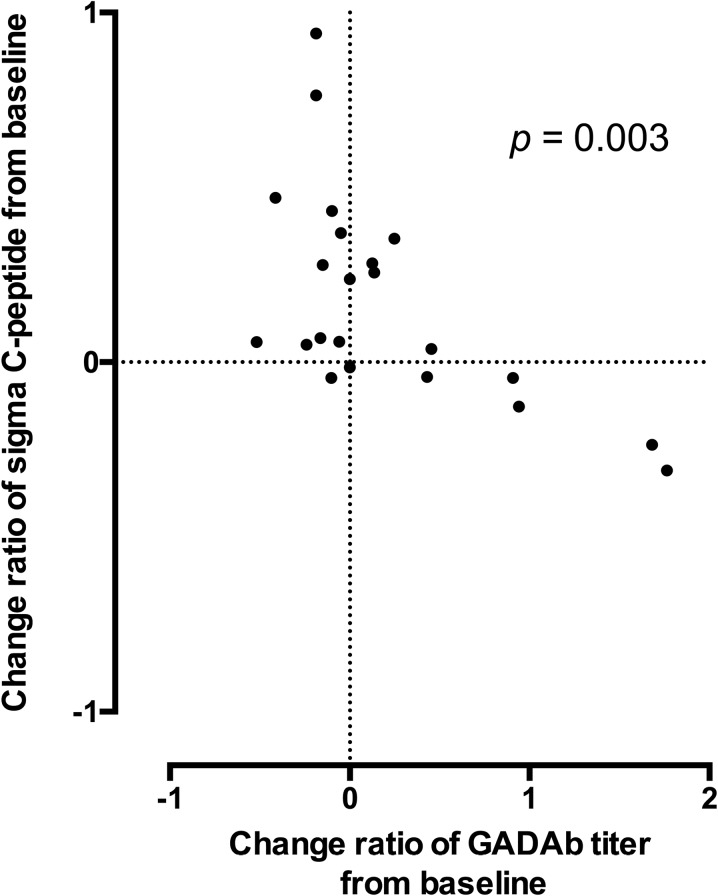
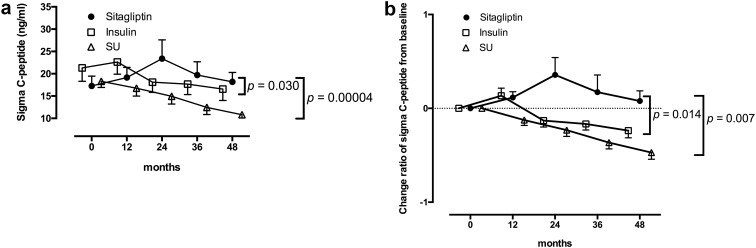
On average, the ∑C-peptide values during the oral glucose tolerance test through the follow-up periods showed a nonsignificant increase in the S group (n = 6, n = 5 at 48 months) compared to the P group (n = 5, n = 2 at 48 months). In comparison to the data in the Tokyo Study, treatment by sitagliptin significantly influenced the longitudinal changes in the ∑C-peptide values with a more increased direction than insulin or SU, especially in patients with 48 months of follow-up (p = 0.014 and p = 0.007, respectively). Although the titers of GADAb were not significantly different between the S and P groups during the study, the change ratio of the GADAb titers from baseline was significantly inversely correlated with the change ratio of the ∑C-peptide values from baseline in the S group (p = 0.003); in particular, when the GADAb titers decreased from baseline, the ∑C-peptide values frequently increased.
The present pilot trial suggests that treatment of SPIDDM/LADA by sitagliptin, a DPP-4 inhibitor, may be more effective in preserving the β-cell function than insulin treatment for at least 4 years, possibly through the immune modulatory effects of DPP-4 inhibitors.
Japanese Clinical Trials Registry UMIN000003693.
我们检验了以下假设,即二肽基肽酶-4(DPP-4)抑制剂对于长期维持缓慢进展性1型糖尿病(SPIDDM)或成人隐匿性自身免疫性糖尿病(LADA)患者的β细胞功能有效。
在本开放标签、随机、对照试验中,14例谷氨酸脱羧酶自身抗体(GADAb)阳性且无需胰岛素治疗的糖尿病患者被随机分配接受西他列汀治疗(S组)或吡格列酮治疗(P组)。作为历史对照,采用了东京研究,该研究将非胰岛素依赖型SPIDDM患者分配接受胰岛素或磺脲类药物(SU)治疗。
平均而言,在随访期间口服葡萄糖耐量试验中的总C肽值,S组(48个月时n = 6,n = 5)相较于P组(48个月时n = 5,n = 2)呈非显著性增加。与东京研究的数据相比,西他列汀治疗显著影响了总C肽值的纵向变化,其变化方向比胰岛素或SU组更大,尤其是在随访48个月的患者中(分别为p = 0.014和p = 0.007)。尽管在研究期间S组和P组之间GADAb滴度无显著差异,但S组中GADAb滴度相对于基线的变化率与总C肽值相对于基线的变化率显著负相关(p = 0.003);特别是当GADAb滴度从基线下降时,总C肽值常常升高。
本初步试验表明,DPP-4抑制剂西他列汀治疗SPIDDM/LADA在维持β细胞功能方面可能比胰岛素治疗至少4年更有效,可能是通过DPP-4抑制剂的免疫调节作用实现的。
日本临床试验注册中心UMIN编号000003693。