Cueva Alejandro, Bullock Stephen H, López-Reyes Eulogio, Vargas Rodrigo
Departamento de Biología de la Conservación, Centro de Investigación Científica y de Educación Superior de Ensenada, B.C., Ensenada, Baja California, 22860, Mexico.
Department of Plant and Soil Sciences, University of Delaware, Newark, DE, 19716, USA.
Sci Rep. 2017 Sep 20;7(1):11925. doi: 10.1038/s41598-017-11849-y.
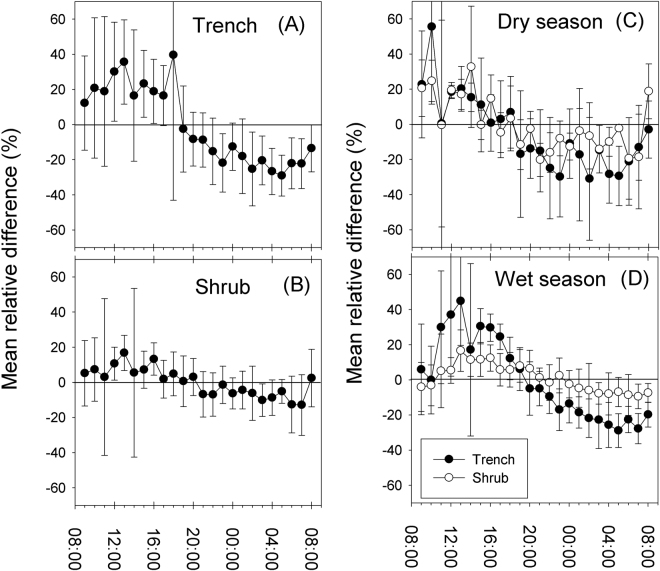
Soil respiration (Rs) has been usually measured during daylight hours using manual chambers. This approach assumes that measurements made during a typical time interval (e.g., 9 to 11 am) represent the mean daily value; locally, this may not always be correct and could result in systematic bias of daily and annual Rs budgets. We propose a simple method, based on the temporal stability concept, to determine the most appropriate time of the day for manual measurements to capture a representative mean daily Rs value. We introduce a correction factor to adjust for biases due to non-optimally timed sampling. This approach was tested in a semiarid shrubland using 24 hr campaigns using two treatments: trenched plots and plots with shrubs. In general, we found optimum times were at night and potential biases ranged from -29 to + 40% in relation to the 24 hr mean of Rs, especially in trenched plots. The degree of bias varied between treatments and seasons, having a greater influence during the wet season when efflux was high than during the dry season when efflux was low. This study proposes a framework for improving local Rs estimates that informs how to decrease temporal uncertainties in upscaling to the annual total.
土壤呼吸(Rs)通常在白天使用手动气室进行测量。这种方法假定在典型时间间隔(例如上午9点至11点)进行的测量代表每日平均值;在当地,情况可能并非总是如此,这可能会导致每日和年度Rs预算出现系统偏差。我们提出了一种基于时间稳定性概念的简单方法,以确定一天中进行手动测量以获取代表性每日Rs平均值的最合适时间。我们引入一个校正因子来调整由于采样时间不理想而产生的偏差。在一个半干旱灌丛地区,采用两种处理方式(挖沟地块和有灌木的地块)进行了24小时的试验,对该方法进行了测试。总体而言,我们发现最佳测量时间是在夜间,相对于Rs的24小时平均值,潜在偏差范围为-29%至+40%,特别是在挖沟地块。偏差程度在不同处理方式和季节之间有所不同,在通量较高的雨季比通量较低的旱季影响更大。本研究提出了一个改进局部Rs估算的框架,该框架为如何在扩大到年度总量时减少时间不确定性提供了指导。