Morimoto Akio, Suga Tadashi, Tottori Nobuaki, Wachi Michio, Misaki Jun, Tsuchikane Ryo, Isaka Tadao
Faculty of Sport and Health Science, Ritsumeikan University: 1-1-1 Nojihigashi, Kusatsu, Shiga 525-8577, Japan.
Kanazawa Orthopaedic & Sports Medicine Clinic, Japan.
J Phys Ther Sci. 2017 Sep;29(9):1644-1648. doi: 10.1589/jpts.29.1644. Epub 2017 Sep 15.
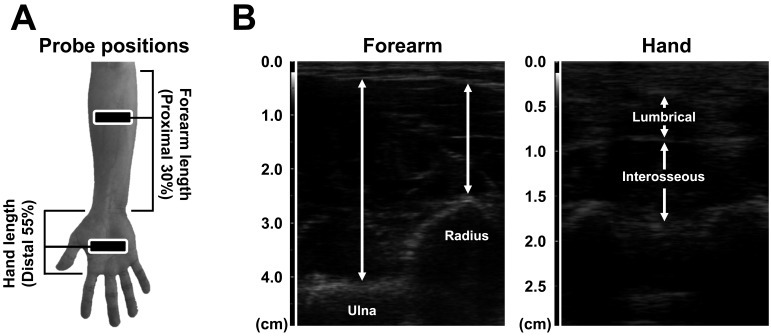
[Purpose] Handgrip strength is a surrogate indicator for assessing disease-related and age-related skeletal muscle loss. Clinical utility as such a surrogate can be at least partially explained by the close relationship between handgrip strength and whole-body skeletal muscle mass. The handgrip strength is related to hand muscle size. Thus, the present study examined whether hand muscle thickness is associated with whole-body skeletal muscle mass. [Subjects and Methods] Thirty healthy male adults participated in this study. All subjects were right-hand dominant. Two muscle thicknesses (lumbrical and interosseous muscles) in the right hand were measured using ultrasonography. Whole-body and appendicular skeletal muscle masses were assessed using dual-energy X-ray absorptiometry. [Results] Although lumbrical muscle thickness was not correlated with whole-body skeletal muscle mass, there was a significant correlation with appendicular skeletal muscle mass. Furthermore, interosseous muscle thickness was significantly correlated with both whole-body and appendicular skeletal muscle masses. [Conclusion] The present findings suggest that two muscle thicknesses in the hand are related to whole-body and/or appendicular skeletal muscle mass in healthy adults. Therefore, we propose that despite being smaller than other limb muscles, hand muscle thickness may be useful as surrogate indicator for assessing disease-related and age-related skeletal muscle loss.
[目的]握力是评估疾病相关和年龄相关骨骼肌流失的替代指标。作为这样一种替代指标的临床效用至少可以部分地通过握力与全身骨骼肌质量之间的密切关系来解释。握力与手部肌肉大小有关。因此,本研究探讨了手部肌肉厚度是否与全身骨骼肌质量相关。[对象与方法]30名健康成年男性参与了本研究。所有受试者均为右利手。使用超声测量右手的两块肌肉厚度(蚓状肌和骨间肌)。使用双能X线吸收法评估全身和附属骨骼肌质量。[结果]虽然蚓状肌厚度与全身骨骼肌质量无关,但与附属骨骼肌质量显著相关。此外,骨间肌厚度与全身和附属骨骼肌质量均显著相关。[结论]本研究结果表明,手部的两块肌肉厚度与健康成年人的全身和/或附属骨骼肌质量有关。因此,我们提出,尽管手部肌肉比其他肢体肌肉小,但手部肌肉厚度可能作为评估疾病相关和年龄相关骨骼肌流失的替代指标。